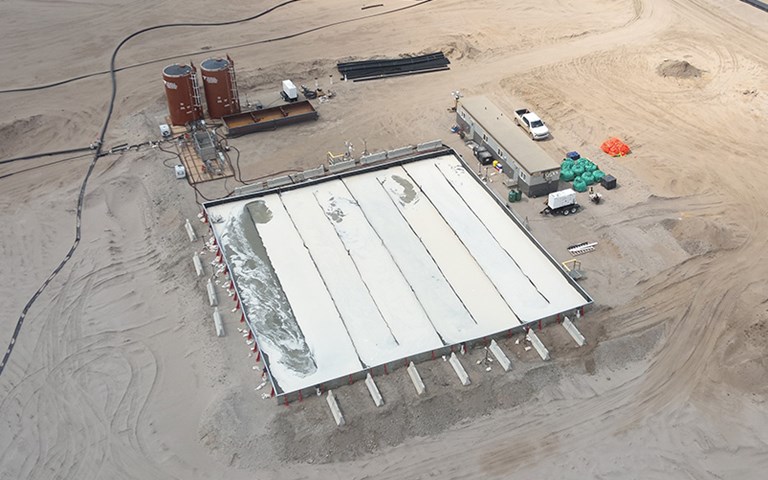
H2nanO’s ongoing SolarPass mine water treatment pilot at the Kearl oil sands mine. Courtesy of H2nanO
T
he Alberta government is moving ahead with efforts to reduce the size and environmental impact of tailings ponds at the province’s oil sands operations by investing in a new generation of technologies to tackle the problem.
Some 20 per cent of oil sands projects access the resources via surface mining techniques, which result in the creation of tailings ponds after the bitumen has been extracted. These tailings ponds contain a combination of water, sand, fine silts, clay and residual bitumen from the oil sands mining process, as well as hydrocarbons, according to the Government of Alberta.
A regulatory gap distinguishes Alberta’s oil sands operations from other mines in Canada: there is currently no federal or provincial framework authorizing the release of treated mine water back into the environment. Without such regulations, oil sands operators must store all water on-site. It is estimated that more than 1.4 billion cubic metres of fluid tailings are currently stored in tailings ponds at Alberta’s oil sands operations.
The Oil Sands Mine Water Steering Committee—which was established by the Alberta government in 2024 to assess feasible options for safely managing the water in oil sands tailings ponds and speeding up tailings pond reclamation—released its first set of recommendations in June 2025. These included urging the provincial government to work on pilot projects with a variety of stakeholders and independent research organizations to minimize the environmental impact of these tailings ponds and to encourage better reclamation practices.
The challenge
Emissions Reduction Alberta (ERA) launched the Tailings Technology Challenge in June 2025 to align with the committee’s recommendations, committing up to $50 million in funding. In March this year, ERA announced nine projects that would share $46 million in funding through the challenge to bring the pilot projects to commercial viability.
“Over the past 15 years, oil sands production has nearly doubled, even as emissions per barrel have dropped by over 26 per cent,” said Grant Hunter, Alberta’s minister of environment and protected areas, at a March 4 press conference at the University of Calgary’s Schulich School of Engineering.
He noted that the oil sands industry has substantially lowered its use of freshwater since 2013, reducing use per barrel by 28 per cent and increasing water recycling by over 50 per cent.
“But even with this amazing progress, large volumes of water have built up over 50 years. We cannot allow water to continue to accumulate for another 50 years,” he said. “Tailings ponds were never meant to be permanent solutions. Storing this water indefinitely is not good for the environment, nor the economy.”
If the selected projects are successful and applied to oil sands operations, the impact could be immense, said Justin Riemer, CEO of ERA, at the March 4 press conference.
“These projects are estimated to deliver emissions reductions of about 4,600 tonnes [of greenhouse gases] annually, and reductions of about 79,000 cumulative tonnes by 2050,” Riemer said. By 2027, these projects, if implemented, would generate $220 million in GDP, he added.
The nine projects chosen to receive funding reflect several different approaches to addressing the oil sands tailings pond conundrum. Projects focusing on water retreatment and reuse dominate the list, with Canadian Natural Resources garnering funding for two projects using this approach. The first will focus on using advanced membrane technologies to treat and recycle mine water for use in bitumen extraction at the company’s Albian Sands operation, while the second will undertake research into tailings geochemical processes to develop technologies that could enhance both water and soil quality at closure.
Suncor Energy received funding for a project to continue tests on membrane-based technologies to reduce stored water volumes in tailings ponds, while an H2nanO project will demonstrate two mine water treatment technologies designed to remove organics, address salinity and allow reuse of water year-round.
Other initiatives supported by the Tailings Technology Challenge are tackling the stability of the tailings ponds themselves. A second Suncor Energy project, for example, is developing modular amphibious equipment to install wick drains and use other ground improvement techniques to accelerate dewatering and stabilization. A third Canadian Natural Resources project focuses on improving the in-pond mixing of fine and coarse tailings using inline flocculation to create more stable tailings and reduce water volume in ponds.
Imperial Oil has also been awarded funding for a project to pilot its Enhanced Thickened Tailings process at its Kearl oil sands mine. This process uses flocculation, colloidal silica binding and coagulation to accelerate consolidation, potentially enabling earlier land reclamation.
Finally, some projects are focused on better characterization and monitoring of oil sands tailings. ConeTec Investigations’ project is advancing a field-ready platform for geo-characterization of tailings that will provide high-resolution data to help improve dewatering, consolidation and water use decisions, while the Northern Alberta Institute of Technology (NAIT) has started a project to work with members of Canada’s Oil Sands Innovation Alliance and Indigenous communities to establish a Standardized Tailings Technology Evaluation Framework.
“We will generate comparative performance data across multiple tailings types, giving technology providers a pathway to refine their solutions, and operators the confidence to make informed adoption decisions,” said Heather Kaminsky, applied research chair for the Centre for Energy and Environmental Sustainability at NAIT, at the March 4 press conference.
The technology would “improve water recovery and reuse, decrease long-term environmental liability and result in faster pathways to reclamation,” she said.
Energy-efficient water reuse
Among the successful applicants to the Tailings Technology Challenge, Kitchener, Ontario-based H2nanO—a cleantech company that was spun out from research undertaken at the University of Waterloo—illustrates the kind of technology ERA hopes can move from laboratory research to commercial deployment. The Tailings Technology Challenge awarded $1.8 million to H2nanO’s $3.6 million project to scale up and demonstrate two distinct but complementary technologies.
H2nanO is focused on solutions that sit midway between active mine water treatment, such as adding chemicals or absorbents to facilitate water purifying processes, and passive mine water treatment, such as solutions that rely on nature to generate similar results in water purification, said H2nanO president Zac Young in an interview with CIM Magazine.
The first technology H2nanO is developing with funding from the Tailings Technology Challenge is its Active Photocatalysis (A-PC), which builds on the company’s existing SolarPass photocatalyst platform that uses sunlight to remove contaminants from water. While SolarPass uses a passive process, A-PC aims to integrate high-efficiency UV-LED reactors to intensify the removal of organics.
“We’re taking what we’ve already demonstrated and brought to a late-stage commercial scale-up technology, and accelerating it by applying high-efficiency UV light,” Young said. “[This] will allow the technology to be more controllable, and will enable its application all year long, instead of just in the summer season.”
“We’re taking what has worked well, and making it more active, with the goal of having that treatment efficacy maintained in an active system that still does not require the input of chemicals or absorbents,” he added.
H2nanO has been evaluating the photocatalyst treatment technology for the past eight years and is confident that substituting natural sunlight with LEDs or other high-efficiency light sources will maintain its performance. “It’s a matter of proving and designing reactor systems to be efficient and reliable,” Young said.
H2nanO is also developing its Stratus “interfacial multi-effect distillation” technology, a low-energy thermal desalination solution. This technology uses a fouling-resistant thermal process to tackle salinity, purifying water from oil sands operations to enable high-efficiency water reuse.
“We’re bringing our materials expertise into making the evaporation and condensation of water as efficient as possible, developing a system to recycle heat, optimized for high efficiency and water recovery,” Young said.
Stratus minimizes emissions in distilling high-quality water from saline water by using low-grade heat, such as thermal energy in the form of solar thermal, geothermal or surplus industrial heat sources such as compressors and process operations.
“The goal is to accelerate and improve water quality, and doing so in a way that can be as cost- and carbon-efficient as possible by using an energy source that’s currently going to waste,” Young said.
H2nanO’s next step in developing these technologies is moving them to the direct application stage, where the company can work with operators to have a positive impact on water treatment and reuse at existing oil sands and shale gas projects, Young said.
“We’re in a unique position,” Young added, noting that H2nanO has been working for several years with Oil Sands Alliance members as a technology developer. “We’re able to say, ‘This is what it looks like in a commercial application,’ and we’re derisking the technology from a ‘promising concept’ to ‘proven in the field.’”
Beyond the technologies being developed with the new ERA funding, H2nanO is continuing work to further develop SolarPass, using sunlight to break down the dissolved organic compounds present in water used in oil sands operations.
“The new ERA project is building our knowledge and operator feedback with SolarPass to steward and manage water operations, and reduce the amount of emissions and energy associated with doing so,” Young said.
It is important for government to play a role in supporting early-stage technologies, Young said.
“Government funding, such as ERA’s, helps to get innovative tech engaged with industry and serve public priorities, while creating a new base of cleantech innovation here in Canada,” he said. “It has benefits beyond implementation—it creates new jobs, as well as a stepping stone to growing and exporting these technologies around the world.”
These ERA projects are part of the work being done to advance water management in oil sands operations, Young said.
“Right now, there is a gap in regulatory certainty for managing water in oil sands,” he said. “We’re both contributing and listening to that conversation with stakeholders, regulators and industry. The next steps are defining and directing how to manage this water, which we continue exploring alternatives for here.”