A
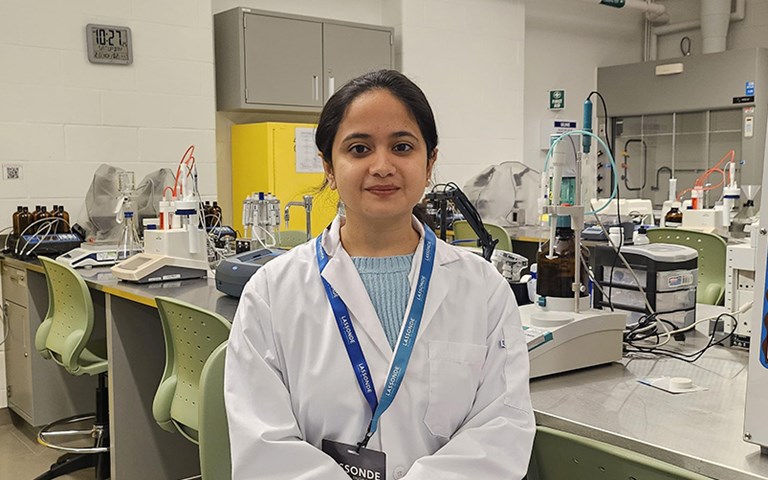
t 28 years of age, Khyati Joshi is among a new generation of researchers rethinking how industrial waste can become a valuable resource. By bridging the gap between advanced biotechnology and industrial mining practices, the York University PhD research scholar and environmental engineer’s research focuses on recovering rare earth elements (REEs) such as yttrium from Alberta’s oil sands tailings through biomining—a process that could both reduce environmental liabilities and strengthen Canada’s domestic supply of these critical metals.
In May, Joshi presented her research at the Student ePoster Competition at CIM CONNECT 2026 in Vancouver, receiving first place in the competition. Her track record also includes the 2025 Ed Patton Memorial Scholarship from the Maintenance, Engineering and Reliability Society (MERS) of CIM and an award for the student poster contest at the 57th Canadian Mineral Processors Conference in 2025.
CIM Magazine sat down with Joshi to discuss the mechanics of organic acid leaching, the economic potential of oil sands tailings and how biotechnology can reshape the environmental, social and governance (ESG) landscape of Canadian mining.
CIM: What inspired you to focus your PhD research on recovering REEs from oil sands tailings using organic acids?
Joshi: My interest in the topic began during my undergraduate studies, where I worked on projects involving molecular biology and biotechnology. I then pursued my master’s in industrial biotechnology, focusing on isolating and characterizing bacteria used to treat lignocellulosic biomass for biofuel production. That experience sparked my passion for using microorganisms to develop sustainable solutions to environmental challenges.
My current doctoral research builds directly on that foundation by using bio-based organic acids, produced by microorganisms, to recover REEs from oil sands tailings. Oil sands tailings are generated in enormous quantities during bitumen extraction and are traditionally viewed as a waste product. However, they contain valuable critical metals essential for clean energy technologies like electric vehicles, wind turbines and electronics. Instead of relying solely on conventional extraction methods, which require harsh chemicals and high energy inputs, I am exploring bio-based organic acids as a much more sustainable approach to metal recovery.
CIM: How significant is the potential of oil sands tailings as a secondary source of REEs?
Joshi: Oil sands tailings represent a highly significant, yet under-explored, secondary source of REEs. Although they are traditionally considered an environmental liability due to their massive volumes and complex composition, research—including my own—has shown they contain measurable concentrations of critical metals; this can be up to 1,000 milligrams of REEs per kilogram.
Given the immense scale of Canada’s oil sands operations, even relatively low concentrations can add up to a meaningful national resource. This dual-purpose approach addresses waste remediation and resource recovery simultaneously, reducing tailings volumes while reclaiming valuable technological metals.
CIM: What are the primary advantages of using organic acids, such as citric acid, for REE extraction compared with inorganic acids?
Joshi: One of the biggest advantages of using organic acids like citric acid is that they provide an environmentally friendly alternative for extraction. Inorganic acids traditionally used for extraction, such as sulfuric or hydrochloric acid, are highly effective but are also corrosive, hazardous to handle and generate large volumes of acidic waste that contribute to acid mine drainage. In contrast, citric acid is biodegradable, less toxic and can be produced by microorganisms using renewable feedstocks like agricultural waste.
Additionally, organic acids are more selective than inorganic acids. This selectivity simplifies downstream processing, which can significantly lower overall operational costs. My research focuses on applying this selectivity to reduce the dissolution of unwanted metals. In oil sands tailings, aluminum is present in very high concentrations and acts as a major impurity. By tailoring the process, I can target and dissolve more REEs while leaving the aluminum behind. Minimizing these impurities directly reduces downstream purification costs.
CIM: What are the limitations of using organic acids?
Joshi: Because organic acids are less aggressive [than inorganic acids], their extraction efficiency can be lower than conventional methods and they require significantly longer leaching times. A process that takes 10 to 15 minutes using conventional inorganic acids can take several hours with organic acids, and bioleaching can take days. To address this, my research aims to optimize process parameters to improve extraction efficiency and reduce leaching times so that bio-based methods can become competitive with conventional mining practices.
CIM: Why does your research focus on yttrium in particular?
Joshi: In the specific samples I am processing, yttrium was extracted in higher quantities than other REEs. It is a critical material used in a wide variety of applications, including LEDs, lasers, phosphors and vital medical procedures. While I am working to recover a broad spectrum of REEs, yttrium is currently my primary focus due to its high yield and high demand.
CIM: If major oil sands operators integrated your organic acid leaching process into their existing tailings management frameworks, how could that reshape the public perception and ESG profile of Alberta’s oil sands industry?
Joshi: The most immediate impact would be on the environmental component of ESG. Tailings would transform from a long-term waste liability into a valuable secondary resource. Successfully recovering critical metals from these waste streams would showcase a functional, circular economy approach within the oil sands sector, [which would] fundamentally rewrite how we manage waste streams. Instead of treating mine tailings and industrial residues as end-of-life materials requiring perpetual storage, this approach uses organic acids to reclaim critical elements, effectively closing the material loop.
Furthermore, using organic acids produced via microbial fermentation from agricultural waste aligns mining with low-carbon, bio-based production systems. Generating value from materials [that would be] otherwise discarded supports a more resilient and sustainable mining industry.
CIM: What are the immediate next steps in your research, and what engineering milestones are needed to scale this up from the lab?
Joshi: Currently, I am optimizing the bio-based leaching system under controlled lab conditions. While my initial poster presentation utilized commercially purchased citric acid, I am now focused on producing these organic acids biologically using the fungus Aspergillus niger. I am adjusting parameters like pH, pulp density, contact time and acid concentration to maximize REE recovery. Right now, I am growing the fungus in shake flasks, but the next major milestone [will be] moving to controlled bioreactor systems to achieve higher, more consistent acid yields.
I am also developing an integrated bioprocess-hydrometallurgical system. This will test whether it is better to perform a one-step process—where tailings are added directly while the fungus grows—or a two-step sequential process, where we harvest the biological acids first and use them separately for extraction.
I expect that within the next year, I will transition to larger-scale bioreactor systems to produce greater quantities of organic acids and scale up metal recovery testing.
CIM: Beyond oil sands tailings, do you see potential for organic acid leaching of REEs to be applied to other industrial waste streams or mine tailings across Canada?
Joshi: Yes, absolutely. Organic acid leaching has immense potential because it is already being explored in several areas. One of its greatest strengths is its versatility in processing complex, low-grade and heterogeneous materials that are often not economically viable using conventional extraction methods.
These materials include mine tailings from base metal operations, historical mining sites and metallurgical wastes containing residual concentrations of critical metals. Electronic waste (e-waste) is another highly promising area where research is growing rapidly. Other potential applications include residues from alumina production, phosphogypsum stacks and various smelter slags.
CIM: You have received a significant amount of recognition and interest from the mining industry. What impact has this had on your research and your development as a researcher?
Joshi: Winning the 2026 CIM CONNECT Student ePoster Competition was an incredibly meaningful milestone for me, particularly because it allowed me to share my research directly with diverse professionals working across the mining industry.
This year, I had to choose between two different mining conferences, and funding was definitely a major consideration. Graduate students cannot attend every event without financial backing. Being awarded a spot in the Canadian Mineral Processors Future Leaders Support Program to attend CIM CONNECT in Vancouver was invaluable. The program provided a fantastic opportunity to connect with industry experts, but it is just the start. I look forward to building broader connections with mining professionals to discuss scaling this project forward.