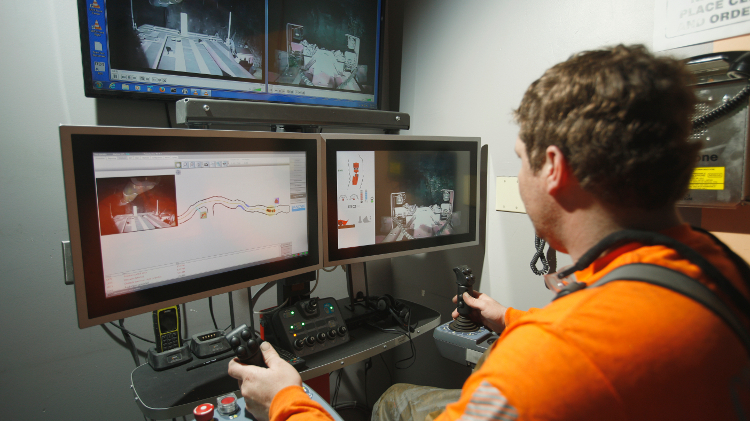
By installing its underground detectors, Ideon Technologies is able to capture data from cosmic-ray muons, enabling detailed 3D imaging of geological structures below the surface. Courtesy of Ideon Technologies
Block caving has the potential to be one of the most efficient and cost-effective methods of underground mining, but it also presents some of the industry’s greatest geotechnical challenges.
The mining method relies on gravity and natural rock fracturing to extract ore, making the process inherently difficult to observe, predict and control.
Operators must contend with challenges such as stalled cave propagation, drawbell blockages, unpredictable ore flow and the challenge of accurately assessing how an ore body will behave over time.
These challenges make geotechnical monitoring a critical component of modern block caving operations. Companies such as Ideon Technologies, Sintela and Orica are developing advanced monitoring systems that improve visibility, while highlighting the growing importance of multiple sensing technologies for building a more complete understanding of what lies beneath the ground.
Deeper revelations
To improve how mines see underground, Ideon Technologies developed its REVEAL for Caving platform, which uses muon tomography to generate high-resolution, four-dimensional images (the fourth dimension being time) of what is happening inside a block cave.
Muons are naturally occurring cosmic-ray particles that constantly shower down upon the Earth. Dense rock slows down muons as they penetrate the ground, while voids and less dense rock allow more to pass through. By placing detectors underground to measure the number and directional intensity of incoming muons, Ideon generates 3D-density reconstructions of the subsurface.
The approach is designed to address one of the biggest limitations in cave monitoring today: geological and geotechnical uncertainty due to insufficient data. Traditional cave monitoring methods such as passive seismic systems provide isolated data points that require extensive extrapolation between measurements, said Gary Agnew, co-founder and CEO of Ideon Technologies, in an interview with CIM Magazine at Ideon’s British Columbia-based headquarters.
What the REVEAL for Caving solution delivers instead is high-resolution volumetric imaging of the cave back, air gap and muckpile over time.
“Our customers have little understanding of what is truly happening in their caves. They are moving from [traditional] systems where they typically get a few isolated points of data every few months to now getting regular delivery of reliable full cave visibility and in-cave activity from us,” Agnew said. “Their understanding of what’s happening underground—and their ability to make better informed decisions with confidence—has fundamentally changed through the implementation of [our] solution.”
Ideon typically works with customers in three phases: simulation, on site demonstration and scale activation. Before the equipment is installed, the company uses physics-based forward modelling to estimate the imaging resolution and monitoring cadence for a specific cave environment. Mining companies often prefer to move into a demonstration phase to install and assess the solution on site before transitioning to long-term deployment.
At the core of the platform is density mapping, which Agnew described as the “backbone” of subsurface understanding. Those data can then be integrated with other sensing technologies such as seismic, gravity and magnetometry systems.
“No single measurement or rock characteristic gives you the full picture,” Agnew said. “Complementary technologies allow you to colour in different aspects of the picture to better understand what’s truly happening in the subsurface.”
Ideon is also advancing a wireless subsurface beacon to enhance its REVEAL for Caving solution. The beacon functions like a “rock modem” capable of transmitting data wirelessly through hundreds of metres of solid rock, said Agnew. Multiple sensors will be incorporated into the beacon to measure variables such as porosity, temperature and water saturation as material moves through the cave.
“We’re able to really understand the flow of rock through the muckpile with unbelievable precision and then complement that with full-cave imaging using muons,” Agnew said. “It’s the best of both worlds.”
The data collected underground are typically transmitted through the mine networks into Ideon’s cloud environment, where automated quality assurance/quality control and processing workflows are conducted. Unlike conventional geophysical surveys that can take weeks or months to process, the Ideon REVEAL for Caving imaging workflow processes and visualizes the subsurface in near-real time.
For Ideon, however, the objective is not simply to deliver more data but to generate what it calls “decision-grade intelligence.”
“What this industry doesn’t have is lots of high-resolution, high-signal, low-noise data,” said Agnew. “The higher the resolution we can provide customers in terms of understanding the subsurface, the bigger the optimization opportunity they have.”
Fibre sensing
Among the geotechnical monitoring technologies gaining traction in block cave mining is distributed fibre-optic sensing (DFOS).
Sintela has developed the ONYX hardware and its accompanying dashboard platform, which uses standard telecommunications fibre-optic cables to enable a continuous monitoring system capable of tracking seismicity, fracture propagation, strain and temperature over long distances.
The solution is based on a distributed acoustic sensing (DAS) unit that captures vibration signals along many kilometres of fibre-optic cable, detecting changes in amplitude and frequency.
“With the installation of a standard fibre-optic cable, we can effectively turn it into a dense array of sensing points, allowing us to observe subtle changes in the rock mass across a large volume,” said Zara Anderson, vice-president of mining at Sintela, in an interview with CIM Magazine at CIM CONNECT 2026. “If there are subtle rock mass responses, such as microseismicity, strain evolution or deformation associated with geological structures, we can detect them early and investigate before they develop into hazards.”
According to Anderson, block caving stands out as a key application for Sintela’s technology. Traditional monitoring instruments struggle in block cave environments because access to the active cave zone becomes increasingly restricted as the cave propagates, and sensors can only measure isolated points and are difficult to install in deep boreholes.
Fibre-optic cables, by contrast, can be deployed from surface or underground and provide continuous coverage over large areas at relatively low cost.
Sintela deploys different layouts of fibre-optic cable for block cave operations, explained Anderson. The first approach is a “consumable fibre layout” installed directly within the cave zone and designed to fail progressively as the cave advances. Following breakage, the fibre continues to provide useful data, allowing operators to localize the cave back position while still acquiring distributed strain measurements along the surviving fibre segments.
“With multiple fibres across boreholes, you can track the cave back profile as it propagates,” Anderson said. “Breaks in the fibre indicate the cave back position, while the remaining fibre continues to measure strain, helping identify where the cave is likely to advance next.”
For the second approach, fibres can be installed in surrounding boreholes outside the caving zone, where they are protected from damage and designed to operate as a permanent sensing system, detecting microseismicity and strain response. Combined with the in-cave fibres, the DFOS platform supports high-resolution 3D characterization of the cave and surrounding rock mass, aiding in the delineation of yielded, seismogenic, and elastic zones.
Beyond the sensing hardware, Sintela has focused on developing its data processing and integration capabilities to support operational use of DFOS systems. Anderson noted that improvements in software and automation have made DFOS outputs more accessible, reducing the effort required to interpret and act on the data.
“A few years ago, there wasn’t really a mature software ecosystem for this technology,” she said. Sintela provides a web-based platform for 3D visualization of deployed fibre arrays, combined with near real-time monitoring of strain and seismicity, along with configurable alerting tools.
Sintela has recently developed an ONYX nano DAS unit aimed at making DFOS deployment more practical in mining environments, said Anderson. Designed for targeted monitoring applications, including block caves, the compact unit has a range of up to 20 kilometres while requiring lower power and infrastructure compared to larger DAS systems.
For Anderson, these advances mark a step towards making continuous, high-resolution rock mass response monitoring more accessible in complex underground environments.
Integrated monitoring
Through its GeoSolutions category, Orica Digital Solutions has built a broad portfolio of geotechnical monitoring technologies aimed at helping mining companies to better understand ground behaviour. The portfolio combines instrumentation from several companies Orica has acquired over the past decade—including RST Instruments, Measurand, Navstar, Syscom, 3VGeomatics and GroundProbe—giving operators access to tools that monitor deformation, vibration, pore pressure and seismic activity through a single ecosystem.
Among the technologies suitable for block caving is the Measurand ShapeArray, an automated shape-measuring, inclinometer-style instrument on a reel. The instrument can be installed vertically in boreholes to monitor slope deformation or horizontally to track lateral movement underground. Orica Digital Solutions is also deploying ShapeArray convergence systems in tunnels, where arrays installed around the perimeter of an excavation continuously measure how the rock mass deforms over time.
“The beauty of [ShapeArray convergence system] is that you’re getting continuous monitoring of data over time,” said Damian Williams, senior business development manager at Orica, in an interview with CIM Magazine at CIM CONNECT 2026. “It’s not a manual system. That simplifies the process and also obviously makes it safer for personnel working on the ground.”
ENVIROTrack is another advanced technology used in block cave environments. Fully integrated with Orica Digital Solutions’ Syscom hardware and back-end systems, it delivers a complete, vertically integrated solution for monitoring and managing underground blasting vibration.
“It measures seismic movement and gives operators the opportunity to monitor and capture excessive vibrations when you are doing block caving underground,” Williams said.
According to Orica, the value of the company’s approach lies not only in the individual instruments but in how different technologies work together to provide a broader understanding of ground behaviour.
“Most geotechnical instrumentation [available on the market] gives you point-specific data,” Williams said. “But they’re all used in a collaborative way. They each give you data, essentially, but you would use instruments to help you with a better process of elimination to see exactly what and where the movement is occurring.”