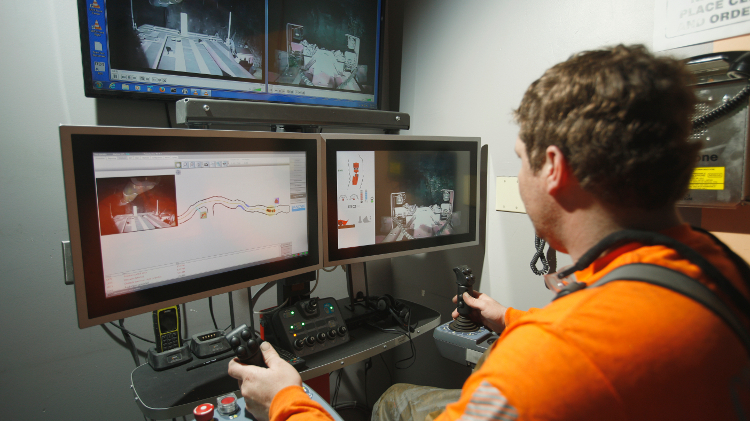
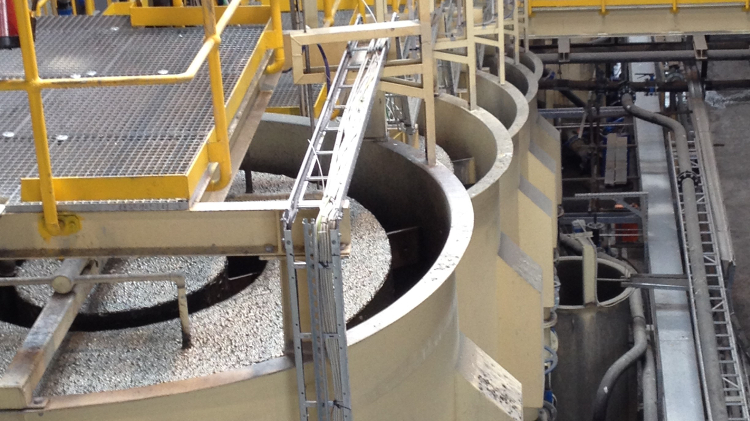
The expansion of operational technology is creating large volumes of data from nearly every aspect of mining operations. Shutterstock
Mining companies have never had more data at their disposal—or more difficulty turning them into something useful, say experts across the sector. While operations are generating volumes of information that would have been unthinkable even a decade ago, the ability to manage, interpret and standardize data has not kept pace.
“[Companies] have been investing a lot in data capture,” said Steve Gravel, manager at the Centre for Smart Mining (CSM) at Cambrian College of Applied Arts and Technology in Sudbury, Ontario. “What mines are struggling with now is how do we take that data and actually get the interpretation to a point where you can make an intervention that optimizes a process?”
For an industry under constant pressure to improve productivity, reduce costs and operate safely, that question sits at the centre of performance.
More data, less clarity
Two decades ago, data quality issues already existed at mining operations, but the volume was manageable enough to work around and engineers could reconcile inconsistencies manually, said Jessica Kaczmer, artificial intelligence (AI) and data partner at Deloitte. “Things didn’t move as fast [and] we could generally clean the data through manual effort and spreadsheet work,” she said.
Now the rapid expansion of operational technology—sensors, connected equipment and automated systems—has created a continuous stream of data that she said comes from nearly every aspect of mining operations.
On site, the shift has been just as dramatic. Emma Hill, a senior geological engineer and associate at Klohn Crippen Berger, has seen data collection evolve from periodic manual readings to near real-time monitoring in the last decade. “When I first started, we were doing manual readings maybe once a month,” she said. “Now, we have sites where they take readings every five minutes.”
What was once a manageable dataset has become a constant flow of information, with some operations moving from hundreds of data points per year to millions, said Hill.
At the same time, mining operations are dealing with long asset life cycles that bring decades of historical data into the equation. Hill noted that many projects rely on 30 to 50 years of legacy information, all of which must be integrated with current datasets to fully understand system behaviour.
With most mines already understanding the importance of data collection, Gravel said the issue is not lack of awareness, but rather the ability to translate data into meaningful action. “Mining operations aren’t car plants and you don’t have the predictable inputs and outputs you’d see in more automated systems,” he said. “At the end of the day, you’re breaking rock.”
Compounding the problem is a patchwork of legacy systems that do not talk to each other, he said, making it difficult to build a coherent view of operations without extensive data reconciliation.
Integration and standardization are key
With mine sites operating as interconnected but often siloed systems, teams responsible for different parts of the operation—pit, plant, tailings or maintenance—collect and manage data independently, using tools and formats that suit their immediate needs.
“You have lots of different teams working on a site, and each of those teams are typically collecting data in a different way,” said Hill. Information arrives in different formats, at different frequencies and with varying levels of quality. “If you look at them in isolation, you’re not going to see connections between those different datasets,” she explained. “You’re not going to see patterns.”
Hill pointed to a case where integrating geotechnical data with historical aerial imagery revealed the cause of unexpected subsurface conditions. This kind of insight is where data can deliver value, she said, but it only becomes possible when datasets are brought together in a consistent and accessible way.
Achieving that consistency requires standardization, and this is where the mining industry faces one of its most persistent challenges. “We don’t really have any standard data formats,” Hill said, noting that in her experience every client and project tends to structure data differently.
The lack of standardization extends beyond formats to the definitions that underpin the data itself. “How do you define an operating hour in a mine? Everybody’s got their own definition,” said Zoltan Lukacs, a mining engineer and operations advisor with over 40 years of industry experience. “We seem to have trouble agreeing on what we’re looking at.”
Moving towards solutions, Tim Skinner, president of SMART Systems Group and an active contributor to the Global Mining Guidelines Group (GMG), said companies need to step back and take a more structured, operation-wide approach to data. “You need a single source of data; single entry, single master, multiple use,” Skinner said. He noted that integration depends on establishing clear ownership of data—from equipment and maintenance records to geological datasets—so that data can be used across teams without duplication.
That foundation, he added, allows companies to build systems that support multiple uses across the operation. “It’s like having the full puzzle picture laid out,” he explained. “Then when you put systems in place, you’re just dropping the pieces into it.”
AI raises the stakes
There is no doubt that the rise of AI has brought renewed urgency to data management. Advanced analytics and machine learning promise to unlock new efficiencies, from predictive maintenance to process optimization. But those capabilities still depend entirely on the quality and structure of the underlying data.
While AI can identify patterns, it cannot independently validate whether those patterns reflect real-world conditions. Without human oversight—and without reliable data—AI-driven insights can quickly become misleading. “AI doesn’t understand the mining context—people do,” said Gravel.
Skinner said AI is best understood as an amplifier of existing data conditions—not a solution to them. “AI is more the application that uses the data than manages the data,” he said. “If it’s using incorrect data, you’re just going to get incorrect answers faster.”
The consensus among industry experts is that stronger data governance—the policies and standards that determine how data are collected, managed and used—is critical to closing that gap. “It’s always been seen as an IT problem, but more than ever, operators need to take ownership of it,” said Kaczmer, noting that systems relying on flawed inputs can produce inaccurate recommendations or fail to detect critical issues.
That shift is also reshaping workforce expectations. Data literacy is becoming a baseline requirement across roles—from engineers and operators to supervisors and managers.
Hill pointed to growing demand for hybrid roles that bridge technical expertise and data analysis. “You need somebody who understands the technical subject matter and can translate that for the data analysts,” she said. “If we can free up engineers from copying and pasting in Excel, we also get more engineering hours out of them; then they have more time to solve engineering tasks.”
However, building those capabilities is not straightforward in a sector where change itself can introduce risk. Mining remains a risk-averse industry, where adjustments to established processes can affect safety, production and profitability. “There’s a perception that anything new could interrupt production,” Gravel said, pointing to concerns around downtime and safety as barriers to change.
Overcoming that resistance requires more than technical solutions. As Kaczmer noted, success often depends on demonstrating clear, practical value at the operational level—whether by reducing travel between sites, improving maintenance planning or enabling faster decision making. “It’s about showing how it makes your life easier,” she said.
Industry-wide efforts are also helping to support that shift. Skinner pointed to GMG’s ongoing work on interoperability and shared data frameworks, including guidelines such as the time usage model for mining equipment, which was released in 2020 and provides a consistent way to define and compare key metrics like an operating hour, delays, availability and utilization across operations.
At the same time, training is emerging as a critical piece of the puzzle. Gravel said one of the biggest gaps he is seeing across mining operations is not access to data, but the ability of staff to interpret and apply them effectively.
Cambrian’s CSM launched a new three-part corporate training program in January, focused on the fundamentals of data analytics, data visualization and dashboards, and advanced analytics with an introduction to AI. The goal is to give workers across the value chain—not just data specialists—the ability to understand, question and act on the data they use every day. “Anyone who interacts with a spreadsheet more than once a day—this is for you,” said Gravel.
He added that this kind of upskilling is becoming increasingly important as mining companies adopt more advanced digital tools. Many operations are implementing third-party AI and analytics platforms, but those tools often fail to deliver value if employees lack a basic understanding of how the data work. “Those solutions hit barriers when the staff who are adopting those tools don’t have a foundational understanding of AI and data analytics,” he said.
He expects data literacy to become a baseline requirement across the industry—not just for analysts, but for engineers, operators and even executives who interact with dashboards and real-time performance data. “Eventually, everyone’s going to have to have a baseline understanding of data literacy,” he said.
Ultimately, while AI and advanced analytics are reshaping the mining industry, they are not replacing the need for strong data fundamentals. In an increasingly data-driven industry, the difference between good data and bad data is no longer academic. It directly influences performance, safety and competitiveness.
For mining companies that treat data as strategic assets rather than byproducts, the opportunity is significant: better decisions, more efficient operations and a stronger position in a competitive global market.