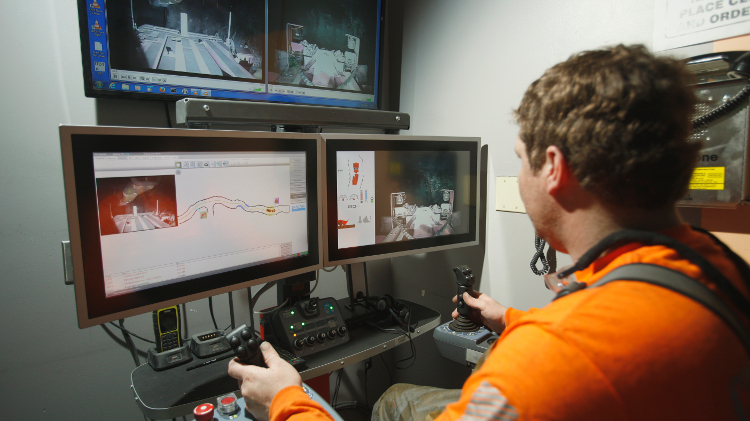
Wenco’s Emily Tetzlaff wearing electroencephalography-based fatigue monitoring technology in a Hitachi 1200 excavator. Courtesy of Emily Tetzlaff, Wenco
T
he mining industry has made advances in detecting and monitoring worker fatigue in recent years. Those studying the phenomenon see opportunities to improve performance not just by identifying tired workers but in addressing the scheduling, working conditions and operational pressures that cause fatigue.
Teresa Johnson, partner at Sleepwell Consulting, noted that for a long time, mining companies saw fatigue as being strictly a personal issue for workers rather than an organizational issue. “[Now], I think that the mentality has started to shift in heavy industry across North America,” she said. “Companies are recognizing that maybe they have a bigger role to play, a bigger opportunity and maybe even responsibility in trying to mitigate some of that risk when they’re looking for opportunities to improve safety [and to] protect their employees in a different way.”
Reactive, not proactive
Progress in addressing fatigue in the mining industry has been uneven, said Marc Hébert, professor, department of ophthalmology, faculty of medicine, Université Laval in Quebec City and deputy scientific director of clinical research at the university’s CERVO Brain Research Centre.
He noted that most large mine operators now have fatigue risk management plans, and many use in-cab fatigue detection technology where a fatigue event can be catastrophic. However, control room operators, dispatchers, maintenance crews doing lockout-tagout, hoist operators, supervisors in light vehicles and engineers making decisions at 4 a.m. all pass through the same circadian low point, usually without comparable fatigue protection.
“Those engaged in passive tasks will typically suffer the most,” said Mike Harnett, president of Solaris Fatigue Management. “A passive task is one that requires sustained attention or vigilance, which is highly taxing on the brain. At the same time, these tasks are often boring and monotonous, such as operating a haul truck or staring at a control panel. In such environments, the brain quickly fatigues from intense concentration and will disengage after about 20 to 30 minutes.”
When this occurs, either the brain starts looking for distractions to reduce the cognitive demand, or it pushes the worker towards a microsleep, a period of sleep that can be measured in seconds and is much more likely to occur if they already have sleep debt.
Mitigating this risk will require moving past simply detecting drowsy behaviours to thinking about the source of the fatigue, said Harnett.
“If you focus solely on employee behaviour, you’re focusing strictly on fatigue management, not fatigue risk management, which redirects focus to the work system and what’s contributing to employee fatigue levels,” she explained.
Hébert echoed Harnett in saying that the industry has invested far more in detecting fatigue than in preventing or counteracting it. “Detection tells you performance has already started to degrade,” he explained. “That is valuable, but by then the hazard is present. Far less has been invested in interventions that act before performance drops.”
The holistic approach
A comprehensive fatigue program has several layers: prevent fatigue where possible, reduce fatigue during the shift, detect fatigue that remains and learn from the results.
“Good roster design, adequate sleep opportunity, commute management and recovery strategies reduce the underlying [fatigue] risk,” Hébert said.
However, Harnett noted that every schedule design has its risks. “The goal is to determine where the risks are within the design and then plan your mitigation efforts around that schedule,” she said.
She highlighted seven factors that increase fatigue-related risk: erratic or irregular schedules; early morning starts (6 a.m. or earlier); shifts longer than 12 hours; the number of consecutive shifts worked; number of waking hours, regardless of shift length; camp conditions; and commute distances.
Hébert also emphasized workers’ commutes as a significant fatigue risk. “A worker finishing a 12-hour night shift and then driving 30 to 45 minutes home may be at the highest-risk point of the entire shift cycle,” he said. “Yet that drive happens outside the workplace, outside most incident statistics and outside most fatigue programs. The same applies to the drive in for a very early shift start, when the brain is not yet fully awake—what we call sleep inertia.”
Other factors can also wear on workers, said Emily Tetzlaff, principal scientist, environmental health and safety at Wenco International Mining Systems, and adjunct professor with the Centre for Research in Occupational Safety and Health at Laurentian University. In underground operations, for example, low or no lighting impacts the brain’s response, because people need light stimulus to make them feel wakeful.
Noise also has a clear relationship to fatigue, said Tetzlaff, as do heat, humidity and vibration exposure. In addition, she noted, a worker’s circadian rhythm—the body clock that regulates many functions including the sleep/wake cycle and cognitive function—comes into play.
Hébert added that decision making itself is impaired at night, because the brain is operating at its natural circadian low point. “Alertness, attention, judgment and executive function all decline at a time when the body is programmed for sleep,” he said. “When an entire night crew hits that ‘brain fog’ at roughly the same time, you get the perfect cocktail for an accident: the person making the mistake, the person expected to notice it, and the person expected to correct it may all be impaired at once.”
Industry efforts
Tetzlaff acknowledged that a lot of mining companies have made some “pretty fantastic” efforts towards addressing the problem of worker fatigue. She pointed to Rio Tinto’s Oyu Tolgoi operation in Mongolia and AngloGold Ashanti’s Iduapriem operation in Ghana as sites with well-established fatigue risk management programs and as strong adopters of wearable electroencephalography-based fatigue monitoring for over a decade each. These companies have layered the technology within comprehensive fatigue risk management programming with dedicated on-site staff supporting the programs.
“I would love to see more companies move towards being proactive and not needing it to be a compliance requirement to put effort towards it,” she said.
Hébert’s work at the CERVO Brain Research Centre concentrates on the use of lighting, specifically pulsed blue light, as one mitigation for fatigue, though he stressed that it is not a substitute for a complete fatigue management system.
“Countermeasures such as blue light support alertness within the shift, while detection systems catch the fatigue that still breaks through,” he said. “Each layer addresses a different failure mode, and the strongest programs use them together.”
Still, experiments with pulsed blue light have proven effective. A study of blue-enriched light intervention at Glencore’s Raglan mine in northern Quebec, funded by the Natural Sciences and Engineering Research Council of Canada and l’Institut de recherche Robert-Sauvé en santé et en sécurité du travail, was published in the Journal of Occupational and Environmental Medicine in 2023.
The researchers studied the reaction time of workers doing 12 consecutive 12-hour night shifts; under normal lighting, the workers’ reaction times grew progressively slower over the 12 days, and attention lapses increased, despite them getting decent sleep. However, monitoring screens showed increased vigilance over time when exposed to pulsed blue light (from a Bluewake device invented by Hébert).
Since the study was published, he said several mines—including multiple Agnico Eagle operations globally, and Trekor Metals’ Gibraltar mine in British Columbia—have adopted the Bluewake technology.
Harnett stated that Solaris Fatigue Management’s mining clients that have seen the greatest impact took multi-pronged approaches to tackling fatigue. They have built strategies around managing overtime, call-outs and other high-risk scenarios, combined with employee education and improved investigative procedures that objectively measure whether fatigue was a potential contributor to an incident. Some mines are also including sleep disorder screening during onboarding and annual physicals, as well as reviewing benefit plans or employee allowances to allow coverage for items such as blackout drapery, air conditioning for bedrooms or personal sleep trackers.
“More importantly, we’re seeing the creation of metrics to better track fatigue and the impact of any adopted mitigation strategies,” Harnett said.
Proving ROI
Worker fatigue not only has a safety cost; it can also become an operational cost for mines. However, Harnett pointed out that the business case behind managing worker fatigue has not been well presented to the mining industry, so some companies are not making the connection between fatigue and overtime costs, quality of work, poor shift handovers, absenteeism, turnover, health care costs and even employee and family assistance program utilization rates. “Organizations need to examine their own pain points and see if there’s a potential link to any of these factors,” she said.
Tetzlaff noted that proving return on investment (ROI) for fatigue mitigation to mining companies, as with anything involving health and safety, has historically been challenging, but added that there has been some progress in terms of recent studies.
Lagging indicators—like physical costs such as equipment repair after a haul truck hits a safety berm—have been historically easy to find and quantify, but Tetzlaff pointed out that by linking other datasets from fleet management or asset health systems to a fatigue monitoring system, companies can monitor the whole operation using leading indicators and look at broader questions such as whether alert workers are easier on equipment, more responsive to dispatch, smoother in their driving or less likely to send ore to the waste dump.
Companies can now determine these costs at more granular levels, she noted, driving cross-departmental conversations between the health and safety or industrial hygiene teams and the asset maintenance teams. These correlations can help mines to quantify the actual operational cost of fatigue, which can in turn help better inform real-time decision making, such as break timing.
Tetzlaff added that there are also use cases beyond the cab of a truck, such as in the control room, because they are responsible for—or have a degree of responsibility for—the operators in the field. “If they themselves are too fatigued, then how are they going to help protect the operators in the field that are becoming fatigued?” she asked. “You need to have proper fatigue management in the control room so that you can have it in the trucks as well. We really need to see the expansion of fatigue management to be inclusive of the entire site, from the control room all the way across the operation. If we protect our workers, we protect our assets, and ultimately production.”