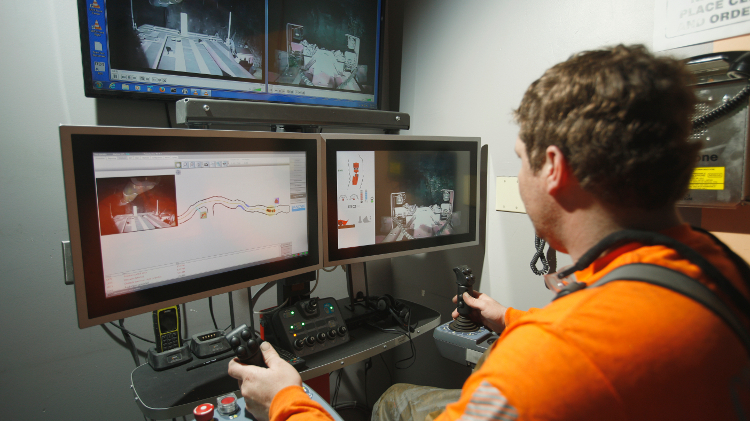
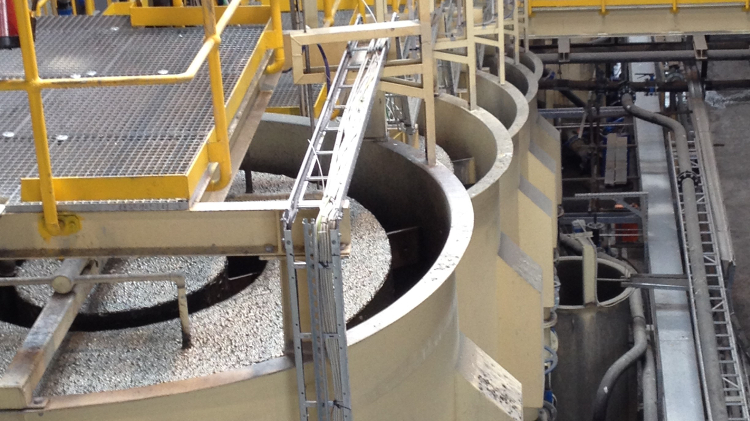
Sachtleben Technology’s Owl Eye platform uses LiDAR sensors to continuously measure material volumes on conveyors. Courtesy of Sachtleben Technology
M
aterial handling serves as the circulatory system of a mining operation, moving ore and waste efficiently throughout a mine site. From pit to port, that movement can account for a major share of operating costs, making it one of mining’s biggest opportunities to improve productivity and control spending.
The challenge is not simply moving more material but keeping it moving safely and predictably. Challenges like conveyor downtime, uneven loading and limited visibility can quickly disrupt production, accelerate equipment wear and increase energy and maintenance costs.
New technologies are giving operators more control by improving conveyor performance and making material movement easier to track and manage across the value chain.
Control from the start
Within a conveyor system, control over material movement begins with the motor that sets the conveyor belt in motion. Schneider Electric’s Altivar Soft Starter ATS490 range gives mining operators greater control over the acceleration, deceleration and starting torque of low-voltage motors, allowing conveyors to start and stop progressively rather than abruptly.
Pouria Emtiaz, business manager of industrial control, drives and human-machine interface at Schneider Electric Canada, said that managing motor acceleration and deceleration reduces mechanical stress and can extend equipment life. This makes soft starters particularly valuable in applications where motors and gearboxes may be older and costly to replace.
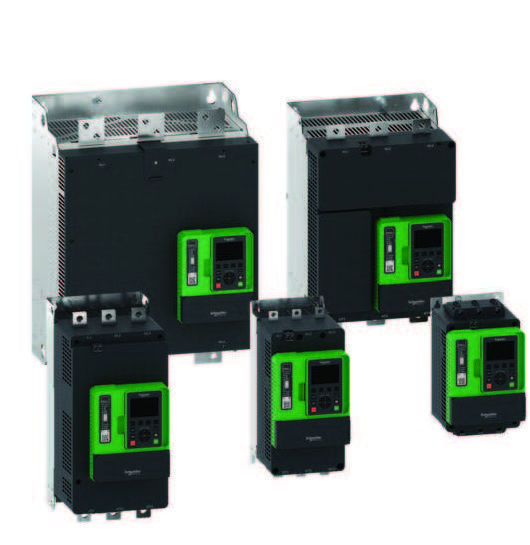 Launched in mid-2025 the Altivar Soft Start ATS490 range allows mining operators greater control over conveyor belt motors. Courtesy of Schneider Electric
The soft starters are designed for fixed-speed conveyor applications, managing motor starting and controlled stopping rather than providing continuous speed control. The ATS490 range is intended for low-voltage motors operating from 208 to 690 volts.
The ATS490 line provides torque management and application-specific functions, as well as Safe Torque Off, a feature that prevents the motor from producing torque or restarting unexpectedly when the safety circuit is activated. The ATS490 range, launched in mid-2025, also connects to plant control and asset-management systems, making motor data accessible through the control architecture and its embedded web server using a laptop or tablet. By giving operations and maintenance teams a clearer view of equipment performance, the system can help them recognize changes in operating conditions before they become more serious.
“You can predict what’s going to happen to your system,” Emtiaz said. “You don’t have to wait for downtime to stop the process.” As an example, he said performance data could indicate if a malfunctioning fan is likely to fail within the next two months, giving maintenance teams time to intervene before a failure actually occurs.
Emtiaz explained that this ability to improve uptime is a key value for mining operations, where a conveyor failure can have considerable financial consequences. Recalling a conversation with one gold mining customer, Emtiaz said the operation had told him that previously its downtime had cost $1.5 million per day.
Looking ahead, Schneider expects future improvements to the ATS490 range to centre on more connected, software-driven systems that use better energy and equipment data to support predictive maintenance and, eventually, automate more operating and maintenance decisions.
Schneider’s soft starters are already being used by several large gold mining operations in Ontario and Quebec. According to Emtiaz, reported feedback includes smoother production, longer motor life and better visibility into equipment condition.
Visible flow
At mine sites, material often moves through the operation faster than it can be measured and reported. Truck and bucket counts, handwritten shift sheets and periodic stockpile surveys provide estimates, but only after the material has already been moved. Sachtleben Technology’s Owl Eye platform is designed to close that gap by continuously measuring material volumes across stockpiles, haulage routes and processing plant infrastructure, giving operators a more immediate view of where material is and how it is moving.
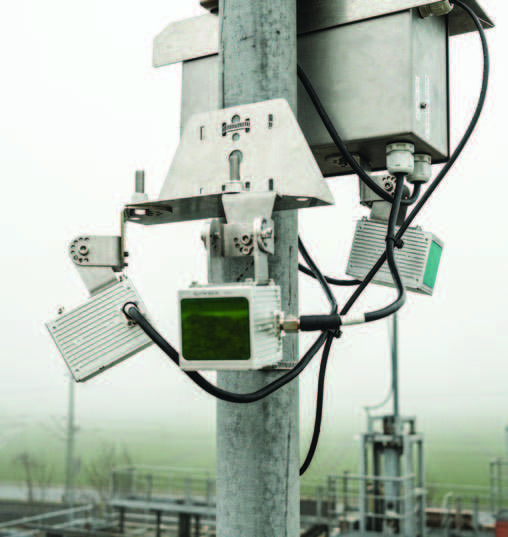 The Owl Eye technology gives operators near real-time visibility into material flow. Courtesy of Sachtleben Technology
The system uses rugged, non-contact light detection and ranging (LiDAR) sensors to scan bulk material and calculate its volume. Sensors can be mounted around stockpiles, conveyors, silos and storage areas, with data transmitted through Wi-Fi or cellular networks to a shared dashboard, bringing measurements from across the operation into a single view.
For conveyors, a sensor mounted over the belt captures thousands of cross-sectional profiles per second and typically measures volume to within approximately one per cent on a calibrated belt, according to the company. Converting that volume into tonnes still depends on accurate and consistent bulk density assumptions. This can complement or, in some applications, replace conventional belt scales, which require calibration and maintenance.
“You can get more measuring points,” said Harry Goetz, the North American business manager for Sachtleben Technology. “You get a better resolution of what’s going on in the operation.” The resulting information can support preventive maintenance and utilization monitoring by showing how consistently each conveyor belt is being loaded.
Goetz said Owl Eye’s fixed LiDAR sensors provide continuous measurements, unlike drone surveys, which require a pilot, data processing and a chosen survey interval. Continuous measurements can show how much high- and low-grade material is available for blending, whether sufficient feed remains on a stockpile and whether truck boxes or conveyors are being under- or overutilized.
By giving mining and processing teams a shared view of inventories and material movement, the platform can support faster and better-informed decisions. That can reduce reconciliation disputes between mine and mill and replace manual reporting with automated data collection.
“Being able to get [that] information on a daily [or] hourly basis is important,” Goetz said. It also frees engineers and technicians to focus on other work.
Owl Eye’s hardware is designed for industrial conditions, with components rated for low-temperature operation. They also feature protective housings for potentially explosive environments and cleaning options for dusty sites. The first Canadian deployment of the Owl Eye was at Eldorado Gold’s Lamaque gold complex in Quebec over a year ago, said Goetz. The system reportedly continued operating in temperatures near minus 40 degrees Celsius and during blizzard conditions.
The system still depends on site conditions and supporting data. Mines seeking independently verified tonnage figures may still require a complementary weighing system.
Goetz explained that, in some applications, “instead of measuring the tonnage, you’re measuring the volume,” which can still help operators see whether equipment is being overfilled or underfilled. Sensors also require suitable lines of sight, power and connectivity, while installations in dusty environments may need automated cleaning.
Maintenance by measurement
At conveyor transfer points, maintenance decisions can determine whether material continues moving reliably or a small problem develops into costly belt damage. Steel skirt liners, which guide ore and ensure it remains on the belt as it passes through a chute from one conveyor to the next, must remain roughly three to five millimetres above the belt and be monitored for progressive wear. If set too low, they can damage or rip the belt; if left in service too long, worn liners can allow material to escape and increase the risk of unplanned maintenance.
Geobotica’s BeltBot is designed to give maintenance teams more consistent information about these difficult-to-access components. Resembling a small Mars rover, the compact, remotely operated robot crawler can move through the enclosed transfer areas during a shutdown, said Geobotica CEO and founder Lachie Campbell.
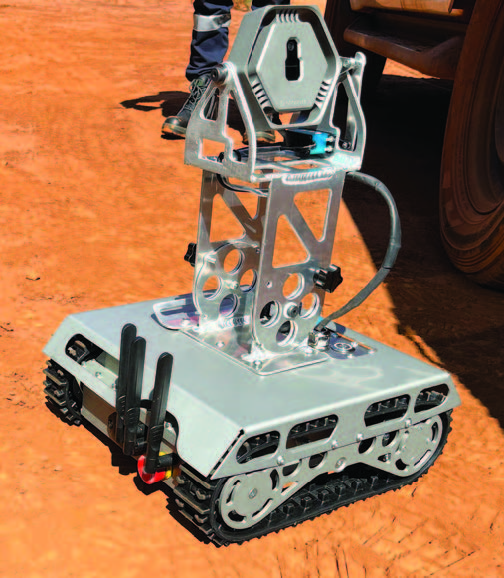 Geobotica’s BeltBot uses LiDAR, cameras and custom lighting to capture images and measurements of conveyor liners. Courtesy of Geobotica
Using LiDAR, cameras and custom lighting to capture images and measurements of the liners and surrounding structure, it measures both the liner-to-belt gap and the loss of liner thickness, while producing a 360-degree visual record and a 3D point cloud, effectively creating a digital twin of the inspected section.
Campbell noted that this replaces a highly variable manual process. Traditionally, a worker would crawl into the confined space with a taper gauge, flashlight and clipboard, taking measurements beneath material that may remain lodged above.
“It’s a very difficult and unsafe place to work, and so inevitably there are errors and very low repeatability when you’re doing it manually,” Campbell said, adding that the BeltBot keeps the worker outside the immediate hazardous area and produces a repeatable dataset that can be reviewed later.
For maintenance teams, the system’s value lies not only in collecting measurements, but in using them to plan work more precisely. BeltBot can link photographs, liner gap data and wear measurements spatially and can convert thickness loss into heat maps. These maps show where ore is striking one side of a chute and wearing down the liner, and which liners remain serviceable. Instead of replacing every liner on a fixed schedule, maintenance teams can target only the components that require attention and plan that work around scheduled shutdowns.
“Now with the digital measurement, you can go from time-based maintenance to condition-based maintenance,” he said.
This can reduce unnecessary parts consumption, manual handling and exposure to unsafe conditions during maintenance, while improving shutdown planning and lowering the risk of belt damage and possible interruptions to material flow.
BeltBot’s fourth-generation design scans the complete environment rather than one skirt liner at a time. This approach references each surface against the surrounding structure, allowing relative change to be detected across the whole scene.
In partnership with BHP, the first generation of the robot was deployed at BHP’s Australian operations in 2023. The fourth-generation BeltBot was deployed earlier this year and is in active use in a growing fleet size, said Campbell.
BeltBot is intended to change how inspections are performed rather than eliminate maintenance roles. “It’s definitely not replacing jobs,” he said. “It’s just changing the work that we do by being safer and more productive.”
Future BeltBot applications, according to Campbell, could include measuring chute liner wear—which is the vertical “funnel” that goes from one conveyor to another, sometimes reaching a few storeys high—as well as inspecting enclosed mill spaces and creating digital records of long overland conveyors, extending measurement-based control beyond individual transfer points.