For the last 20 years, laser cladding has been used to improve the durability and repairability of components operating in extreme industrial environments. By using high-powered lasers to apply wear- and corrosion-resistant coatings with greater precision and lower heat input than traditional welding methods, the technology has become increasingly useful in industries such as mining, oil and gas and heavy manufacturing.
Now Edmonton, Alberta-based Apollo-Clad Laser Cladding is exploring how machine learning (ML) can strengthen those processes further. Over the past several years, the company has been working to integrate ML-enabled process monitoring into its laser cladding operations; the goal is to identify process abnormalities during production rather than rely solely on post-process inspection.
As part of the 65th Conference of Metallurgy and Materials (COM 2026) that will be held on Aug. 17 to 20 in Calgary, Alberta, Apollo-Clad’s production engineering manager Gentry Wood will present a keynote on the topic “Practical Considerations of Machine Learning for Defect Detection in Industrial Laser Cladding Processes.”
In a conversation with CIM Magazine, Wood discussed the opportunities and challenges of bringing ML onto the laser cladding shop floor—and what that could mean for the mining sector.
CIM: What makes laser cladding valuable in the mining industry?
Wood: The laser’s precision and level of control are particularly important in mining, where components such as bucket teeth, crusher teeth and crusher liners operate in highly abrasive and corrosive environments, and where repair costs, downtime and component replacement can become significant.
Laser cladding is an excellent process for applying coatings to newly manufactured parts, but it is also routinely used as a repair technology. Damaged components can be carefully recoated, extending the service life of critical parts. In our shop, some laser-clad components have been refurbished six or seven times, and we have the tracking numbers to prove it. These parts have been sent to literally all corners of the globe and returned to us for repair over periods of many years.
Some oil sands mining components repaired at Apollo-Clad weigh several tonnes and require some of the largest laser systems in the company’s facilities.
This same technology is also used in additive manufacturing, referred to as Laser-Based Directed Energy Deposition, which is used to complete repairs that add tens (or sometimes hundreds) of pounds of material to existing components. This is where laser cladding becomes more than just a coating process; it is a practical, industrial-scale tool for restoring, modifying and extending the life of high-value components.
CIM: How did the AI-SLAM project influence Apollo-Clad’s foray into machine learning?
Wood: The Artificial Intelligence and Advanced Processing Sensing for Laser Additive Manufacturing (AI-SLAM) collaboration, administered through the National Research Council of Canada’s Industrial Research Assistance Program, brought together Canadian and German small and medium-sized companies, universities and research institutes to tackle the challenge of developing next-generation manufacturing solutions for the mining industry.
Apollo-Clad was the industrial demonstrator of the technology, and it was obvious to the group by the end of the research portion of the project in 2025 that there was more good work to do to fully realize the benefits and potential of this exciting technology.
In total, the group worked together for four years [from 2021 to 2025], and we developed working relationships that continue to this day. Apollo-Clad continues to work with organizations such as Germany’s Fraunhofer Institute for Laser Technology and the Alberta Machine Intelligence Institute (Amii), where ML resident Mutahar Safdar is currently helping us to support on-machine defect detection in industrial laser cladding operations. His project aims to scale the use of ML for the production and repair of functional parts with applications in the mining, oil and gas, agriculture, drilling and steel industries.
It was an incredible experience to work with such a diverse group that brought together some of the very best in the world in terms of laser materials processing, ML and machine integration.
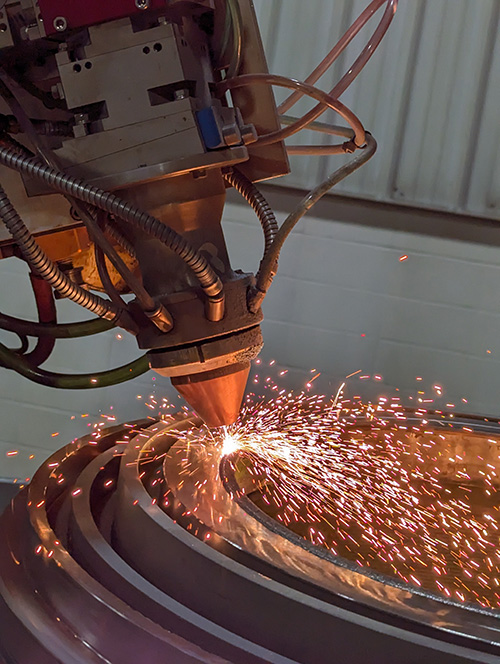 Laser cladding uses lasers to apply coatings to components used in abrasive and corrosive environments. Courtesy of Apollo-Clad Laser Cladding
CIM: Why is real-time defect detection important in laser cladding operations?
Wood: In a real production environment, conditions are never perfectly controlled. ML defect detection improves quality control by shifting the process from reactive inspection to proactive intervention. It reduces rework, scrap, wasted powder, machine time and downstream inspection burden. It also provides better traceability by identifying which parts or where on the part an abnormal condition occurred, rather than simply discovering afterwards that a problem exists somewhere in the coating.
For high-value repair components, this is especially important because the goal is not only to produce a coating that passes final inspection, but to protect the value of the part throughout the repair process.
CIM: What advantages can ML models offer laser cladding operators?
Wood: The main benefit is decision support. Operators receive faster feedback, can identify potential issues earlier, understand where on the part they occurred and take corrective action with greater confidence. The goal is not to replace operator expertise, but to capture and strengthen it by giving operators better information in the moment it matters most. Early intervention is almost a necessity for pivoting laser cladding technology towards full-scale industrial additive manufacturing, and we see this being a major opportunity for our business for the future.
CIM: What are some of the challenges of integrating defect detection tools into a manufacturing facility?
Wood: One of the biggest challenges is that real production environments are far more variable than controlled lab settings. In high-mix, low-volume manufacturing, materials, geometries and process parameters can change constantly, making it difficult to build ML models robust enough for production-scale deployment.
Data quality is another issue. While large amounts of sensor data are generated, clean data labels and consistent defect records are often limited. That is why Apollo-Clad is taking a staged approach to ML complexity on the shop floor, starting with deviation detection before advancing towards defect classification and operator recommendations.
Systems integration is another factor because ML tools must communicate reliably with sensors, lasers, controllers and other machine subsystems in real time, which creates challenges around synchronization, latency and usability.
Operator trust is equally important. Again, the goal is not to replace expert operators, but to support them with earlier warnings, localized quality information and better decision-making tools during production. Early intervention is almost a necessity if laser cladding is going to move towards full-scale industrial additive manufacturing, particularly for high-value mining and resource sector components, where quality failures become extremely costly.
CIM: How do you see AI and ML changing manufacturing and component repair processes in the years to come?
Wood: A major opportunity is to make laser cladding and repair operations more data-driven, consistent and repeatable. In mining, components are often high-value, geometries vary significantly and quality is critical. Today, many repair decisions still rely heavily on operator experience, manual adjustment and post-process inspection. Over the next decade, AI and ML tools can help move us towards systems that understand the process as it is happening, detect deviations earlier and support better decisions in real time.
Early detection of issues and recommending parameter adjustments between subsequent layers will ensure that additive manufacturing with this technology does not become a cost-prohibitive technology for the industry. There is nothing more devastating than finding out there is a critical issue in final inspection. These AI tools will help with detection and prevention to unlock this technology for the uptake at scale into a wide range of industries, including but not limited to mining and resource extraction.
The exciting part is the path towards greater autonomy. We can start with monitoring, then move to prediction and recommendations, and eventually to agentic systems that can suggest or adjust process parameters within safe limits. The goal is not simply to automate the process but to make production more reliable and efficient by reducing defects, lowering rework, improving records and delivering more consistent repairs for high-value components.
CIM: How is Apollo-Clad positioning itself for future growth?
Wood: We are one of four business units operating under the broader Apollo Group, which also includes machining, heat treatment and premium threading divisions. In recent years, we relocated to a significantly larger Edmonton facility as part of a broader expansion effort. We are already approaching capacity again as new machining equipment, robotic systems and laser technologies continue to be added.
The company currently operates 11 industrial-scale laser cladding systems (with more coming) and is working towards implementing ML-enabled monitoring across all production cells over the next several years. We are also preparing to bring in a next-generation robotic laser cladding research system intended specifically for ML and research and development applications tied to industrial repair and additive manufacturing.
Apollo-Clad’s next step is to systematically mature AI implementation by combining domain expertise with data-driven methods. The first stage focuses on robust deviation detection on production lines, followed by defect classification and eventually operator-assist recommendations. More broadly, our vision and mandate from Apollo-Clad management is to deploy ML at full production scale across all Apollo-Clad laser systems within the next five years, with target completion by fall 2030.
This ambitious goal is only possible with the support of partners such as Amii, as well as funding from the federal government’s Regional Tariff Response Initiative. It has matched our funding to help bring next-generation robotic laser cladding equipment and advanced manufacturing technologies to our Alberta facilities.
This is a strong example of industry, academic and government collaboration aimed at strengthening Canadian manufacturing capability in increasingly competitive global markets. A lot of people are surprised that this kind of advanced manufacturing work is happening in Alberta. Part of our mission is to make people more aware of the capabilities that exist here.