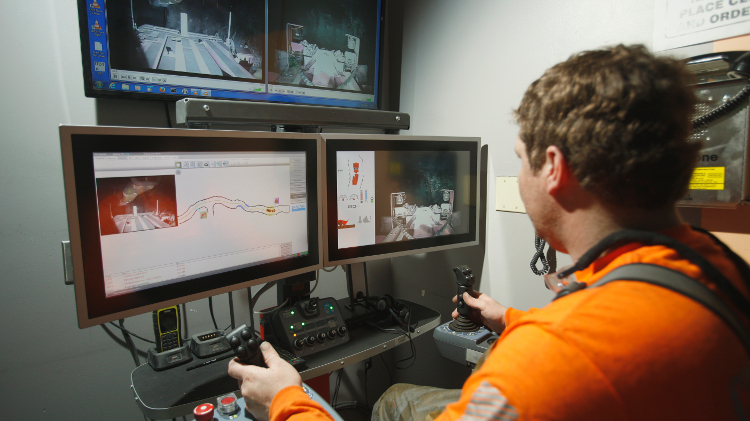
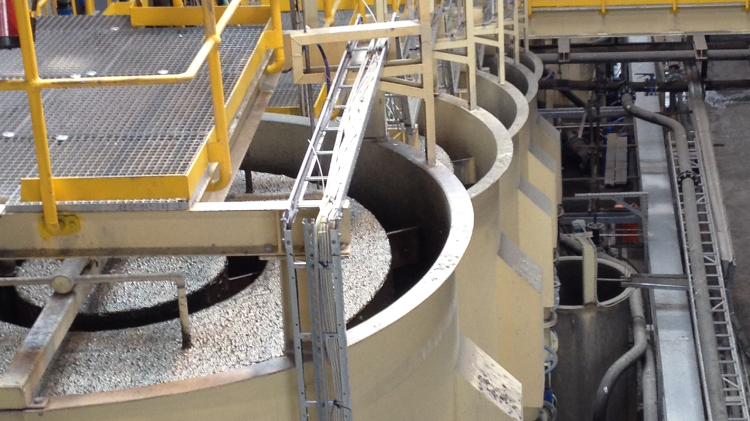
The aim of the ABB Ability Operations Management System is to optimize the coordination between mine planning and real-time operations through dynamic scheduling and tracking of people, assets and tasks. Courtesy of ABB
Mining operations are large, complex and expensive. A small discrepancy between what was planned and what was executed can lead to large impacts across operations—from sequencing and equipment allocation to final costs.
The challenge begins with the information used to build a mine plan. Exploration drilling and geological modelling provide engineers with their best understanding of what is underground, while assumptions about equipment availability, productivity and operating conditions shape the schedule. But once mining begins, reality starts supplying new information. An equipment issue, a change in ore body conditions or an unexpected delay can alter what is achievable.
In traditional mine planning processes, incorporating those changes can depend on people manually gathering information and communicating between systems and teams. The result is a gap between what the schedule says should be happening and what the operation needs to do next.
“If you start with the wrong thing, you’re going to end up with the wrong thing,” said Jim Sronce, general manager of MineScape at Datamine.
Rather than treating the mine plan as a fixed set of instructions, newer software technologies are increasingly designed to keep information moving between planning and execution, allowing operations to respond to changing conditions and use what they learn to inform future decisions.
Companies such as ABB are connecting planning and execution to enable dynamic scheduling; Datamine is using digital models to keep mine information current as operations generate new data; meanwhile, Strayos is applying artificial intelligence (AI) to specific operational drill-and-blast data to help optimize subsequent blasts.
Interconnected systems for smoother operation
Recognizing the shortfalls of manual systems, many mining companies have invested heavily in new digital tools, from fleet management and mobile applications to automated data collection. However, this can lead to disconnected point solutions that improve individual tasks without necessarily improving the operation as a whole.
For ABB, the challenge is less about adding another tool and more about optimizing by connecting the information mines already generate.
“Mining has no shortage of data,” said Eduardo Gonzalez Solari, digital mining lead, North America at ABB Process Industries. “One of the biggest challenges facing operators today is whether that data arrives in a form, and at a time, when someone can actually do something useful with it.”
The ABB Ability Operations Management System (OMS) is designed to connect planning and execution by bringing together information about resources, equipment, maintenance and materials. The capabilities of OMS include short-term planning and scheduling, fleet and mobile operator management, inventory, maintenance, data connectivity, performance and quality analytics and short interval control—which supports adjustments when conditions change.
The value, according to Gonzalez Solari, comes from allowing those functions to inform one another.
An equipment problem, for example, is not only a maintenance issue. “It may also change what a planner can achieve that shift,” explained Gonzalez Solari. “When equipment availability and maintenance forecasts are part of the same operational picture, those constraints can be considered when work is scheduled, rather than discovered after a plan becomes unachievable.”
This is where dynamic scheduling becomes a key functionality of an interconnected data landscape. Mine schedules are made and judged by how effectively and efficiently they use resources and account for constraints of the project, as they are understood at the time. A truly effective schedule needs to respond when those conditions change, which can happen quickly.
“Dynamic scheduling recognizes that change is part of normal mine operations,” Gonzalez Solari said. “Instead of leaving planners to manually work through the consequences of an unavailable machine, delayed task or changed resource, scheduling tools can recalculate around the situation that actually exists.”
This has implications beyond speed; it changes planning from a periodic exercise into something much more closely connected to the shift itself. Short interval control provides regular feedback on execution, while dynamic scheduling allows that information to influence what happens next.
The schedule therefore becomes less of a fixed instruction and more of a living operational tool. For mine planners, that creates room to spend more time improving the plan rather than continually repairing it.
Gonzalez Solari pointed to Gold Fields’ Granny Smith gold mine in Western Australia as a good example of the benefits that can be realized when information that was previously disjointed was brought together for a clearer viewpoint. The operation replaced Excel spreadsheets and verbal instructions with digital scheduling, operations management and fleet management systems supported by OMS, giving teams real-time visibility of people, equipment and tasks across the operation.
“When a disruption affects the schedule, rescheduling can now be done in seconds rather than hours,” Gonzalez Solari said. With OMS, he said mining companies have been able to cut manual data input by 30 per cent, provide up to 25 per cent cost savings from integrations, while improving productivity by up to 10 per cent through digitalized short interval control.
Digital twins for real-time visibility
Information gathered in the field can take time to reach the people responsible for design and scheduling, creating a lag between conditions on site and the information used to plan the next phase of work. That gap can be particularly significant as mining advances and new geological information becomes available.
“The initial plan may be based on relatively limited drilling information,” said Datamine’s Sronce. As mining advances, surveyors and geologists collect additional information, including current topography, exposed geological conditions and updated interpretations of the top and bottom of stratigraphic intervals. However, that information is not always incorporated back into the geological model and mine plan.
“That’s a big problem because it affects everything—the mine design all the way through scheduling and operations,” Sronce said.
MineScape, Datamine’s optimization software, is designed to help close that gap by creating digital twin models that provide a visual representation of the site. Digital twins allow mining companies to merge all the information from plans, geological models and sensor data into a single visual format so that all teams can better understand operations as they continue. Equipment placement, drill locations and worker activities can all be monitored in real-time, so that managers can make fast, informed decisions that have a big impact on the operation’s bottom line.
Any updated information can then be used to rebuild the model and recalculate quantities and schedules based on current conditions. Rather than starting the planning process again, engineers can work from the existing mine plan and incorporate new information as it becomes available.
“Engineers don’t have to start the planning process over,” Sronce said. “They can update the existing model, rerun reserves and quantities, and revise the schedule based on the latest information.”
Keeping the plan current is only part of the opportunity, added Sronce. MineScape’s Rapid tools are also intended to make creating and evaluating engineering designs faster and more interactive.
Part of that efficiency is building multiple scenarios during the planning phase. For each different scenario, the schedule updates to reflect the projected outcomes. Rapid tools are new interactive engineering tools added to MineScape 2026 that give immediate visual feedback about the outcome of design changes. Rapid CAD updates the design geometry immediately, making iterations fast and intuitive, while Rapid Ramps allows engineers to define parameters of ramps, including switchbacks and flat segments in pit and dump scenarios. Rapid Drive lets designers see test truck movement on roads and ramps, showing how vehicles would behave in the real world before the design leaves the computer-aided design (CAD) system.
MineScape is part of Datamine’s broader digital offering, which provides an end-to-end solution that covers mine planning and execution. Bringing all the solutions under one broad umbrella allows diverse teams to share information as site conditions change. MineScape is designed for coal applications as well as stratigraphic deposits, including phosphate, bauxite and oil sands.
Looking ahead, Sronce sees AI-assisted design as the next frontier for MineScape. One potential application is voice-driven interaction, allowing engineers to describe design changes and have the software help execute them with less manual interaction. The goal is to move mine planning away from static, periodically updated designs and towards a more connected process that continuously reflects what is happening in the operation.
Forward-thinking intelligence
Strayos approaches optimization at a more specific point in mining execution: drill and blast.
One of the challenges that comes with the drill and blast method of extracting ore is that it is difficult to get an accurate representation of the geotechnical conditions of the rock types before blasting. A clearer picture of conditions would allow teams to streamline and design blasting to reduce waste.
Strayos has developed mine-to-mill computer vision software that uses physics-based AI models to improve understanding of conditions in the blast area. The application combines drone imagery, drilling data and other operational information to create a more detailed picture of the rock and use it to inform blast design.
The approach is intended to address a broader challenge in mining: operations generate large amounts of data, but they are not analyzed and turned into actionable information.
Legacy mine planning or CAD software does not typically integrate with the equipment generating the data in the field for seamless flow of information back into the planning process, said Ravi Sahu, founder and CEO of Strayos. Changes that teams could implement to make operations more efficient, such as finding that a specific grade resulted in a better throughput, are never used in future mine planning.
Strayos uses AI to help close that feedback loop, beginning with the information available before a blast. Drone imagery can be used to create 3D models of the rock, including the location of joint planes, which can help engineers develop blast designs and determine drillhole locations. The resulting designs can then be communicated directly to drilling equipment.
The feedback continues once material is extracted. As blocks are drilled, tags can be applied to identify the source material. As those loads move through the pit operation and into the plant, the tags can be used to associate the material with its originating ore block and information such as rock hardness.
That creates a link between what engineers knew when they designed the blast and what happened to the ore after it was extracted.
Strayos’s software uses information collected from sensors to find the specific cutoff grade and boundaries of ore deposits. The system then uses AI to assess the collected information and run it through hundreds of scenarios of drill and blast parameters and then models how to reach certain cutoff grades to maximize profitability and increase yield. The models allow for optimal direct drill and blast parameters, so ore gets extracted effectively and not mixed up with waste and sent to the dump.
Post-blast drone imagery can be uploaded into Strayos to assess muckpile movement, generating reports that can be used to evaluate the blast and improve future prediction models.
“Strayos’s work is focused on the physical AI,” Sahu said. “That means really understanding the rock conditions and then building the value from it.”