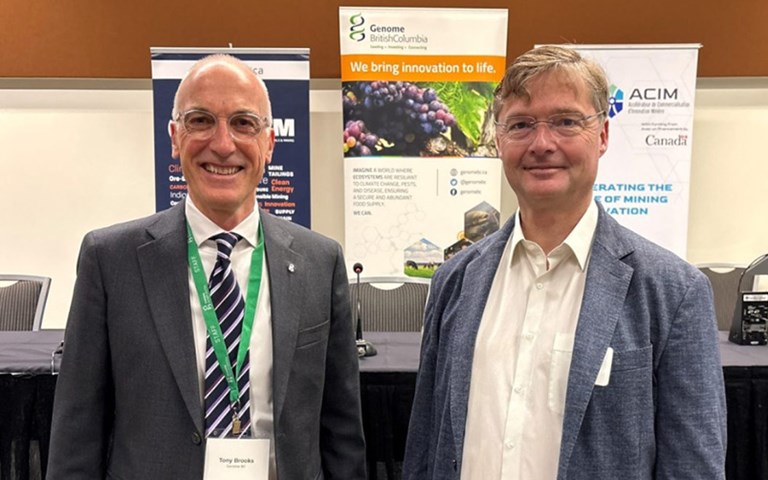
Genome BC interim president and CEO, Tony Brooks (left), and UBC BRIMM director, John Steen. Courtesy of Genome British Columbia
While biomining has been studied for decades, translating laboratory breakthroughs into scalable, commercial solutions remains a significant challenge.
A new partnership between Genome British Columbia (Genome BC) and the University of British Columbia’s Bradshaw Research Institute for Minerals and Mining (BRIMM) aims to advance the real-world applications of biomining in the province.
Biomining is a process that uses microorganisms to break down minerals in ores, which binds or releases metals into more soluble forms. It can also be used to reprocess tailings, effectively turning waste into revenue, extending the life of existing mines and reducing energy use and environmental impact.
However, biological systems can be harder to predict and control than chemical processes for extracting minerals. Environmental factors such as temperature, pH and mineral composition can significantly influence microbial behaviour, making it difficult to replicate controlled lab results in the dynamic conditions of an operating mine.
The new biomining innovation partnership between Genome BC and BRIMM, which is supported by a joint investment of up to $1 million over three years, is designed to fill that gap by advancing laboratory research projects closer to commercial, scalable use cases to make biomining more attractive for industry investment.
“These projects will act as a stepping-stone to further development and progress,” said A.G. Klei, senior communications manager at Genome BC, a not-for-profit organization that funds life sciences research to improve sustainability and innovation. Klei noted in an interview with CIM Magazine that the focus will be on demonstrating practical, proof-of-concept projects for emerging biomining technologies.
“The mining industry is very solutions-driven,” Klei said. “We’re de-risking development by helping to advance technology to a stage closer to implementation, which makes it more appealing for industry to get on board.”
Researchers behind the work
One of the aspects that sets the new research initiative at BRIMM apart from previous efforts is the size of the project, explained BRIMM director John Steen in an interview with CIM Magazine; it has a great deal of investment from Rio Tinto, as well as many laboratories and professors involved in the research.
Four lead researchers from BRIMM are taking on major components of the project, each addressing a different stage in biomining development and research. Steven Hallam studies the genomics and ecology of microbial communities to identify microorganisms capable of mobilizing metals, while Sue Baldwin’s work focuses on discovering microorganisms that can transform toxic compounds into less harmful forms. Sean Crowe examines the geochemical interactions between microbes, minerals and water and Vikram Yadav applies biological engineering to create patents for sustainable technologies, including the world’s first bacterial solar cell.
Their work spans the full process of understanding microbial mechanisms, engineering applications and predicting behaviours in real-world applications. Together, the research aims to move biomining technologies closer to deployment in the mining industry.
Industry collaboration
A key strength of the biomining innovation partnership between BRIMM and Genome BC is its integration with the Rio Tinto Centre for Future Materials (RTCFM) in London, U.K., providing a direct pathway from laboratory research to operating mine sites.
Launched in December 2024 by Rio Tinto and Imperial College London, RTCFM is backed by a US$150 million investment from Rio Tinto over 10 years. Its mandate is to accelerate the development of sustainable technologies needed to supply critical materials for the energy transition by bringing together leading global academic researchers and industrial partners.
Rather than funding isolated projects, RTCFM organizes its work around “grand challenges” designed to address how materials are extracted, processed, used and recycled, with the goal of making these systems more environmentally, economically and socially sustainable. Its first grand challenge—announced at the same time as RTCFM—focuses on sustainable copper extraction.
According to RTCFM, conventional mining methods are “unsustainable for the long haul” as they rely on high temperatures, chemicals and heavy infrastructure—creating large volumes of waste, particularly from low-grade ores.
Through the partnership with RTCFM, BRIMM researchers will gain access to active mine sites where their biomining technologies can be tested and refined at a scale far beyond the lab settings, said Steen.
“Accessing mining sites has traditionally been a real stumbling block, which can now be averted through the partnership with Rio Tinto,” he added.
In addition, research projects developed under the new partnership between Genome BC and BRIMM will be eligible for consideration through RTCFM’s grand challenge selection process, opening the door to potential co-funding and further scale-up opportunities.
The new initiative also builds on earlier collaborations such as the Mining Microbiome Analysis Platform (M-MAP), which was launched in 2022 and brought together industry, non-profit and academic partners—including BRIMM and Genome BC—to collect DNA from more than 15,000 samples from mine sites over the course of two years.
M-MAP sought to identify the microbes that could replace chemicals used in mineral extraction. The new research from the biomining innovation partnership will leapfrog on those breakthroughs to use those microbes in mining at scale, said Klei.
Implications for Canada
Biomining research comes at an important time for resource extraction in Canada. While the federal government has identified domestic mineral production as a priority in its critical minerals strategy, economic and environmental concerns complicate the process.
“Investors and mining companies are interested in investing in new mines, expanding existing mines and building refining and smelting capacity in Canada,” reads a May 2025 report from the Mining Association of Canada entitled The Mining Story 2025. “Unfortunately, regulatory inefficiency can slow project momentum.”
Recovering more value from existing resources—whether from low-grade ores or mine waste—grants new opportunities to improve the efficiency and sustainability of mining operations while reducing the need for new mine sites.
Biomining can also be particularly helpful in extracting small amounts of metals that emerge as byproducts when mining another commodity. For instance, ore from copper mines can contain low amounts of tellurium, which is a metal critical for alloys and certain clean energy technologies, according to Steen.
Through the partnership between BRIMM and Genome BC, researchers hope to position Canada at the forefront of knowledge and expertise in the area—extracting more value from the materials already being mined, which is an increasingly important capability as global demand for critical minerals accelerates.