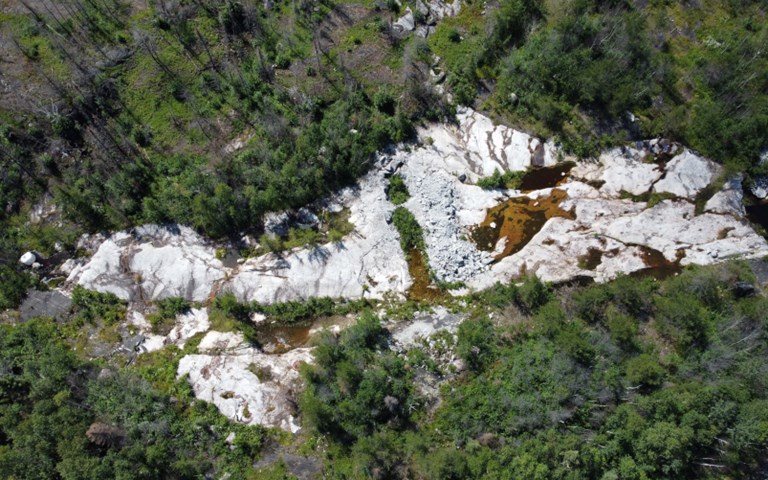
An aerial view of Pan American Energy’s Big Mack lithium project in Ontario. Courtesy of Integral Metals
Mineral exploration has always been a high-risk venture, and it is becoming even riskier now as new mineral deposits grow harder to find.
Before exploration drilling begins, exploration teams conduct a battery of surveys—from geophysical imaging and geochemical sampling to remote sensing and satellite mapping—to improve the odds of finding mineral deposits underground.
In the search for the next frontier in resource detection, mineral prospectors are turning their attention to microbes and DNA sequencing.
At the University of Regina’s Institute for Microbial Systems and Society (IMSS), co-founder Andrew Cameron and his research team are delving into how microorganisms could be used to reveal where mineral deposits are located and help to prioritize areas for future drilling.
This field of study, known as geomicrobiology, looks at the microbial communities that live in soils. Mineral occurrences often interact with the surrounding soil and rock in ways that can influence local microbial communities. Current research is focused on understanding whether such relationships exist and how they might be applied in exploration, explained Cameron.
By sequencing the DNA profile of those microbial communities with the use of modern genetic and genomic technologies, researchers at IMSS can map microbial species and communities over geological data to begin to infer what minerals may lie in the subsurface and where.
Real-world field sampling
The concept of using microbial communities in soils to help detect mineralization underground has been circulating in academic communities for some time, with early studies going back to the 1980s.
But for Cameron’s research laboratory, the opportunity to do a large-scale field test for the first time came about in May 2024, when IMSS partnered with junior mineral exploration companies Pan American Energy Corp. and Integral Metals Corp. to conduct a comprehensive field prospecting and sampling program. The first half of the program focused on Pan American’s Big Mack lithium project, about 80 kilometres north of Kenora, Ontario, while the second half focused on Integral’s Burntwood rare earth element (REE) project, about 115 kilometres northeast of Flin Flon, Manitoba.
The research project, titled “Geomicrobiology for detecting rare metal deposits,” aims to determine whether microbial communities can help generate drill targets for lithium-bearing pegmatites and REE-bearing carbonatites.
As part of the field study, IMSS sent a team of eight students from the University of Regina to collect a wide range of samples across the Big Mack and Burntwood projects, including soil microbiology, soil chemistry, rock chemistry and vegetation chemistry.
“The dataset was highly multi-faceted,” said Jared Suchan, vice-president of exploration at Integral Metals Corp. and technical advisor for Pan American Energy Corp.
The goal, he explained, is not to position geomicrobiology as a standalone solution, but as an additional tool to help refine exploratory drill targets and eliminate potential false positives and negatives in geochemical and geophysical datasets, in order to narrow down the highest-ranked spots that would most likely yield the best mineral results.
“Geomicrobiology is not going to be a silver bullet that replaces traditional exploration methods, but it could be that extra tool in the belt,” Suchan said. “If you’re already out there [collecting] geochemistry samples, maybe you should take an extra sample and test the microbial species in the soil, in addition to testing everything else.”
The Big Mack and Burntwood projects were selected as the sites for this early geomicrobial study because they offered controlled testing grounds where explorers already had an idea of mineralized areas due to previous exploration efforts.
“This is important when moving to a new commodity or a new terrain,” explained Suchan. “Having some spots where you have an idea of what is there, and then profiling the microbial communities in proximity to lithium-bearing pegmatites or REE-hosting carbonatites.”
The team deliberately took samples both on top of areas of known mineralization and in areas where they were “pretty darn sure” none existed.
Establishing this contrast, which Suchan described as the “calibration” step, is essential when working with microbial data. This is because while data from traditional surveying, such as from geochemical surveys, is limited to the elements on the periodic table, microbial datasets can be enormous.
“The database is huge. There is a lot of power in that, but it’s also overwhelming if you don’t know what you’re looking for,” said Suchan. “The calibration stage was really important and that was one of the reasons we picked Big Mack and Burntwood as places to start.”
In total, the team collected over 5,000 samples; this included 1,742 soil samples, 1,101 rock samples and 501 plant samples collected for geochemical analysis, and 1,741 soil samples collected for geomicrobial analysis.
Sequencing in the lab
The soil samples, which were homogenized into capsules weighing approximately one gram each, arrived at the IMSS laboratory in electric coolers to preserve biological content. Next, they were frozen and then bead beaten—a process that involves placing the sample and small beads in a tube and rapidly shaking it in order to lyse the bacterial and fungal cells and release their genetic material from the soil.
Researchers then extract the pure DNA from the microbial community contained in that single gram of soil. From there, the sample can be run under one of two DNA sequencing approaches to identify which species are present.
The first is a technique called metabarcoding, which amplifies and sequences a single specific gene shared by all bacteria, explained Cameron. This gene acts like a barcode, allowing researchers to identify the different species in the sample and their relative abundance.
Metabarcoding can reveal patterns such as a species that likes to be in soil near lithium-bearing pegmatites or one that consistently avoids lithium-rich environments. “Both of those are very revealing,” said Cameron. By tracking these patterns across hundreds of samples, he said, “we can get these really nice heat maps across the landscape of where a species of interest is enriched or depleted.”
The power of the dataset goes beyond individual organisms, he added. Each soil sample also provides researchers with a community profile that is its own biological system and entity.
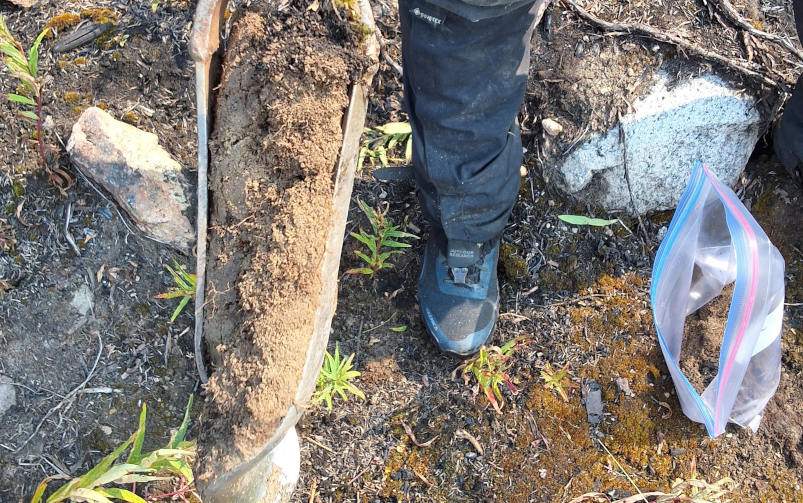 A team of students from the University of Regina collected soil samples across the Big Mack and Burntwood projects. Courtesy of Pan American Energy
Cameron explained that as better statistical tools and more machine-learning capabilities are developed, researchers can look not only for species linked to certain minerals, but for entire microbial community structures that correlate with specific soil types or minerals. “It is actually the community and how it functions together within that gram of soil that is the most informative to us,” he said.
The second sequencing technique the IMSS lab performs is called metagenomics. It takes a broader approach where researchers sequence all the DNA in the sample, which includes everything from the bacteria to viruses, fungi, plants and roots.
While metabarcoding is better for pinpointing specific species, said Cameron, metagenomics allows researchers to look for genes that have known functions within that soil sample—for example, genes for particular metal tolerances.
By sequencing all these fragments of genes, “we can start to put together a functional picture of what that community of bacteria and fungi is doing, their many metabolic activities, and begin to predict relationships between organisms,” explained Cameron.
With such large datasets, machine learning can help to detect patterns across hundreds of soil samples that humans might miss.
“We can ask the computers to look for patterns in the soil that we’ve collected that may correlate with certain chemical features that we’re interested in,” said Cameron. “That will provide even more predictive power. The research aim is to develop the predictive ability to say that if a sample has these sets of enzymes, these species and this community profile, there’s a high probability that there’s something of interest to folks in [mineral exploration] either in or underneath that soil sample.”
Industry and academic partnership
Both Cameron and Suchan recognized that projects like the geomicrobiology research project at Big Mack and Burntwood would not be possible without academia and industry working together.
Cameron noted that early-stage research often struggles to secure funding.
“When you’re trying to figure out things that are new, there’s not a lot of start-up monies within the federal funding system,” he said. “But the minute you can get an academic-industrial partnership like this, then there are certainly greater pots of funding that can be deployed.”
The collaborative research project received a total of $828,700 in 2024 and 2025 through the Alliance Advantage Grant from the Natural Sciences and Engineering Research Council of Canada, which included approximately $82,000 from Mitacs Accelerate.
Meanwhile, for Suchan, the value in working with academic institutions comes from the freedom to experiment.
Mineral exploration, he said, is not always quick to adopt new branches of science. “Geochemistry and geophysics are the tools people use, but there’s this whole untapped area where geology and biology intersect,” he said. “As a junior exploration company, we’re not able to have the resources to bring on biologists, to get all the equipment and to trial a new idea, but in partnering with academics that have everything, that is amazing.”
In addition, Cameron pointed out that another draw for him as a researcher was the scale of testing that partnering with industry affords.
Microbial ecology has refined DNA sequencing techniques for decades, but tests are typically only done on a few dozen samples at a time, said Cameron. The Big Mack and Burntwood field programs, in contrast, brought hundreds of soil samples and the opportunity to access more data to make better models.
“The rise in computational capabilities makes this ever more exciting because we’ve got three great things coming together: rapid acceleration of our genetic capabilities, the need for more mineral exploration and the ever-improving computer capabilities to deal with this type of complex data,” added Cameron.
The road ahead
Geomicrobiology provides a novel approach to mineral exploration, and while much of it remains unknown, Cameron and Suchan think it is that uncertainty that makes it exciting for both industry and academia.
The research team is still in the process of analyzing the datasets from the Big Mack and Burntwood field programs. “There’s such a tremendous amount of data to incorporate, including bringing in data from previous exploration activities on the projects,” explained Suchan.
They plan to publish their findings in the future, as well as evaluating new opportunities to test the geomicrobial exploration method for new commodities and in new locations, as the field will need to advance through repeated testing in different regions and deposit types.
“We don’t know if the same microbial species will work at every project—probably not,” said Suchan. “We need to keep doing new projects, [testing] new places [and] new variables [because] the more we do it—whether it’s for diamonds in the Northwest Territories, lithium in Ontario, REEs in Manitoba or uranium in Saskatchewan—the more it’s going to become not just this special niche thing we’re trialling in this industry-
academic partnership, but maybe [it could] start to become something usable and tangible.”
One advantage to geomicrobial surveying, he added, is how easily it can be baked into existing field programs. Collecting a soil microbiology sample is “just one more sample,” which requires only some additional equipment to preserve the sample as well as protocols to prevent cross contamination.
The inclusion of a whole other dataset to more accurately understand what is in the Earth’s subsurface can have substantial benefits. “If we can reduce the number of holes and trenches that are required [for mineral exploration], it’s cheaper, better for the environment, better for stakeholders and rightsholders—a win for everyone,” said Suchan.
Another strength is that the fieldwork itself is straightforward. Suchan pointed to the sampling programs at the Big Mack and Burntwood projects, which trained some first-time-in-the-field university students to collect the samples. “Despite the back-end complexity, the front-end data collection [is something] almost anyone can do with a bit of training,” he said.
As the field of geomicrobiology matures and more data is collected, Suchan said he hopes to see large-scale microbial databases emerge that would allow a researcher heading into a greenfield to know which microbial species they should or should not expect to see without having to run a fresh calibration study each time. Or, he added, he would like to see the development of rapid, in-field testing systems for certain commodities or regions for quick results.
“This is a whole other partnership between biology and geology—it’s all very new, but I think there are some big leaps that we can make the more that we do it,” said Suchan.