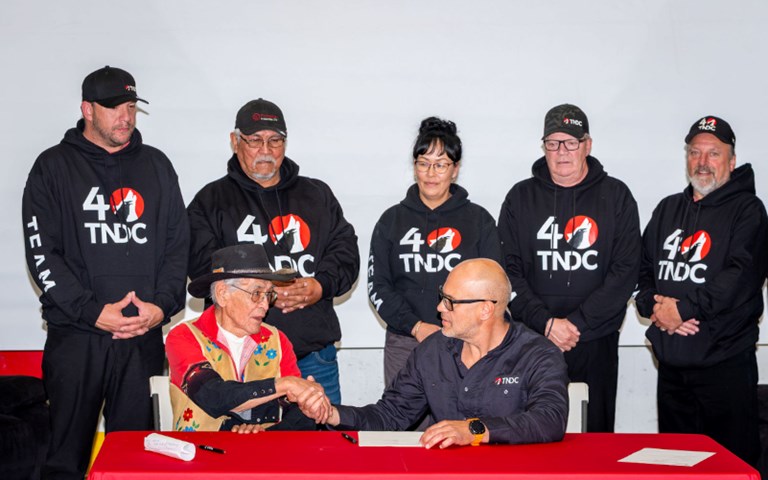
Front row, left to right: Tahltan Elder Representative Pat Etzerza and TNDC CEO Todd den Engelsen. Back row, left to right: TNDC joint support team representatives Dean Dejong, Clarence Quock, Crystal Dennis, Mark Luyben and Larry Amero. Courtesy of the Tahltan Nation Development Corporation
From humble beginnings in residential construction, the Tahltan Nation Development Corporation (TNDC)—the business arm of the Tahltan Nation—is celebrating 40 years of creating locally rooted employment and career development for its community while supporting mining projects within its territory.
Launched in 1985 as an Indigenous-owned non-profit society and jointly owned by the Tahltan Band, the Tahltan Central Government and the Iskut Band, TNDC was created to ensure the Tahltan Nation benefits from responsible development across its roughly 95,933-square-kilometre territory in northwestern British Columbia.
By 1988, TNDC had expanded into heavy civil construction services for resource development and mining, investing approximately $3 million in equipment. Later that same year, the company secured its first mining service contract at the past-producing Golden Bear gold mine, about 100 kilometres west of Dease Lake, delivering road construction, maintenance and earthworks services.
“I think one of the underlying values…of the Tahltan people is that they want to sovereign stewardship over their own land and future,” said Todd den Engelsen, who became CEO of TNDC in January 2024 and who is himself Métis. “They want to be the ones performing the work [on their land], so that’s an underlying value of self-reliance and self-determination that’s existed right from the beginning, when 40 years ago, [the founders of TNDC] said, ‘What if we build our own homes instead of having Indian Affairs or others build our homes?’”
Over the years, TNDC has provided a wide range of services across multiple mining projects in the region, including road construction, mining equipment maintenance, camps and catering, logistics, site reclamation and land development, and aviation and airport services offered through a partnership with Central Mountain Air and the Executive Flight Centre. Projects the corporation has been or is involved in include Newmont’s Red Chris and Brucejack mines, Skeena Resources’ Eskay Creek Revitalization project, and the Galore Creek project, jointly owned by Teck Resources and Newmont.
Den Engelsen recalls that, despite some “pretty tight times when TNDC was financially strapped” as it expanded from housing construction into mine-related services, and alongside other challenges over the years—such as equipment costs, the seasonal nature of exploration work and unpredictable fluctuations in commodity prices affecting the mines TNDC serves—the company and its employees have remained resilient.
“Being the nation’s business arm, we want to ensure that we’re not just building jobs, but that we’re building careers, and that we’re also involved in long-term infrastructure projects that will pay dividends for generations to come.”
From training to opportunity
Den Engelsen highlighted how TNDC reinvests the revenue it earns from contracts not only into community infrastructure—such as upgrading recreation centres and the local airports, but also into programs that train and retain local talent. He emphasized the importance of these training and career development opportunities, noting that the corporation aims to equip employees with skills that are “portable anywhere they want to go,” while also prioritizing the retention of local talent.
One of TNDC’s most significant initiatives supporting local employment is its Heavy Equipment Operator (HEO) program, launched in 2023 as a three-year pilot, with partners including TD Bank, Newmont and Finning. The program, which provides hands-on training and career opportunities for Tahltan community members, was recognized with the 2024 Robert R. Hedley Award for excellence in social and environmental responsibility from the Association for Mineral Exploration.
The HEO program offers three levels of training designed to develop local Tahltan talent in operating equipment safely and efficiently, with the long-term goal of preparing residents to handle more complex machinery. Participants gain hands-on experience at mines such as Red Chris within Tahltan Nation territory, enabling local residents to build careers close to home.
Den Engelsen explained that the program is unique because two TNDC employees travelled to Caterpillar’s Tinaja Hills Demonstration and Learning Center in Tucson, Arizona, where they earned Level Two operator certification on hydraulic excavators and track-type tractors—training typically reserved for Caterpillar employees. This specialized training enabled the two TNDC employees to return home to their community and pass on their knowledge to train other instructors in the HEO program.
“This was the first time that [Caterpillar] brought in non-Caterpillar employees who ended up with training certification,” den Engelsen explained. “It’s a nice feather in our cap and in theirs, so we’re pretty proud of it.”
Last year, as part of the HEO program, TNDC partnered with Finning—one of Caterpillar’s Canadian dealers—to launch a mobile training centre at the Red Chris mine. Housed in a 44-foot trailer, the centre features four simulators that provide comprehensive training on articulated trucks, dozers, loaders and excavators, giving inexperienced or new participants a safe, virtual environment to develop their skills on Caterpillar equipment. Each year, the centre trains 80 to 120 TNDC staff, supporting both the development of new operators and the upskilling of current employees.
Beyond its HEO program, TNDC is a year-round employer, continually seeking individuals for their roles such as heavy-duty mechanics, welders and more. The organization also offers mentorship training for senior heavy equipment operators through a two-day course that covers HEO and mining competencies, along with effective strategies for communicating with new learners.
This skills-focused approach reflects TNDC’s broader commitment “to coach, develop and help you in your career,” said den Engelsen. “We want you to enjoy where you’re working. TNDC wants to be the employer of choice that attracts employees who are willing to work with excellence and work respecting the Tahltan culture.”
Strategic partnerships
At Newmont’s Red Chris mine, operations are guided by a close partnership with the Tahltan Nation through an impact benefit and co-management agreement, ensuring Tahltan expertise, perspectives and values shape decision making. Through this partnership, TNDC delivers key services such as heavy equipment operation, logistics and infrastructure support that are integral to the mine’s success. TNDC is the primary contractor at the Red Chris Mine supporting tailings storage facility construction, block cave project development, mill operations, site services and exploration teams, and providing road maintenance.
“Around 220 Tahltans work at Red Chris, and I think it’s worth noting that [this partnership] generates almost $100 million annually in business with the TNDC,” said John Mullally, head, external relations and social performance at Newmont. “Working with [the TNDC] means you’re also working with an entity that has a development objective as well and that there’s a redistribution of profits [that go back] to the nation.”
Mullally added that, over the years, TNDC’s work at Red Chris has helped attract new talent and bring more people into the business, creating a ripple effect where Newmont has benefited from increased skills, participation and employment at its mines.
Coinciding with TNDC’s 40th anniversary, Newmont celebrated the 10th anniversary of operations at Red Chris in May, committing $8 million to support community well-being across Tahltan Nation territory. The investment is funding projects such as community-use spaces, recreation facilities and other local initiatives, with a portion dedicated to planning and pre-development work to improve housing in Telegraph Creek, Dease Lake and Iskut.
“Indigenous participation in the natural resources sector is foundational,” said Mullally. “It’s absolutely critical that decisions are incorporating traditional knowledge and that the financial benefits and employment are made available to the nations [involved].”
While partnerships like those with Newmont showcase TNDC’s operational expertise, the Tahltan Nation is also thinking beyond mining sites to key infrastructure that supports both local communities and the transportation of critical minerals.
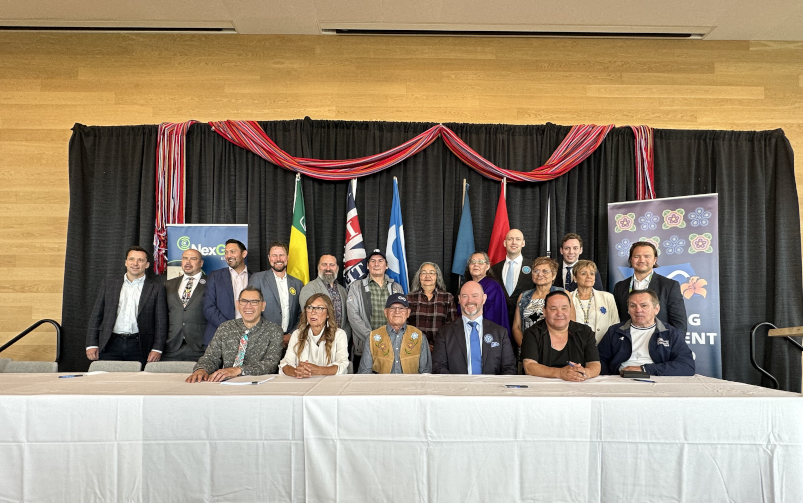
On Aug. 25, the TNDC and the Nisga’a Nation, in partnership with Arrow Transportation, announced the formation of the Portland Canal Holdings Limited Partnership. The joint venture completed the acquisition of the fully permitted Port of Stewart bulk terminal, which is currently undergoing an expansion, on Sept. 28. The acquisition is the first in B.C.’s history where Indigenous nations will own and operate a deep-sea port terminal.
According to TNDC, this joint venture will strengthen the nation’s role in regional commerce and global trade, including serving as a key shipping point for copper concentrate from the Red Chris mine. The acquisition is supported by a $5 million grant from the B.C. government.
“At the Portland Canal Group, we will leverage Arrow’s internal training and development programs to ensure Tahltan and Nisga’a participation not only in the workforce but also in management and oversight roles,” said Darrell Remple, regional manager of Arrow Transportation. “The long-term outcome will be sustainable careers across operations, administration, and leadership, ensuring that Indigenous communities share directly in the growth of the regional economy.”
TNDC views the port acquisition as a strategic milestone, providing the Tahltan Nation and its partners with direct access to Asian markets while fostering greater community participation in the terminal’s operations.
In addition to the port acquisition, Arrow Transportation is consolidating its Stewart Trucking Division with the Tahltan-Arrow Transportation Limited Partnership to launch a new transportation business as part of Portland Canal Holdings limited partnership, with the aim of “enabling smoother, more efficient movement of materials,” said Remple. With this consolidation, Remple noted that mining companies will see immediate benefits from a unified workforce, greater market stability, and better information flow across their supply chains. Beyond these operational efficiencies, the partnership is also focused on building capacity within Indigenous communities, ensuring that the workforce benefits extend beyond day-to-day operations to include training, leadership and long-term career opportunities.
“One of the key messages that we want to get out to government and to other stakeholders is that the Tahltan and Nisga’a Nations and our partners are here to run a safe and efficient business that respects Tahltan values, while respecting responsible investment principles,” den Engelsen said. While TNDC is business-minded, he added, the priority is to ensure that the region benefits from agreements like this and that resource development grows responsibly, with careful consideration for local communities and the environment.