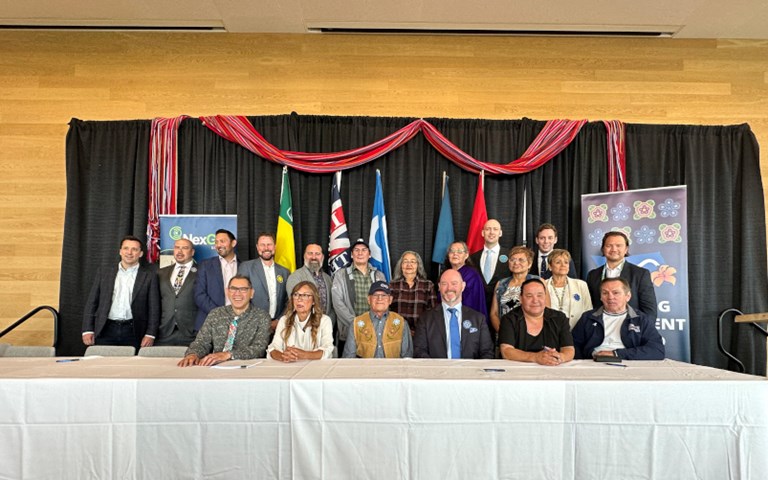
In 2023, an impact benefit agreement was signed between Métis Nation-Saskatchewan (MN-S) and NexGen Energy for the Rook I uranium project. Front row, centre: MN-S president Glen McCallum and NexGen Energy CEO Leigh Curyer; far right, Northern Region II regional director Leonard Montgrand. Back row, far right: NexGen chief commercial officer Travis McPherson. Courtesy of Métis Nation–Saskatchewan
For Métis communities in Northern Region II (NR II), a remote and resource-rich area in northwestern Saskatchewan, the 2023 impact benefit agreement (IBA) with NexGen Energy for the Rook I uranium project represents a historic milestone. According to Métis Nation-Saskatchewan (MN‑S), it is the largest IBA of its kind in Canada, both in terms of geographic area and the number of communities involved.
MN-S is the governing body that represents Métis citizens across Saskatchewan through an elected representative system at the local, regional and provincial level. It is divided into 12 organizations, including NR II, which is the primarily impacted Métis group within the local priority area for the Rook I project. Within NR II, there are seven community-level units of government called locals. These locals function as governance bodies representing Métis citizens in their area, and the elected presidents of the locals, together with the regional director, form the NR II regional council.
Leonard Montgrand, the regional director of NR II, regards the Rook I IBA as a milestone for both his region and the broader Métis Nation, as all seven locals came together during the consultation and engagement process under a “One Voice” approach to define negotiation objectives as a unified region—a model not often seen in IBA negotiations. MN‑S provided support throughout the process to ensure all participating Métis locals’ interests were represented. This model, said Montgrand, is meaningful for members of NR II, as it ensures their region’s decisions remain in their own hands, and it allows them to have a direct say in how their communities will benefit from and participate in the Rook I project.
“We as a region know that at all times we are in charge and that there’s no interference from outside sources, so for that, MN-S has done a great job,” he said.
Montgrand recalled that several years before the negotiations with NexGen for Rook I began, an oil company had approached NR II about a project on their traditional lands. At the time, NR II “didn’t really get [many benefits] because we weren’t as organized as we should have been” during the consultation process, he noted.
This earlier setback became a turning point, prompting the community to strengthen its approach and prepare more intentionally and cohesively for potential future negotiations.
Montgrand explained that when NexGen first approached NR II about the project, “MN-S president Glen McCallum knew that the duty to consult was a great need in our communities, especially in the North, so [MN-S] reached out and helped us to start the process,” adding that a key step was MN‑S providing the region with funding to retain legal counsel.
“From that [first experience] to where we are today is a great accomplishment,” said Montgrand. “A lot of hard work went into the whole process, and [we received] a lot of support from MN-S,” adding that “NexGen has been a good proponent, and as far as our Métis region goes, this is probably the best IBA we’ve ever signed.”
While the full scope of the IBA benefits remains confidential, the agreement is intended to foster lasting economic opportunities for NR II and promote environmental stewardship on traditional lands. It confirms continuous engagement with the nations through all phases of the project, including reclamation, and includes commitments to training, employment and business opportunities for Métis individuals, as well as established processes for ongoing consultation on environmental and social issues, human resources and the provision of tools and resources to help protect their lands.
Further, it reinforces NR II’s and MN-S’s support and consent for the Rook I project throughout its full life cycle.
Montgrand noted that since there have not been a lot of resource development opportunities for NR II, community members are particularly excited about the employment opportunities this project will generate.
Rook I is projected to create around 350 on-site jobs at peak construction and about 490 direct positions during operations, with a majority of the workforce expected to come from local communities.
Beyond employment, the IBA also opens the door for broader community development initiatives.
“We have many infrastructure [projects] that we’d like to put up in the communities, like a long-term care home and an addiction centre, along with more [social] programs that our citizens can use,” Montgrand said, adding that NR II is committed to ensuring all of its community members benefit from these opportunities and that no one is left out of the process.
Project overview
According to NexGen, the Rook I uranium project is the largest development-stage uranium project in the world. The site of the proposed underground mine and mill is in the southwestern Athabasca Basin and centres on the Arrow deposit, which hosts measured and indicated mineral resources of 3.75 million tonnes containing 256.7 million pounds of uranium at an average grade of 3.1 per cent.
According to the company’s 2021 feasibility study, the project is expected to produce an average of 28.8 million pounds of triuranium octoxide per year during its first five years, with an average life-of-mine production of 21.7 million pounds per year. The estimated mine life is approximately 10.7 years, though the company is seeking approvals for an initial 24-year operating life.
In 2023, NexGen received provincial environmental assessment approval, and in January 2025 the Canadian Nuclear Safety Commission (CNSC) confirmed its final environmental impact statement. The company has already participated in the first part of the public CNSC hearing in November, with the second and final hearing scheduled for February 2026 to review the project’s licensing, marking what will be the final stage of a review process that began in 2019.
If the second CNSC hearing results in final approval in early 2026, the project could start production by mid-2030. All engineering and procurement is ready for full-scale construction, and in October, the company closed a global equity offering that raised approximately $950 million to fund engineering and pre-production at Rook I. This capital is expected to carry the project nearly halfway to completion.
Investing in communities
Travis McPherson, chief commercial officer at NexGen, said that it was important for the company to provide these communities ample time during the IBA negotiation process to consider the agreements and to “work with them to develop the capacity, the partnerships and the training so that they can be as successful as possible.” He added that it is crucial to do this on a transparent, ongoing basis with the leadership and economic development arms of the communities living in proximity to the project site.
McPherson explained that the IBA signed with the MN-S communities, including NR II, was a “natural progression of an already organic relationship,” which began in 2013 prior to exploration commencing.
The company has actively engaged with the communities through several initiatives, such as a scholarship program, which began in 2017. The program assists local Indigenous high-school students without a primary source of funding for their post-secondary careers. In September 2025, NexGen announced its largest-ever scholarship initiative, awarding eight scholarships for the 2025-2026 academic year, bringing the total number of students supported since the program’s inception to 38.
In addition, NexGen has supported local communities through a breakfast program, in partnership with the Breakfast Club of Canada, providing healthy meals to Indigenous students while creating employment opportunities for local cooks. The company has also launched a summer student program for local Indigenous youth, offering two streams—high school and post-secondary—where participants gain hands-on experience in a variety of on-site roles at Rook I, including camp maintenance, accounting and surveying.
Once the Rook I project is up and running, NexGen plans to build on these established initiatives, with McPherson noting that these initiatives will “go to orders of magnitude greater when we start constructing and operating this mine, but it’s the same principles and the same foundation.”
He added that an important aspect of the IBAs—signed not only with the MN‑S communities but with all four of the primarily impacted Indigenous communities—is that they include provisions that extend beyond the life of the Rook I project, helping to foster long-term economic development in these remote regions.
“When the mine is closed several decades from now, there’s absolutely no reason why a thriving economy up in this area shouldn’t and won’t exist,” McPherson said. “We have this opportunity to positively impact thousands of lives and drive generational change through partnerships with these communities, so that’s something we’re all extremely excited about.”