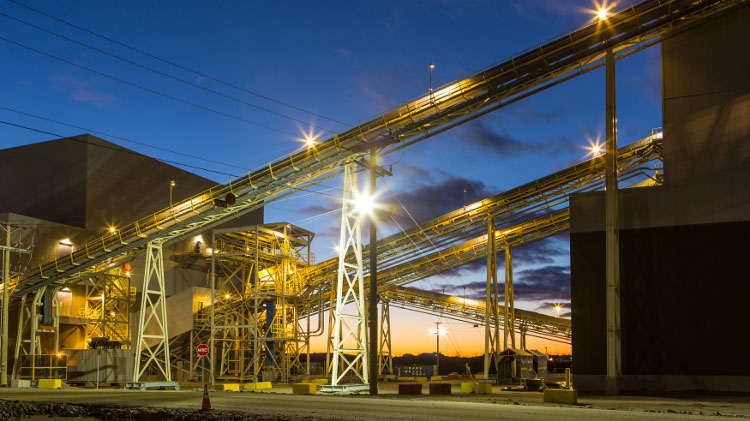
The 2025 tour group at Iamgold’s Coté Gold open-pit mine. Courtesy of the Ontario Mining Association
C
anada’s growing mining industry will need more than 135,000 new employees over the next decade, according to the 2025 Mining Association of Canada report, The Mining Story—Canadian Mining Industry Facts and Figures, and there may not be enough new graduates to replace retiring skilled and experienced employees.
This need has led to a number of initiatives designed to encourage young people to consider careers in the field. For example, the Mining Industry Human Resources Council (MiHR), in partnership with CIM, launched the Career Ambassador Program in 2022, which connects industry representatives with schools and youth groups to raise awareness of the opportunities in mining. The two organizations have also joined forces with PDAC to host virtual career fairs and create a website offering resources showcasing the many areas of the mining industry with available jobs. CIM and MiHR are also collaborating with the mining industry on a new initiative for 2026, the Mining Industry Experience Program (MiEX)—a two-week program where university students can get paid work experience at mine sites.
In spring 2025, the CIM Toronto Branch organized a student mine tour in Ontario in partnership with the Ontario Mining Association (OMA); plans are already under way for a 2026 tour. Applications were open to students enrolled in an engineering, earth science or environmental science program at an Ontario university, with priority given to third- and fourth-year students.
To support amplifying the experience to bigger audiences, the OMA documented the entire experience through its This is Mine Life (TIML) campaign. TIML is supported by both the federal and provincial governments and is designed to inspire young people to explore careers in mining, said Priya Tandon, president of OMA.
“Our core guiding principle is collaboration,” she said. “Recognizing that the CIM Toronto Branch was planning its annual student mine tour, we saw a perfect opportunity to partner—and fortunately, the CIM Toronto Branch team agreed!”
The two organizations gave 11 students the opportunity to get a first-hand look at the world of mining. The four-day tour of Ontario mine sites provided glimpses into many facets of the industry; the students even spent a night in a mining camp, and the OMA filmed it all to make videos. The resulting video series has been used across classrooms, career events and social platforms to encourage young people to learn more about modern mining and the range of careers it offers.
The tours give students a new perspective on mining, noted Alessio Scurci, teaching lab and field coordinator at the University of Toronto’s earth science department and chair of the CIM Toronto Branch, who organized the 2025 excursion. “There are so many misconceptions about the mining industry; you’ll mention mining to someone, and they’ll see it as a dirty industry [that is] very unregulated,” he said. “But the narrative has changed significantly from ‘an old pickaxe, this is how we do it’ to autonomous technology using artificial intelligence (AI) and simulations. We at CIM Toronto Branch really want to help change that narrative by providing these tours where possible. Along with the OMA’s help this year, we were able to film videos to provide students [who couldn’t be on the tour] with that knowledge, as well as to be used in the external curriculum.”
Scurci pointed out that, especially post-Covid, many students do not get real-world experience of mine sites. “Unless [a student] gets a summer internship, it’s extremely hard to get that hands-on experience, to really understand if this is the career path for them,” he said. “It was a trip to help them dip their toes into what they can expect from a career in mining.”
Tandon agreed, noting that the OMA hears repeatedly from students that they want access. “For instance, a recent encounter with engineering students at the University of Toronto revealed that the biggest thing they want is access to the mines,” she said. “They want to understand what it’s like to work and live on a mine site before committing to a career in mining.”
That goes for students of all genders, she added. “Our tour included five women and six men, so there is clear interest among young women in entering the field. A crucial factor is their ability to see themselves in the industry, which is why strong role models are so important—and we’re fortunate to have some outstanding ones.”
Scurci noted that he tries to encourage the female students from CIM student chapters towards mining and to help them understand that this could be a career for them too. “I really wanted to highlight that there are spots available for them to understand this industry more,” he said.
The agenda
The 2025 tour took the students first to mining contractor Redpath in North Bay, where they visited its workshops and learned about some of the machinery from skilled trade workers, as well as about the importance of the service and supply sector to the industry.
From there, they went to the NORCAT Underground Centre in Sudbury, where they underwent a training session, then donned personal protective equipment and toured the company’s training mine. After that, it was back to the classroom for some demonstrations of NORCAT’s use of virtual reality in mining technology.
Their next stop was Vale’s Coleman nickel and copper mine, where the students met the head geologist and went over 1,300 metres underground for a tour, followed by conversations with workers about how they began their mining careers. The day ended with a tour of Vale’s nickel refinery.
The final destination was Iamgold’s Côté Gold mine near Gogama, where they had a look at how an open-pit mine works, checked out the control room where employees manage the mine’s autonomous trucks, and had the opportunity to stay overnight in the mine camp to experience camp life for the first time.
As well as visiting mine sites, the students spent time at Laurentian University’s Centre for Research in Occupational Safety and Health, which conducts research to solve health and safety problems, and heard from Nadia Mykytczuk, executive director of the Goodman School of Mines at Laurentian University, who explained her work in extracting resources from tailings.
All in all, said Scurci, the tour did not just deal with mining operations. “It was dealing with the financial aspect of it, the AI aspect [and] the environmental side of the industry,” he said. “It encompassed everything that students might not have thought about originally and opened their eyes to different career pathways within mining.”
Interest has exploded
According to the OMA, through its TIML social media channels, the videos of the tour have generated more than 500,000 views, driving over 500 new followers to the campaign’s Instagram account, extending the impact of the experience to students, educators and jobseekers across Ontario.
Scurci said that while he originally had a hard time recruiting the student groups for the 2024 tour, the word has spread, and there has already been a lot of interest in the 2026 tour. “It’s absolutely exploded,” he said. “Since the [2025] tour ended, I’ve had at least 30 students come up to me at our [CIM Toronto Branch] luncheons to ask, ‘How can I get on the next tour? I’ll do anything to get on this tour, because I want that experience.’”
As a result, Scurci said the selection process will need to be changed for the 2026 student tour. “We’ve historically prioritized the third- and fourth-year students who are looking to graduate and don’t have that field experience,” he said. “We’re trying to sway away from first and second years that are just starting in the program, that are undeclared majors, as they might change their career path. We really want to focus on the ones that can see this as a potential career.”
There are always exceptions, of course. One second year student of mineral engineering at the University of Toronto, Joaquin Escudero, whose professor had recommended he be included in the 2025 tour, shared his experiences; even seven months later, his excitement was palpable.
The highlight for him was going underground at the Coleman mine. “It took around three minutes going down, and it was the best,” he said. “The first glimpse of being underground was really, really breathtaking. Because when you think of an underground mine, you always think of this confined, small place underground, but it was so big, and the air was so pure, you couldn’t even tell that it was underground.”
He was also fascinated by the autonomous trucks and other technologies. “After seeing all these innovations that we had learned about in class but had not seen applied first-hand in an operating mine—especially the LiDAR system and all this technology being incorporated through autonomous vehicles—I’ve been really keen,” he said. “I recently enrolled myself into an AI minor to accompany my mineral engineering major, because I think it’s really important in mining. I think having a bit of knowledge in that sector would better prepare me for the future.”
Nicolás Oré, also a second-year mineral engineering student at the University of Toronto, echoed Escudero’s excitement. “It was my first time seeing real operations live. This appealed to me because I had the opportunity to observe the processes and machinery I had only seen in a slideshow before,” he said. “It’s a feeling similar to seeing your favourite sports team live for the first time. It was the perfect way to cap off all the things I learned in the classroom that month.”
He was surprised by the breadth of opportunity there is in the field. “It is not only restricted to geologists and mining engineers. Many of the employers we visited explained how they would often recruit chemical, mechanical, electrical engineers for things like mineral processing, fleet maintenance, and so on,” he said. “It’s quite intuitive when you think about it, but for whatever reason it’s something I hadn’t realized until then. Now, I realize a career in mining is possible with different degrees, so I am more open than ever to exploring new areas rather than enclosing myself in a box.”
And that, said Scurci, is the effect he wants the mine tours to have on the students.