

The defence perspective Canada’s Defence Industrial Strategy could change the landscape for financing critical minerals projects

In February, Prime Minister Mark Carney launched a sweeping Defence Industrial Strategy, pledging $6.6 billion to ensure that Canadian industry plays a central role in rebuilding the country’s military.
The funds come from the $81.8 billion the federal government set aside for defence investments in its 2025 budget and will be used to strengthen Canada’s defence industrial base to secure long-term national security and economic prosperity.
However, the strategy could do more than strengthen Canada’s military; by creating long-term demand and government-backed purchasing, it could reshape how critical minerals projects are financed.
Among the strategy’s five pillars is building critical minerals supply chains by bringing forward plans to expand production, processing, procurement and the stockpiling of critical minerals. Canada produces 10 of the 12 raw materials identified by NATO as defence critical, including aluminum, gallium, germanium, graphite and tungsten.
“Canada is entering the most significant period of defence investment in decades, and the mining industry should start paying attention,” said Marc Caroll Dupuis, senior defence advisor to Ottawa-based management consultants Arctech Accelerate. “The companies that recognize this shift today will be better positioned to capitalize on the opportunities that emerge over the next decade.”
Why defence money matters
The support will be important for developing critical minerals projects, some of which are perceived as riskier than other metals and therefore are harder to finance.
Many critical minerals do not have deep or transparent pricing markets. They may be thinly traded or non-exchange traded, with limited hedging tools, modest volumes, opaque pricing and highly specialized end-uses. They may also require complex processing or downstream refining before they are commercially useful.
“From a financing perspective, this translates into tighter terms, lower advance rates, additional equity requirements and, in some cases, infrastructure being financed alongside the mine, complicating capital structures,” said Carla Potter, a partner at Cassels Brock & Blackwell LLP, who has worked with mining companies for decades to get projects funded. “We’re viewing defence spend as a major stopgap and a major opportunity.”
Natural Resources Canada (NRCan) believes that defence-driven demand will shift how financial institutions and industrial players evaluate mining projects, moving beyond traditional price cycles and electric vehicle-driven forecasts towards a broader assessment of strategic value, resilience and alignment with allied supply chains.
“Banks and investors are increasingly factoring in demand certainty linked to defence procurement, as well as the presence of government-backed instruments such as offtake agreements and guarantees,” NRCan told CIM Magazine by email. This can reduce project risk by stabilizing future revenues and reducing exposure to commodity price volatility, helping move some projects into production that may have been difficult to get off the ground otherwise.
The toolkit includes stockpiling, loan guarantees and qualification requirements, NRCan said, and under the Critical Minerals Sovereign Fund the government can now enter into fixed-price offtake agreements, syndicated with allies, and secure access and stockpiling rights.
Coordinated allied action, including the G7 and the Critical Minerals Resilience and Production Alliance, is also moving the needle. The federal government has announced 69 partnerships and initiatives through the alliance since its launch in June 2025, driving $19.2 billion in capital investment for Canadian critical minerals projects.
Alison Manzer, a partner at Cassels Brock & Blackwell LLP, who has worked on project and infrastructure structured finance for nearly 50 years, said the mindset has already started to shift.
“I’m definitely seeing things starting to open up in terms of defence spend in the last four to six weeks and the acceptance of longer timeframes for delivery,” she said at a CIM seminar on April 29. “That’s because the fear of being unable to access these minerals in the supply chain is becoming absolutely rampant.”
Supply contracts with delivery timeframes of up to 18 or 24 months are not uncommon now. That is because defence industry players know they now have a lot of ramp room because this “defence boom” will have a good 10-year run, Manzer told CIM Magazine in an interview.
For miners, that means it is quite possible to start finding their defence offtakers now, she said, and in terms of raising money, contracts are and always have been king.
“Once you get contracts in place, it does get a great deal simpler to attract at least equity financing and, in many instances, the support of debt financing,” she said.
How miners can capitalize
To tap into the once-in-a-generation defence spend, mining company CEOs should start asking themselves which of their capabilities solve a problem that defence is trying to address; which prime/defence contractors should they know; how do their existing technologies align with Canada’s future defence priorities; and which companies can help them navigate the market, said Arctech Accelerate’s Dupuis.
Canadian miners already have significant expertise that can be useful to the defence sector, he said, and some technologies they use in mining could have dual-use applications, ranging from autonomous vehicles and artificial intelligence (AI) to heavy logistics and environmental monitoring.
“Modern mining companies operate some of the most sophisticated industrial systems in Canada” and have “operational expertise” that could be useful for defence, he added. For example, many miners have experience operating in remote Arctic environments, which aligns with Canada’s expanding investments in Arctic security and northern infrastructure, and they could also leverage their relationships with Indigenous communities as strategic partnerships.
Many technologies used in autonomous mining also align with defence modernization efforts. The Canadian Army’s MINERVA Initiative, for instance, is specifically focused on accelerating domestic development of autonomous and uncrewed systems while strengthening collaboration with Canadian industry, he said.
“Depending on their capabilities, mining companies may be able to become suppliers to Canadian or international defence prime contractors; establish strategic partnerships with technology companies, manufacturers or research organizations; support Arctic and northern infrastructure projects; expand into critical minerals processing and value-added manufacturing; leverage autonomous systems, AI and remote operations technologies for dual-use applications; access defence-related innovation programs and government funding and so forth,” Dupuis said.
One of the biggest things the defence industrial base will need in the North is energy resilience, such as batteries and magnets that can survive temperatures of minus 40 degrees Celsius, for example, and that can power a long-distance drone for 1,000 kilometres.
Dupuis also urged miners to familiarize themselves with Canada’s Industrial and Technological Benefits (ITB) policy, which can have a multiplier effect. Under the ITB, major defence contractors must undertake business activities in Canada equal to the value of their contracts.
Today, the ITB portfolio represents about $84 billion across 117 defence contracts, which supports more than 710 Canadian organizations, most of which are small and medium-sized businesses, Dupuis noted. This means opportunities may arise for mining companies not only through direct sales but through strategic industrial partnerships, innovation, processing technologies, automation, environmental solutions, infrastructure and participation in supply chains.
Mining companies need to think creatively about ways to capitalize and reposition themselves as suppliers, Manzer said. Ultimately this will help to lower costs, improve efficiencies and make it easier for the mining sector to raise financing.
The biggest thing mining executives are going to have to do is make sure that they are aware of where the defence spend is going, where the infrastructure projects are being built, particularly in the North, and what the possibility of piggybacking off them might be, she added.
If miners see that a transportation line is being proposed to go one way, for instance, and by moving it a couple of hundred miles the other way, a spur line could be built to access their critical minerals project, now is the time to suggest it, Manzer said. “Developing a spur line off a rail line is a great deal cheaper than building a railway or highway in the first place.”
The joint use of mining properties and facilities is another area that could help miners cut costs and help them to attract project financing. The armed forces need test ranges, places to fly drones without aviation controls and to blow things up, she said. If there are unused facilities on the mining property like housing, these could also be leased out.
Miners should also look closely at where private sector defence spending is going. Manzer sees most of the interest in projects she is working on coming from major investment banks, pension plans and family offices.
“Many critical minerals projects are going to exceed the scope of a family office, but they are not going to exceed the scope of a consortium of family offices,” she said. “They’re not coming together to invest in mining. They’re coming together to invest in defence. It has become a hot sector and as I say to some people, half-joking, defence is the next cannabis, and that means the mining industry needs to act more quickly and with knowledge of the opportunities to take best advantage of it.”
At the same time, technology developed for defence has been, and will continue to be, adapted for use in mining. If miners can identify defence technology that might assist them in reducing costs, they should make themselves customers or work on joint ventures and/or common share splits and sharing, Manzer said.
Remaining challenges
When this article went to print, the federal government had yet to flesh out specifics of the strategy, and the mining industry is eager for more details on how building out critical minerals supply chains can be achieved. One of the biggest unanswered questions is how Canada plans to expand domestic processing capacity.
“Traditionally we have been more ‘get it out of the ground, pile it up and ship it somewhere,’” Manzer said. “I think it’s going to be very positive for Canada as we start to work more effectively on the processing side.”
One of the things that must be addressed before more money starts flowing, however, is fixing the mixed messaging coming from the government and the banks. Defence has been difficult to finance because it is considered to be an area of reputational risk for the primary banks and still is, Manzer said.
“We still have the inconsistent message coming from the Canadian government that we need to increase the assistance to the defence and defence tech sectors, while at the same time, OSFI [Office of the Superintendent of Financial Institutions] has not given guidance to the banks on defence sector risk,” she pointed out. “Despite OSFI lowering the domestic stability buffer in June to free up some capital for the sector, without guidance the banks need to consider high risk allocation—including as to reputational risk—to lend into this sector, which is considered to be volatile and difficult. There needs to be some consistency developed and my guess is that it will occur very quickly.”
While many experts agree that government has a role in creating demand and reducing financing risk, there is less consensus on how far Ottawa should go in directly shaping the market.
Heather Exner-Pirot, director of energy, natural resources and environment at the Macdonald-Laurier Institute, acknowledged that the direction Canada is taking is positive and it is “following a pretty decent playbook.”
The trick is making sure it is “industry-led and government-enabled,” she said. “We aren’t going to do what China does. It’s important that we work in a free-market system.”
Some critical minerals are niche and are not major markets, she continued. “The reason why the market didn’t solve critical minerals gaps before is because they aren’t huge moneymakers. In a free market system, how do you get people to invest in products that likely won’t make money because they can’t compete with China?”
Moreover, the defence sector makes up a relatively small portion of critical minerals demand, she said, noting that most of the graphite Canada produces will be used in automaking.
“How do we get Volkswagen, Audi and Mercedes to buy Canadian graphite instead of cheaper Chinese graphite? Who is paying the difference in cost? Usually, we let the free market solve this.”
A priority should be greater coordination between Canada and its allies and in particular mining nations like Australia, so that governments do not subsidize the same minerals, she said.
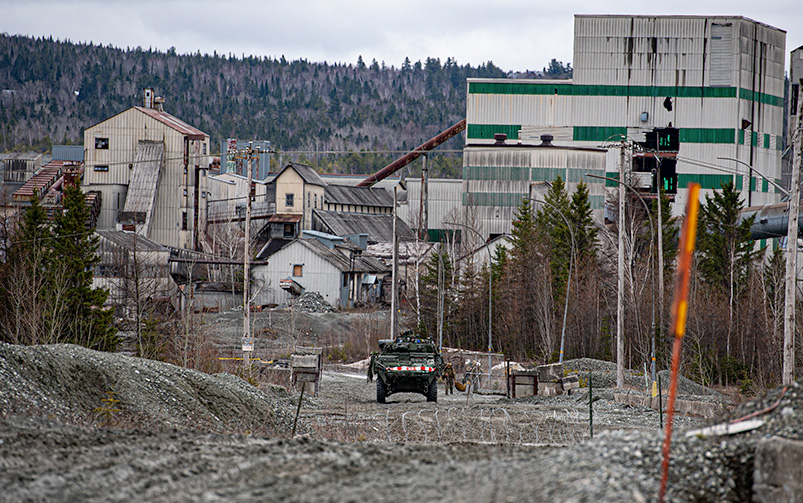 A major Canadian Armed Forces training exercise took place at former mine sites in Thetford Mines, Quebec, in April 2026. Courtesy of Corporal Juan Tornini, Valcartier Imagery Services/Canadian Armed Forces
Canada risks falling behind
While the Defence Industrial Strategy is a start, Canada is moving too slowly, especially when compared to countries like the United States, cautioned Ryan Castilloux, founder and managing director of Adamas Intelligence, a consulting firm specializing in critical minerals, metals and materials markets.
“Canada remains flat-footed in terms of laying out and executing a strategy that is going to leverage the vast critical minerals resources we have in the ground,” he said. “Canada is doing a lot of talking and thinking about what should be implemented, but there aren’t a lot of bricks being stacked.”
By contrast, the U.S. government has been directly investing in and choosing domestic champions and pushing them to ramp up production and supply.
The U.S. Department of War, formerly known as the U.S. Department of Defense, acquired a 15 per cent stake in MP Materials, the largest rare earth elements producer and rare earth magnet manufacturer in the United States, in July 2025.
“They’ve taken an equity stake, which is a huge confidence boost, and guaranteed a minimum price level and committed to offtaking their magnet production, so that got the ball rolling extremely fast,” Castilloux said.
In June, USA Rare Earth Inc. secured up to US$1.6 billion in government-backed funding from the U.S. Department of Commerce. The financing package will support the company’s effort to expand across the rare earths supply chain, including mining, processing, metal production and magnet manufacturing.
In November 2025, the U.S. Department of War and the Department of Commerce struck a US$1.4 billion partnership with Vulcan Elements, which will enable the rare earths company to ramp up its new magnet manufacturing facility in North Carolina to 10,000 tonnes per year.
And at the end of last year, the U.S. Department of War and the Department of Commerce partnered with Korea Zinc to build a US$6.6 billion critical minerals smelter in Tennessee. The partners will jointly invest in the project, which could start phased commercial operations in 2029.
Investments like these have spurred banks to look more closely at the sector. JP Morgan announced in October 2025 that it would invest US$10 billion of its own money into buying stock in companies that are seen as critical to U.S. national security and economic self-sufficiency. The fund “harks back to a former tradition on Wall Street of ‘merchant banking,’ when Gilded Age banks and their successors in the 1980s invested their capital directly into the stock of companies such as Consolidated Edison, U.S. Steel and RJR Nabisco, making bankers powerful sculptors of America’s industrial might,” The Wall Street Journal reported on June 29.
In Canada, however, government support has not catalyzed private sector investments to the same extent, said Castilloux. And unless that changes, alternatives must be considered, whether that is picking champions or some type of hybrid, which is where the United States sits today.
“I share the appreciation for the free-market approach in the West,” he said. “However, I’m mindful that it hasn’t worked out, and China has used our short-sightedness against us.”
One of the reasons for that is that Western companies are focused on quarter-on-quarter growth, he said, and that has long undermined the investment case for critical minerals like rare earth elements, which come with long development lead times and, historically, volatile prices.
One notable Canadian accomplishment so far is Nouveau Monde Graphite. Construction of Phase 2 of its Matawinie graphite mine in Quebec began in May, six months after it was referred to the Major Projects Office, a federal agency launched last year to get major infrastructure projects like ports, mines, trade and energy corridors built faster.
Matawinie will be the largest graphite mine in North America and in the G7 when it starts commercial production—which is currently expected to be by the end of 2028—supplying up to 106,000 tonnes of natural graphite concentrate a year over a 25-year mine life. The federal government has agreed to a seven-year offtake agreement for 30,000 tonnes per year, and in March, Export Development Canada and Canada Infrastructure Bank executed an agreement on a $459 million senior secured debt facility.
The open-pit operation will extract natural graphite, which will be processed into spherical graphite and then turned into high-purity active anode material for lithium-ion batteries at Nouveau Monde Graphite’s planned plant in Bécancour, Quebec.
“Nouveau Monde is a fantastic company and if any champions were to be picked in the battery metals basket, they were a solid choice,” said Castilloux. “But it’s just one drop in a very large bucket of opportunity before Canada.”
“The U.S. has stepped up to the moment, Australia has stepped up and Europe is beginning to as well,” he said. “Aside from supporting a small number of projects, there is so much more we could be doing. This is a critical issue that requires speed like we’ve never seen before.”
More Management
Power and productivity
As the cost of power has steadily risen over the past several years, mine operators have had to become more energy-savvy to keep the lights on
ICMM members adopt new measures to prevent future tailings dam failures
Tailings review from ICMM recommends increased emphasis on governance