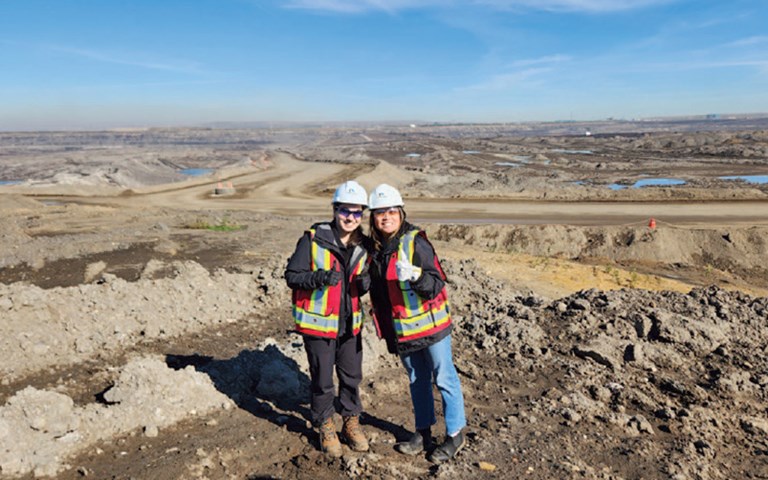
Mining engineering students from Queen’s University on-site as part of an internship program. All mining engineering students at Queen’s take a mandatory sustainability course. Courtesy of Dalena Vo
M
ining schools bridge the gap between students and industry, training engineers to become technical experts and in tune with industry needs. With both the industry and young Canadians more interested in sustainability than ever before, post-secondary institutions across Canada are working to ensure that the future generation of miners is prepared to enter the industry with an eye on sustainability.
In the classroom
From traditional mining schools to engineering programs with a mining option, sustainability is incorporated differently across programs. At the University of British Columbia (UBC), sustainability is the theme of several mining engineering classes.
“Pretty much every single course now has some concept of [sustainability],” said Tonia Welch, assistant professor of teaching and associate head of the undergraduate program at UBC’s Norman B. Keevil Institute of Mining Engineering. “How do you use less energy? How do you impact the environment less? How do you work effectively with local communities? Those are the main three themes that get trickled in through the degree.”
Welch said that UBC’s second year “Introduction to Mining” class, for example, has a major sustainability focus, covering the history and legacy of mining, Indigenous rights and title, environmental impacts in the mining life cycle and more. The course also covers environmental, social and governance (ESG) and corporate social responsibility (CSR), and one of the assignments is to research the environmental and stakeholder management plans of various mine sites. Some of the other sustainability-focused courses in the mining engineering program include classes specifically on mining and the environment, mine waste management and Indigenous engagement in Canada.
As part of her role, Welch often looks for ways to ensure that the curriculum reflects industry needs. While artificial intelligence is currently a popular topic of conversation in the mining industry, sustainability is what industry has often focused on when speaking to Welch about what they would like to see in mining engineering education, and in particular soft skills around sustainability.
“When we talk about soft skills in sustainability, a lot of the time it’s around [understanding] how what [the industry does] impacts the world and the communities around us, [as well as] the people that we work with,” Welch explained.
Part of this is educating mining engineering students to be capable in community engagement and to be able to have those conversations with stakeholders and rightsholders and understand their needs.
Across the country at Queen’s University in Ontario, the Robert M. Buchan Department of Mining relates the importance of sustainability to engineering students through a mandatory course. The sustainability course comes in students’ final year, typically after a year of co-op, and reviews the operating environment they will enter as miners, covering policies, law, international human rights instruments and more. Students also study the Mining Association of Canada’s Towards Sustainable Mining initiative as part of the course.
Anne Johnson, assistant professor of mining at Queen’s University, who teaches the course, said it exposes students to best practices across a number of areas in mining. “A big set of outcomes from both the final year course and the program is to learn to operate with empathy, compassion, inter-cultural competence and communication effectiveness, which is not typical of an engineering program to have,” she said.
“I think empathy is the secret sauce that you would add to technical excellence. Most young people that I teach now say they want to be a different kind of leader. They want to be able to hold their heads up high and say, ‘This is how we mine in Canada, we’re responsible.’ And I want to give them the tools to do that.”
At the University of Saskatchewan, where mining engineering is offered as part of a five-course option in the geological engineering program, associate professor Donna Beneteau uses the P5 Standard for Sustainability in Project Management as a teaching tool to incorporate more thinking and discussion about sustainability into the classroom.
The P5 Standard is a holistic project management tool developed by GPM Global that integrates five key aspects (known as the five Ps) to incorporate sustainability into project management: people, planet, prosperity, product and process considerations. Beneteau uses the tool as a new way to bring sustainable thinking into her geological and environmental design classes.
“When I started, the students were given [design] projects; maybe something as basic as a road going to a mine site,” she explained. “Then I added the P5 Standard to brainstorm everything that they have to think about [for] the project, because when you look at all the different bullet points [through the tool], you might come up with ideas that you would never find by open brainstorming. It’s my way of applying a structured brainstorm to include sustainability indirectly [when] you’re thinking of the whole project life and everything that could be impacted.”
Beneteau said that the product and process considerations are key to having really strong discussions on sustainability, especially process for ensuring that all projects, with a sustainability focus or not, are viable.
“Projects fail because of the process as much as anything else,” Beneteau said. “If you don’t have the process in place that will support the changes you want to make, a project will never go through… You have to be able to implement ideas, and you might not be able to capture those ideas [through] social, economic, environmental [planning] alone.”
Preparing sustainable miners
Given that engineering programs are constrained somewhat by accreditation programs, the emphasis on sustainability across programs is uneven. “Most schools do have a sustainability course, but it worries me to have the course be an elective because I think the people who most need to take a sustainability course will probably be the ones who elect not to take [one],” Johnson explained. “I would like to see schools commit to having a mandatory course that includes environmental, social and economic [pieces].”
However, there can be a gap between how sustainability is taught and how it is practised in the field. “Sometimes, especially when [graduates] first start to work on site, they aren’t seeing the big picture yet [and] what we talk about in class is not necessarily immediately reflected in their work experiences,” noted Welch. “I think that requires us to work a little bit harder in explaining and selling the idea of sustainability to them from that perspective.”
While schools may cover the foundational ideas and values, students might need to see those ideas and values in practice to better understand their significance and impact. If the mining industry wants students or new graduates to be more prepared to handle sustainability requirements in mining, that’s something they can help us understand, said Beneteau.
“They should speak up, hire co-op students and encourage them to learn what is important to the mining companies,” she said. “Industry and educators have to work together to get the proper skills in engineering. None of us can do it alone.”
Engaging the next generation
Welch is seeing more students become interested in mining because of the industry’s role in the green energy transition, as well as seeing that new students have a better understanding of how sustainability plays a role in mining overall. “That idea of sustainability as a whole, and contributing to sustainability through entering the mining field, is becoming more of the narrative, as opposed to five years ago, when it was the opposite,” she said.
For students who still might not know what geological and mining engineering looks like in practice, demonstrating that more clearly might attract more students to the discipline. After the University of Saskatchewan re-engineered its engineering program to have a common first year, beginning in fall 2021, Beneteau saw a major shift in enrolment numbers for geological engineering.
“We went from six graduates two years ago to [being] at capacity and turning away students, as field-school space is limited,” Beneteau said. “Almost every single one of them would say ‘Oh, is that what geological engineering is?’, and a lot of them [are going] into mining. It’s great to reach kids in high school and elementary, but we’re not making an impact for the kids that actually get into engineering and really want this career. When you give students a view of all the engineering disciplines, more and more of them are picking [geological and mining engineering]. We have to start getting the ones that are really keen and interested in it.”
Students in mining engineering themselves are looking for mining companies that are well-versed in sustainability. “I’m seeing students talk about the companies they really want to work for, [which] are the ones with the really good sustainability track records or commitments on record,” Johnson said.
As a focus for both students and industry, sustainability can be incorporated as a core value in mining programs and curriculums—not just to prepare students for a career in mining, but also to show them what is possible as a mining engineer.
“I hope that my students know they have a privilege [and a] huge power to make a difference while practising as engineers,” Johnson said. “If you are someone who cares about social justice, you couldn’t ask for a better place to be than to work in mining because there’s room to make a difference.”