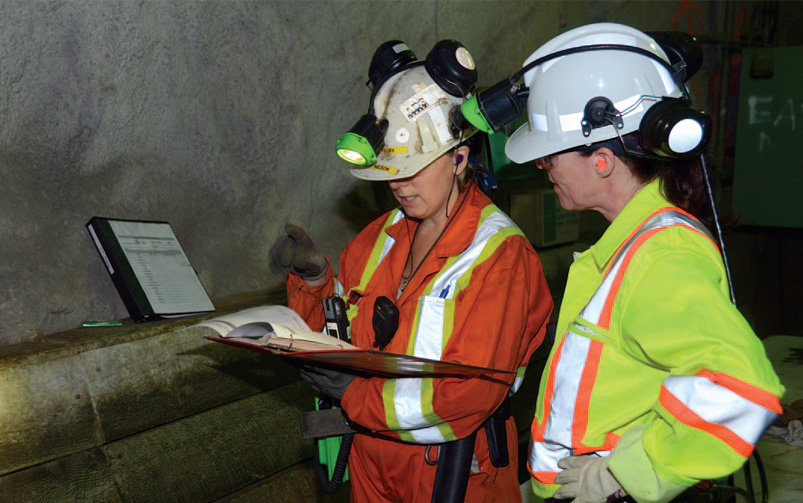
Elizabeth Freele, co-founder of Sympact Advisory, working at the Buckreef gold project in Tanzania. Courtesy of Elizabeth Freele
A
s Canada’s mining industry faces a growing labour shortage and struggles with perception among young people, a new generation of industry professionals are turning to social media, podcasts and online education platforms to connect with potential workers.
For geologist Justin Daley, that effort starts by showing people what exploration work in mining actually looks like.
Growing up with a geologist father, Daley had “a front row seat” to all the fun the profession had to offer before entering the mining industry himself at 17 as a summer intern field technician for Teck Resources Limited. Traversing forests and swamps carrying samples, the budding geologist said he fell in love with the puzzle-solving aspect of fieldwork.
“There’s this unknown geology underneath your feet and you see a couple of outcrops that show you which direction you should be going,” said Daley. “It’s that sort of problem solving that really caught my attention.”
Over two decades later, Daley—now CEO at Made in America Gold Corp. and vice-president, exploration for Nevada King Gold Corp.—wanted to share his love of geology and the industry just like his father had done for him. But instead of doing it in the field, Daley went to Instagram—where he posts educational videos and commentary under the handle @justin_the.geo several times a month. His content looks at a range of topics from innovative mineral exploration methods and field technologies to the growing role of artificial intelligence in modern exploration.
Daley is part of a growing number of mining professionals using social media platforms to provide a more nuanced view of the industry to reach people who may never have considered a career in mining.
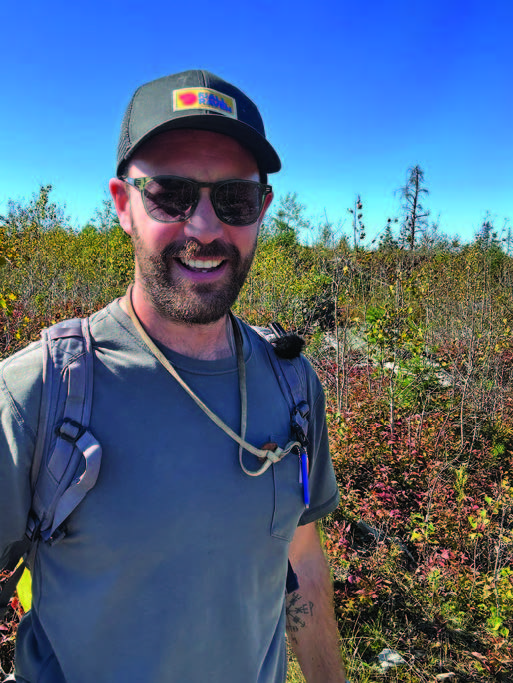 Justin Daley, CEO at Made in America Gold Corp. and vice-president, exploration for Nevada King Gold Corp. Courtesy of Justin Daley
Among these professionals is also Elizabeth Freele, co-founder of Sympact Advisory, a Vancouver-based sustainability think tank and environmental, social and governance (ESG) consultancy.
Unlike Daley, Freele did not grow up thinking she would work in mining. When the opportunity to work as a communications and social projects coordinator for a mining company in West Africa came up over a decade ago, her first reaction was “alarm bells going off.”
“I can never,” she recalled saying. “That would be [like] selling my soul.”
However, Freele soon realized that if she wanted to influence how mining projects interacted with communities and the environment, she might have the greatest impact if she could understand what was happening in the industry from the inside.
That is how she found herself alone in West Africa working in community relations. But with no senior sustainability person to report to, she felt like she was building the plane while flying it.
In 2024, Freele and her fellow Sympact Advisory co-founder Rachel Dekker launched the Responsible Mining Academy, an online ESG training platform designed to equip mining professionals with the knowledge, tools and skills to better lead and support sustainability in the sector.
“That is what I would have liked when I was 21 on a mine site, [in] the middle of nowhere in Africa, trying to figure it out all on my own,” said Freele.
Shifting industry perception
Freele’s initial reservations about joining the mining industry are far from unique.
Polling published in June 2026 by the Mining Industry Human Resources Council (MiHR) and prepared by Abacus Data found that only 42 per cent of 3,000 Canadian youth aged 15 to 24 would consider a career in mining. However, that represents a notable increase from 31 per cent in 2023 and 28 per cent in 2020, adjusted to reflect the same age group across all surveys.
Mining also ranked the lowest on the list in terms of youth perception and interest, which included professions in health care, oil and gas, construction, and arts and culture.
There is a big, untapped source of labour supply in mining that stems from a lack of awareness of the industry, said Will Meyer, director, communications and career development for MiHR.
“A lot more emphasis is being put on mining, and people are becoming more aware of its importance to the country,” said Meyer. “I would foresee that the awareness piece is going to continue to [grow] and we’re going to see a bit more interest in the industry moving forward.”
The number one reason those polled said they would not consider a career in mining was because of workplace safety concerns. The youth perception of the industry as dangerous, dirty work remained high; while “coal,” “hard,” “danger,” “dig” and “labour” were among the top 10 words associated with mining, which, Meyer pointed out, is not the reality.
Digital storytelling is one piece of the puzzle when it comes to shifting the perception of mining, Meyer said. The ability to show the different realities of the industry—whether on social media, websites or podcasts—makes a “big impact.”
“Having individuals who are in various stages in their career sharing information about it is very valuable to show youth what is possible,” he said.
That is the kind of content Freele would have preferred to have available growing up, rather than more traditional pathways like career fairs or guidance counsellors.
“Getting to see authentic ways of life lived in this industry is really valuable,” said Freele.
“If I could have seen more people that are at that next phase of life, that would have been much more helpful.”
That has also been the experience for Daley, who has been approached by young geologists and students who have seen his content and thanked him for showing them a different side of mining. “It’s really cool,” he said, recalling the uncertainty he felt himself early in his career.
Navigating online content creation
Daley started making geology content on Instagram in 2024, when he realized that he was in the right position as both a geologist and a mining executive to be able to speak on the subject while navigating the confidentiality restrictions that often limited more junior employees.
“I felt like I could walk the tightrope between what we can and should be saying publicly and what it actually looks like on the ground,” he said.
Daley’s posting decisions are typically driven by whatever happens to grab his attention on a given day—so long as it is not confidential or yet to be announced. Provided that he speaks generally and safety standards are being followed at the sites—as they should always be—there is not much risk related to posting, he explained.
When it comes to complex topics such as the environment, inclusivity, Indigenous communities and sustainability, Daley said he is careful not to speak beyond his expertise or tell stories that are not his own.
Freele approaches difficult conversations on some of these complex topics on episodes of Sympact’s mining podcast, Prospecting Purpose.
“I think that there is still a lot of denial about just how harmful mining is because of how far we have come,” she said. “NIMBYism and the reticence of youth to be involved in our industry is entirely understandable. And it is touchy.”
Rather than avoiding difficult conversations, Freele believes honesty is essential if the industry wants to attract youth who want to help shape mining’s future.
“This is the world you are inheriting and you have a chance to shape it,” she said.