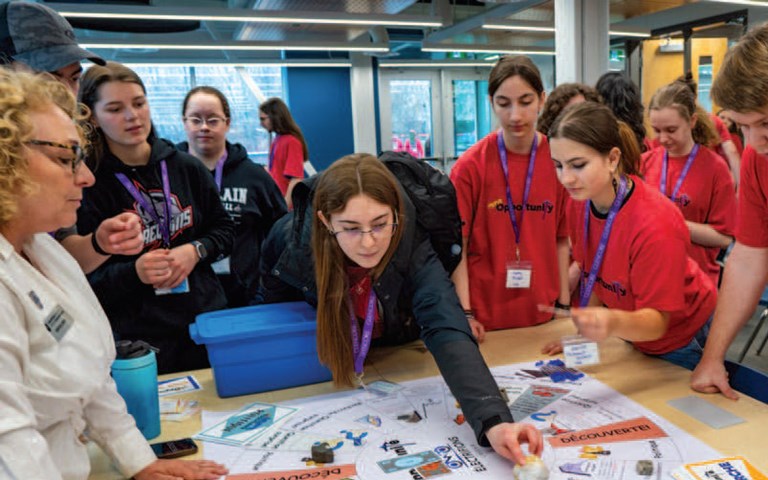
The October 2025 MineOpportunity Games in Sudbury saw a total of 320 high school students participate. Courtesy of Nicole Tardif
An annual board game competition that has been educating northern Ontario high schoolers about the mining industry for two decades is now scaling up with provincial government funding to reach students across the province.
The MineOpportunity Games have reached more than 4,000 students since the board game of the same name was created in 2005 by Laurentian University Goodman School of Mines associate director Nicole Tardif.
During the game, students play in teams to try to develop and build mines, and in the process learn about different careers in the industry and the steps it takes to get from discovery to operation. Students are split into two categories: junior (grades 9 and 10) and senior (grades 11 and 12).
Cards they draw from the deck can send them to booths hosted by local mining companies, mine suppliers, post-secondary institutions and other industry participants to complete challenges such as changing a tire or identifying a mineral from several rock samples. Successfully completed challenges help teams to advance their pieces around the game board. Students also answer trivia questions about the industry, such as “how many operating mines are there in Ontario?” and “how many elements from the periodic table are present in a phone?”
Now a partnership between Laurentian and MineConnect—the industry association for Ontario mining suppliers—the partners are expanding the games beyond Sudbury, with sessions in North Bay, Timmins and Thunder Bay.
In February, MineConnect received $1.5 million over three years from the provincial Ministry of Indigenous Affairs and First Nations Economic Reconciliation. Agnico Eagle also announced in February that it would contribute $300,000 over three years to support the challenge. The funds will go towards digitizing part of the board game so it can be played in a hybrid format and reach more students across Ontario.
The provincial funds will also be used to work with First Nations to develop game content about the industry’s relationship with Indigenous peoples, and to engage with high schools in First Nations communities to bring the games to them.
“We aim to make sure we can have some collaboration with [Indigenous] communities to help us determine how to make the game more relevant to Indigenous youth, so when we play it with them it relates to them better and reflects their views,” said Tardif. “We also want to bring Indigenous views and content to non-Indigenous communities [to] showcase that these processes are a very important part of mining and that they need to be discussed in collaboration with those communities.”
Marla Tremblay, MineConnect’s executive director, said that the partners are aiming to reach 10,000 students in the first year with the hybrid format. She said the goal of expanding the game’s reach is to help shift the public perception of mining, which is not always positive and can be based on outdated ideas of how the industry operates, as well as to open students’ eyes to the possibility of a career in the industry.
Thirty-two per cent of Canadian youth aged 15 to 24 have a positive perception of the mining industry, according to a recently published survey by Abacus Data on behalf of the Mining Industry Human Resources Council. That was an improvement from just 25 per cent in 2023, but mining trailed all other sectors the 3,000 respondents were asked about, including health care, arts and culture, transportation and logistics, financial services and oil and gas. The share of respondents who would consider a career in the industry also increased (42 per cent, up from 31 per cent in 2023) but remained the lowest among all nine fields.
Tremblay said labour needs are the “number one issue” MineConnect members talk about. “We understand that the mines need people and the suppliers need people,” she said.
Small beginnings
The game began two decades ago in a geology lab at Laurentian, where Tardif used it to introduce first-year students to mining careers and professionals.
A few years later, Tardif joined the Sudbury Mining Week organizing committee and realized the game could be repurposed as an activity for high school students. The game became an annual Mining Week competition, typically held over two days for English and French schools, that local high schools could bring groups of students to participate in.
According to Tardif, the events usually attract between 200 and 300 students. She said that reaching students at the high school stage can make them curious about the industry before they make their post-secondary plans. For students who had already been thinking about mining, the games let them know about the opportunities available in their own backyard.
“We all want to be able to promote mining as a really rewarding, high-paying and fun industry,” Tardif said. She also noted that for the university, it is “important for local communities to know Laurentian is a leader in this area. We want to make sure that students who are interested in these programs and want to stay close to home [know] we’re close to home. Where we’re located in Sudbury, there’s a lot of industry activity going on.”
An ecosystem builder
In 2023, Laurentian received $448,550 in funding from the Ontario Vehicle Innovation Network to create an auto-focused version of MineOpportunity, with questions focused on electrification and the minerals and metals used in electric vehicles and batteries. The funding also supported plans to expand the game to North Bay, Timmins and Thunder Bay, but Tardif said Laurentian did not have the local industry connections needed to tailor the events to those communities. Around the same time, MineConnect approached Laurentian about expanding the games and was able to help bridge that gap through its network of mining suppliers and industry members across the three cities.
MineConnect’s partnership with the school in 2023 helped address this challenge, as MineConnect has members in all three cities. Tremblay said she also wanted to increase awareness about mining in those regions, as more mining projects and operations were beginning to ramp up. “There’s so much activity happening in [northwest Ontario], but there’s limited information out there because mining wasn’t a traditional economic driver. There’s been the odd [project] in the Far North but not like there has been recently and what we anticipate coming,” Tremblay said.
Tremblay said the games had previously been more focused on mining from an operator perspective, but MineConnect has expanded the game and its content to also include questions about the broader mining supply chain. Companies that sponsor or partner with the games can develop questions for the game cards and corresponding challenges.
Events in North Bay, Timmins and Thunder Bay have been adapted to the local ecosystem so that students can meet representatives from the colleges, universities and companies working in their area. Tremblay said that this has numerous benefits: it teaches students about the impact of mining on their community and gives high school teachers and guidance counsellors a better sense of local career opportunities for their students.
It also helps to build relationships between all the organizations in the local mining economy. Representatives at post-secondary institutions, such as Confederation College in Thunder Bay or Canadore College in North Bay, can develop relationships with the industry to learn about the skills the industry most needs in new graduates, and mines and mining suppliers can learn about the potential for hiring students for co-ops and apprenticeships.
“It’s an easy way to link them up,” Tremblay said. “All of the broader community are learning about the impact of the industry, what the needs are, and making it stronger for the future in that area.”
Digitizing for the future
MineConnect and Laurentian are planning to digitize parts of the game, including how answers are checked for accuracy and how points are allocated to teams when they have completed a challenge. Tremblay said those changes will make it possible for students all over the province to play the game in their classrooms, because their teachers will be able to act as the game administrator. It will also make in-person competitions easier to run by reducing the number of volunteers needed per board game: currently, for every board being used at the MineOpportunity Games, the organizers need three to four volunteers, including a game facilitator, banker and answer checker.
Tremblay said the hope is that teachers in various parts of the province will be able to input their city or postal code and receive a bank of questions from MineConnect and Laurentian that reflect the local mining and supply chain businesses in their area.
“We’re trying to just share the fun and knowledge so that students can learn about the industry in a fun, practical, educational way,” Tardif said.
MineConnect put out a request for proposals (RFP) earlier this year to begin digitizing the game. MineConnect will also issue a second RFP for the physical board, with the goal of selling the game to schools.
Tardif said she and other MineOpportunity Games organizers have heard from students that playing the game helped open their minds to the industry or confirm their interest in it, and some company partners have hired students they met through the games for summer placements.
“Getting a career is all about networking; the more these students are exposed to professionals and learn about the actual work that goes into each career, the more it expands their opportunities in these areas,” she said.