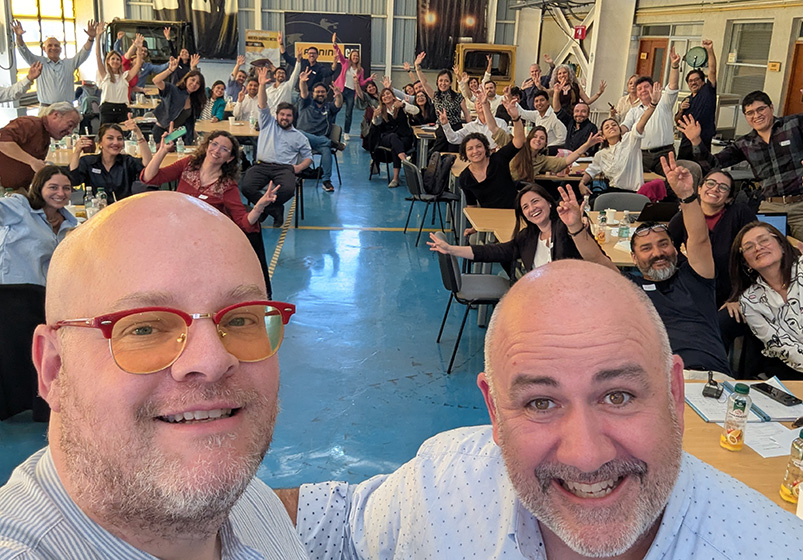
The first live-session cohort of BRIMM’s Economic Leadership for Mining microcredential program, delivered in Chile in May 2024. Courtesy of Benjamin Cox
In March 2020, as the COVID-19 pandemic forced much of the world into virtual spaces, the Bradshaw Research Institute for Minerals and Mining (BRIMM) at the University of British Columbia launched a free virtual seminar series focused on innovative perspectives in sustainable mining practices. The aim was to foster connection and knowledge sharing across the industry during a period of global disruption.
The seminar organizers anticipated a modest turnout from a largely Canadian audience. Instead, the first session attracted roughly 300 participants from around the globe. The series went on to span 10 sessions, each lasting about an hour.
The success of this series laid the foundation for BRIMM’s microcredential programs—short, targeted credentials designed to build specific professional skills without the commitment of a full degree—which are aimed at working professionals, particularly those who lack the time and prerequisites to enrol in traditional, campus-based programs.
The first program, Economic Leadership for Mining, launched in November 2020, and was followed by Leadership in Sustainable Mine Closure in March 2024. The Economic Leadership program is taught by Benjamin Cox and Ben Murphy, while the Mine Closure program is led by André Xavier and Jocelyn Fraser.
The Leadership in Sustainable Mine Closure program, which was developed in partnership with Rio Tinto, Curtin University in Australia and Ernst & Young, is designed to provide a globally informed exploration of best practices in mine closure and to equip learners with the planning, social, environmental, financial and technical skills needed to deliver sustainable and socially responsible closure outcomes across the mining life cycle.
Meanwhile, the Economic Leadership for Mining program is designed to develop economically sustainable and inclusive leadership by equipping mining professionals with practical business and financial tools to lead projects and organizations across the industry.
Each program comprises four interconnected courses and includes approximately 36 hours of live instruction, along with 50 to 100 hours of homework. The structure is designed to closely mirror traditional university offerings through live teaching and structured coursework.
A globally accessible format
Instead of following standard microcredential formats, BRIMM designed a more interactive delivery model. According to Cox, many microcredential programs, like Coursera, rely heavily on pre-recorded content with minimal or no interaction with instructors or peers. While these models are relatively inexpensive and easy to scale, they often suffer from low completion rates and limited engagement.
Instead, BRIMM prioritized live instruction—with recorded sessions available for those unable to attend—alongside group work and meaningful interaction between participants and instructors. Cox explained that the programs were initially created with students from the developing nations of the Global South in mind, “to focus on people who do not automatically have a seat at the educational table,” adding that “we’re only now getting more Canadian students.” He noted that the programs are designed to be accessible on mobile phones for participants without access to computers and do not require formal academic prerequisites.
While these programs have been delivered online since their inception, the Economic Leadership for Mining program is now also offered in a live format in select countries, including Chile, Peru and Argentina; the first cohort launched in Chile in May 2024. The program is taught by instructors Cox and Murphy. This year, the Leadership in Sustainable Mine Closure program will be delivered live in Mexico for the first time.
“We initially thought that Canadians would be our biggest target, but we actually found that once you remove the barrier of geography by going into an online space, it really makes it a global product,” said John Steen, director of BRIMM. “We do have quite a few Canadians, but our far biggest markets are South America and Africa.”
Building capacity
Since the microcredential programs began at BRIMM, Steen has seen graduates progress into more senior roles across both mining companies and the Canadian government. He considers this to be particularly important given the strong need within government to build capacity in mining-related sustainability skills, as the sector is subject to extensive regulations.
Another key area of strength within BRIMM’s microcredential offerings is mine closure, which Steen regards as a major strategic issue for the mining sector. As new mines are developed to meet growing demand, companies are simultaneously facing the challenge of responsibly closing operations that have reached the end of their life. Managing mine closure effectively, he noted, is critical to maintaining the industry’s social licence to operate.
Though he does not see microcredential programs replacing traditional undergraduate or master’s degrees in mining engineering, he believes they can play a key role in strengthening the capabilities of those working in the mining industry.
While BRIMM may expand its microcredential offerings in the future to help address these workforce needs, Steen said that the institute has identified two areas in which it has particular strengths, and that any expansion of its microcredential programs would require collaboration with partners across Canada, such as other educational institutions.
The microcredential programs were funded entirely by BRIMM for their first three years, before receiving a $1 million federal investment from Natural Resources Canada (NRCan) in 2023. The funding has helped to support the development and expansion of the Economic Leadership for Mining credential by offering 300 scholarships for individuals who require financial support, along with covering two in-person programs for up to 50 students each in Argentina and Chile.
In addition to funding from NRCan, the B.C. provincial government offers a Future Skills Grant that provides eligible students with up to $3,500 towards their tuition to prepare for high-demand jobs. This grant supports approximately 30 funded seats per year across the two programs.
 Benjamin Cox (left) and Ben Murphy, instructors of the Economic Leadership for Mining program, delivering the course live in Chile in November 2025. Courtesy of Benjamin Cox
Flexible learning
Chantel Coburn, a senior process innovation engineer at Nutrien with 10 years of experience in the mining industry, completed the Economic Leadership for Mining credential in 2025 to deepen her understanding of the financial side of mining without committing to a full-time master’s degree.
After completing a bachelor’s degree in chemical engineering at the University of Saskatchewan, Coburn considered pursuing a master’s degree following a few years of professional experience, though she remained unsure. She decided that a microcredential could offer a shorter-term way to upskill while also easing her return to learning and helping her to assess whether a master’s might be right for her in the future.
As she was balancing family responsibilities and a full-time job, Coburn appreciated the program’s flexible format, which allowed her to attend sessions live when possible and rely on recordings when other commitments arose. Although she noted that “there’s a certain magic to doing courses in person,” the instructors worked to make the virtual experience engaging and collaborative, she said.
“There were a lot of great interactions and group work activities during the live [sessions], and I met some really interesting people through that [group work],” she said, adding that the experience also made for a great networking opportunity.
Coburn said the program strengthened her financial modelling skills that could help her craft clearer, more effective business cases and presentations—tools she found immediately applicable to her current role at Nutrien.
Adam Howse, business development executive for Ideon Technologies and a 2025 graduate of the same program, also valued the program’s flexible format. He noted his courses were offered in both early-morning and afternoon sessions, making it possible to attend even while travelling for work. He added that participants could join both sessions if they wished.
Howse, who already has a diploma in mechanical engineering technology from Mohawk College in Ontario, as well as around 20 years of mining industry experience, found the program useful in upskilling, especially in expanding his knowledge of the financial side of mining.
Howse explained that without a university degree, many MBA-style programs were not an option for him, making it important to find a credential that aligned with his existing skill set while remaining flexible enough to fit around a demanding work schedule.
“I think microcredentials are a great way to go,” he said. “[The program] has helped me significantly in my work, and it’s a great way to upskill with fairly limited time and financial commitment, especially if you’re looking for something that you can action immediately.”


