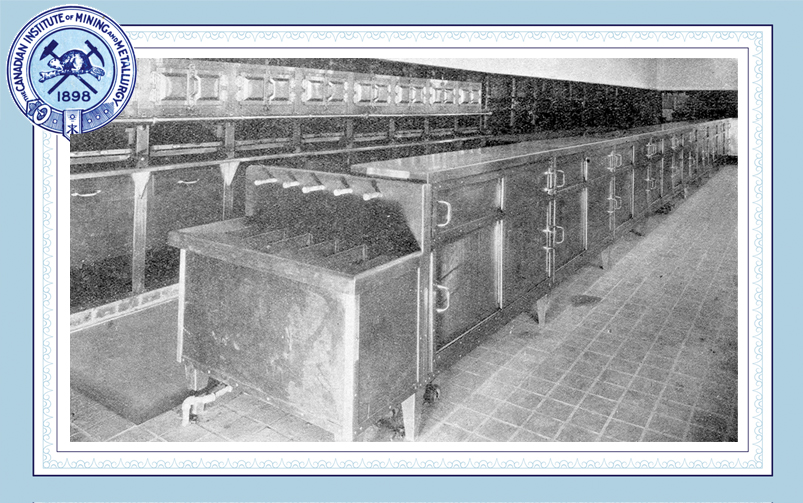
Electrolytic refining of standard grade indium at Trail (CIM Bulletin, June 1959)
The origin stories of our industry are contained within the digital archives of the CIM Bulletin, the predecessor to CIM Magazine. Explore more of the CIM archives on OneMine.
I
ndium is a rare metal that was included in Canada’s critical minerals list due to its use in advanced technologies, such as semiconductors, as well as its vulnerable supply chain. According to the federal government, Canada currently produces six per cent of the world’s indium. The country’s major indium producer is Teck Resources Limited’s Trail smelter in southern British Columbia.
Indium is a silver-white metal that does not occur in its native state. It is malleable, ductile and softer than lead; it can be scratched with a fingernail, noted B.G. Hunt, C.E.T. White and R.A. King (CIM Bulletin, June 1959). “When a bar or rod of the pure metal is bent, a high-pitched ‘cry’ can be heard,” they wrote.
This rare metal is found in various ores, including those of iron, lead, copper and particularly zinc. “Most ores contain less than 0.1 per cent indium, and many less than 0.001 per cent,” wrote Hunt et al. “Like many others of the rarer metals, indium becomes concentrated in by-products during recovery of the major metals. Indium is most frequently associated with zinc and is recovered commercially from zinc residues and smelter slags.”
W.H. Hannay and James Bryden (CIM Bulletin, 1934) wrote that from 1927 to 1928, the Consolidated Mining and Smelting Company of Canada (which later became known as Cominco) operated a two-ton slag-retreating plant at its Trail smelter for experimental purposes. The goal was to recover the zinc and lead contained in these slags—byproducts of ore from the company’s Sullivan mine, located approximately 270 kilometres from Trail—that had previously been lost to waste. “The zinc plant had been in successful operation on Sullivan zinc concentrates for twelve years, and the lead blast-furnace charge was essentially either Sullivan lead concentrates or byproducts of Sullivan zinc concentrates,” they wrote.
When researchers attempted to produce electrolytic zinc from the zinc oxide fume in 1928, the results were “most discouraging” as they could not achieve commercial current efficiencies. The cause was identified as cathodic impurities, which Hannay and Bryden explained as “impurities that cause a definite loss of current efficiency in zinc electrolysis,” noting that “as little as 0.15 parts per million (0.000015 per cent) of some elements in a zinc electrolyte may be fatal to good electrolysis.”
Using group separation followed by analysis with a spectroscope, “two hitherto unsuspected elements were found to be present, namely, tin and germanium,” they wrote. Germanium was identified as being particularly toxic to the process at very low concentrations.
Further research identified 13 elements present as impurities, one of which was indium; this was the first confirmation of its presence in the smelter’s materials. However, indium was determined to be “harmless” to zinc electrolysis at concentrations of up to 50 parts per million.
Indium production at Trail
Cominco first produced indium at its Trail smelter in 1941. “The metal was recovered by laboratory methods from zinc oxide fume containing 0.1 to 0.2 per cent indium,” wrote Hunt et al. (1959). “This operation was discontinued in 1942 due to lack of demand, after some 400 troy ounces had been produced.”
However, in mid-1946, it was discovered that indium is concentrated in the complex dross re-treatment furnace (DRF) slag. “This by-product, containing 2 to 3 per cent indium, provided the major outlet for the indium entering the zinc-lead operations at Trail,” they wrote. “The DRF slag had been stocked for many years for the primary purpose of removing tin from the lead smelter-refinery circuit. This stockpile constituted a substantial reserve of indium which was large enough to justify commercial production.”
A process for recovering indium from DRF slag was developed and production of indium from this source began in 1949. “This process was operated intermittently on a small scale to provide indium for sale and for a sales development programme,” they wrote.
According to R.C. Bell and H.R. Banks (CIM Bulletin, April 1952), “recent noteworthy researches at Cominco” included “the development of a process for recovering indium from plant intermediates in which it is concentrated, and for producing this metal at higher than 99.95 per cent purity.”
Hunt et al. (1959) noted that “late in 1954, because of the promising sales outlook, it was decided to provide facilities for the production of indium on a commercial scale.”
Cominco’s commercial indium plant started operations in April 1955. Hunt et al. recorded that by the late 1950s, it was producing about 38,000 troy ounces of refined indium metal per month.
“Over 80 per cent of the indium that enters the Trail plants originates in the zinc concentrates,” they wrote. “In the electrolytic zinc process, indium remains in a residue which is treated at the lead smelter for recovery of lead and residual zinc. When the bullion from the lead blast furnace is drossed, the indium is removed in the dross. On re-treating this dross for the production of a copper matte and lead bullion, the indium, together with the iron, silica, zinc, some lead, tin and copper passes into the slag. This complex DRF slag is segregated, providing the major outlet for indium and tin from the Trail plants. It contains the highest concentration of indium encountered in the Trail operation and is the raw material for Cominco’s commercial indium plant.”
Furnace feed prepared from this slag was smelted with coke and limerock in an electric furnace; this bullion was parted electrolytically, producing a marketable lead-tin alloy containing about eight per cent tin, and leaving the indium in the anode slime.
“Recovery of indium from the anode slime involves roasting the slime with sulphuric acid, followed by leaching with water, purifying the leach solution, recovering the indium by sponging with zinc or aluminum, and refining electrolytically,” wrote Hunt et al. (1959). “This process yields standard grade (99.97+ per cent) indium which is either sold or refined to high purity (99.999 per cent) indium for special uses requiring higher purity metal.”
The metal produced—sold under the name Tadanac Brand High Purity Indium—was marketed primarily to the electronics industry.
The indium market
According to N.E. Izatt, S.R. Izatt, R.L. Bruening, K.E. Krakowiak and R.M. Izatt (Conference of Metallurgists 2015), the first large-scale application for indium was as a coating for bearings in high-performance aircraft engines during World War II. Hunt et al. (1959) also recorded that indium’s first major use was in the production of bearings, adding that this application was still a major consumer of the standard-grade material. “Major uses are in aircraft engines, diesel engines, and several types of European automobile engines,” they wrote.
The other major applications for indium noted by Hunt et al. were as transistors and rectifiers in semiconductors, as well as in special alloys. “New uses, particularly in intermetallic semi-conductor devices, are showing considerable promise,” they wrote.
According to Izatt et al. (2015), in the middle- to late-1980s, “the development of indium phosphide semiconductors and indium-tin-oxide thin films for liquid crystal displays (LCD) aroused much interest. By 1992, the thin-film application had become the largest end use.”
In early 1988, Cominco announced the construction of a new indium plant at the Trail operations to increase annual production capacity from 150,000 ounces of indium to one million ounces. Cominco’s 1988 annual report mentioned uses for indium in the “rapidly growing electronics industry” and stated that the new plant would begin production in the second quarter of 1989.
Cominco’s Red Dog zinc-lead mine in Alaska began commercial production in 1989. “The roasters [at Trail] currently treat about 1,400 t/d of zinc concentrates,” wrote G.W. Toop (CIM Bulletin, September 1994). “Over half of the total [zinc] concentrate treated originates from the Red Dog mine in Alaska. The remainder of the roaster feed is made up of Sullivan concentrate and various custom concentrates.” The Sullivan mine ceased operations in 2001, and ore from the Red Dog mine is now the primary source of indium produced at Trail.
In 2006, the company (by then called Teck Cominco) commissioned a $9 million tin removal process in the drossing plant, as indium production had been limited by high levels of tin in the concentrates. This expanded Trail’s annual indium production capacity from 45,000 kilograms to 75,000 kilograms, according to Teck Cominco’s 2005 annual report.
Today, Teck’s Trail Operations is one of the world’s largest integrated indium producers, continuing to extract the metal from these modern concentrate feeds at its Trail smelter and refinery.
The origin stories of our industry are contained within the digital archives of the CIM Bulletin, the predecessor to CIM Magazine. Explore more of the CIM archives on OneMine.