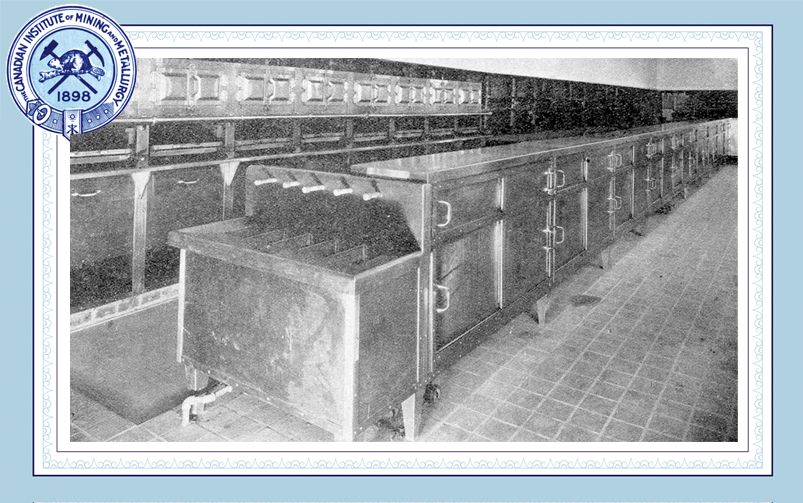
A dog sled at the Eldorado mine—later renamed Port Radium—in the Northwest Territories (CIM Bulletin, 1938).
The origin stories of our industry are contained within the digital archives of the CIM Bulletin, the predecessor to CIM Magazine. Explore more of the CIM archives on OneMine.
Dog teams and dog sleds were essential tools in the development of the Canadian mining industry, providing a reliable means of winter transportation, logistics and exploration support in remote areas.
“Seldom, perhaps, do we stop to think how the lone party of prospectors, with canoes or dog teams, has helped to change this former wilderness, carrying it from an obscurity however romantic to world-wide attention,” pondered G.E. Cole (CIM Bulletin, 1927).
Dog teams were frequently used by prospectors to reach unexplored regions in winter and to stake claims before the spring thaw. C.L. Monroe (CIM Bulletin, 1929) described how George Miller heard about gold in the Atlin region of northern British Columbia from a prospector staying at his hotel in Juneau, Alaska. His brother Fritz and Canadian prospector Kenny McLaren decided to investigate.
“Starting out with a dog team from Skagway, they mushed in over the White pass, leaving the Yukon trail at Bennett,” wrote Monroe. “They prospected up Pine Creek, and in January 1898, made their discovery of the coveted gold at a point about six miles from the mouth of the creek, where the town of Discovery later flourished.”
Neil R. Burns and Michael Doggett (Explor. Mining Geol., Vol. 13, 2004) wrote that in 1937, J.F. Tibbitt and F. McInnes used dog sleds to travel from Churchill, Manitoba, to Baffin Island, Nunavut, and staked four claims. “One of the claims was on the north end of the South Pyrite zone of the eventual Nanisivik mine,” they wrote.
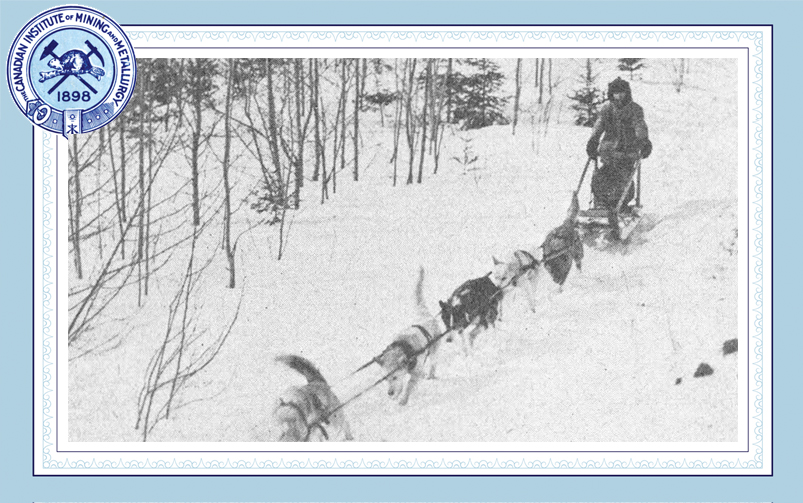 A dog team pulling a sled (CIM Bulletin, 1927).
When news of significant mineral discoveries spread, dog teams could be the fastest available transport to these areas. “In 1915, a sudden widespread interest was aroused by the report that a sample of ore collected near Fond du Lac [in northern Saskatchewan] had yielded a very high assay in silver,” wrote F.J. Alcock (CIM Bulletin, 1936). “In March and April, prospectors began to rush into the field by dog teams to take up claims.”
Dog teams in remote regions relied heavily on local wildlife for sustenance. Forrest A. Kerr (CIM Bulletin, 1929) stated that game was “abundant” in northern British Columbia. “On practically all the mountains, goats are plentiful and afford a good meat supply for both men and dogs,” he wrote. J.P. Norrie (CIM Bulletin, 1931) recorded that “abundant fish for human consumption and dog feed may be obtained anywhere” in the Northwest Territories’ Great Bear Lake region.
Other Functions
Beyond pulling sleds, dogs were sometimes used as pack animals to carry supplies on trails where other transport options were not feasible. Kerr (1929) described northern British Columbia as “a very hard country to travel,” noting that while horses could be used to some extent in the northeast, “without adequate trails, they are useless throughout the greater part of the area adjacent to the Stikine River.”
However, “as far south as Little Canyon, dogs can be used to advantage,” Kerr added. “In fact, a good dog properly handled is of more service as a packer than a man.”
The Consolidated Mining and Smelting Company of Canada opened its Wellington Lake hydroelectric power plant in northern Saskatchewan in 1939. When it was under construction, “twelve stop logs 18 feet long, weighing 700 pounds each, were hauled 15 miles by dog team, skirting the rapids up the frozen Charlot water-course,” wrote E.M. Stiles (CIM Bulletin, 1940).
According to S.T. Bishop, T.S. Heah, C.R. Stanley and J.R. Lang (Porphyry Deposits of the Northwestern Cordillera of North America, Special Vol. No. 46), Kennco Explorations (Western) utilized dog teams at its Lorraine property in north-central British Columbia. “The first diamond drill was mobilized to the property by dogsled in 1949,” he wrote.
Dogs also aided in essential services in remote areas. S.C. Ells and A.A. Swinnerton (CIM Bulletin, 1937) noted that in 1913, when the Department of Mines was investigating the potential of the oil sands deposits in northern Alberta, “no telegraph line had been laid, and a casual mail service by canoe or dog team once in three months formed the only means of communication with the outside world.”
Gradual replacement
The decline in the use of dog teams in the mining industry was due to the gradual introduction of alternative transport options. Where railways were built, they replaced dog sleds for long-distance freight hauling and made these areas more economically accessible.
“Canoe transportation in summer or even dog teams or snowshoes in winter were not sufficient to make an interesting gold deposit look attractive,” wrote Cole (1927). “In Canada we owe much to our railways, politically and economically.”
By the late 1920s, airplanes began to be used for mineral exploration and freight transport. “Travelling time was reduced from days to hours and, in some cases, from weeks to hours,” wrote John E. Hammell (CIM Bulletin, 1929). “A closer analysis will probably make the old methods appear antiquated and very uneconomical.”
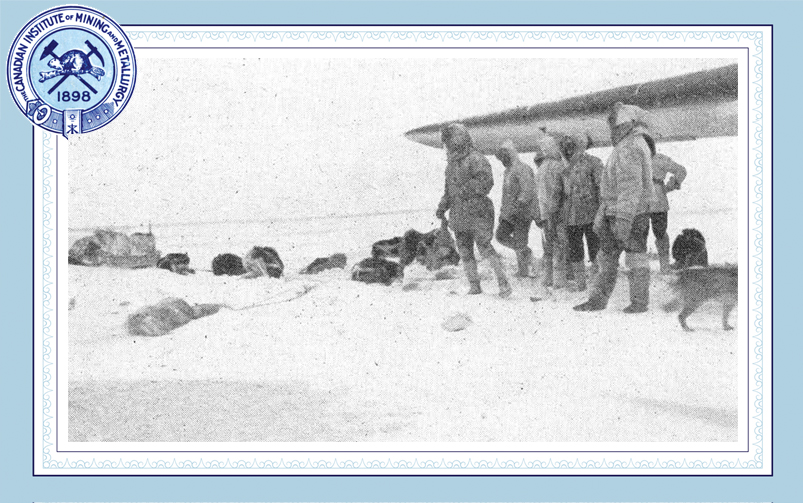 Transferring supplies from plane to dog team at Rupert House in Quebec in January 1929 (CIM Bulletin, 1929).
According to a paper by the staff of the Dominion Bureau of Statistics (CIM Bulletin, 1937), air freight in Canada consisted largely of machinery and supplies for mines in northern Quebec, Ontario, the western provinces and the N.W.T. “Many of these mines are otherwise accessible only by canoe in the summer and dog team in the winter, and aircraft transportation will probably be the cheapest and most effective method of transportation during the early life of a large number,” they wrote.
As aircraft expanded access to remote areas, dog teams remained indispensable for local transport and support. Norrie (1931) detailed that when Dominion Explorers Ltd. established a base at Great Bear Lake in 1930, supplies were transported to the area by air. “With the aid of dog teams, a two-story office and radio building was built at the mouth of Sloan river,” he wrote.
In 1947, the Geological Survey of Canada began a research program in the Arctic Islands. R.L. Christie (CIM Bulletin, January 1970) noted that between 1947 and 1954, it used “airborne geological reconnaissance with the aid of the Royal Canadian Air Force; further work was done entirely by dog team or canoe.”
In 1955, it began Operation Franklin, which used large helicopters to coordinate the mapping of large areas of Arctic terrain. According to Christie, “canoes and dog teams continued in use” from 1955 to 1958.
The Polar Continental Shelf Project began in 1959 as a research and logistical support division of the Department of Energy, Mines and Resources. “The field program is supported primarily by fixed-wing aircraft and helicopters, as well as by overland mechanical vehicles and even dog teams,” wrote W.E. van Steenburgh (CIM Bulletin, May 1963).
The modern snowmobile was invented in the 1950s; in the decades that followed, these motorized overland vehicles would largely replace dog teams for winter travel in mining applications.
Although dog teams were usually referred to only in passing in the CIM archives, these mentions underline their essential contribution to the exploration and development of Canada’s mining frontier.
The origin stories of our industry are contained within the digital archives of the CIM Bulletin, the predecessor to CIM Magazine. Explore more of the CIM archives on OneMine.