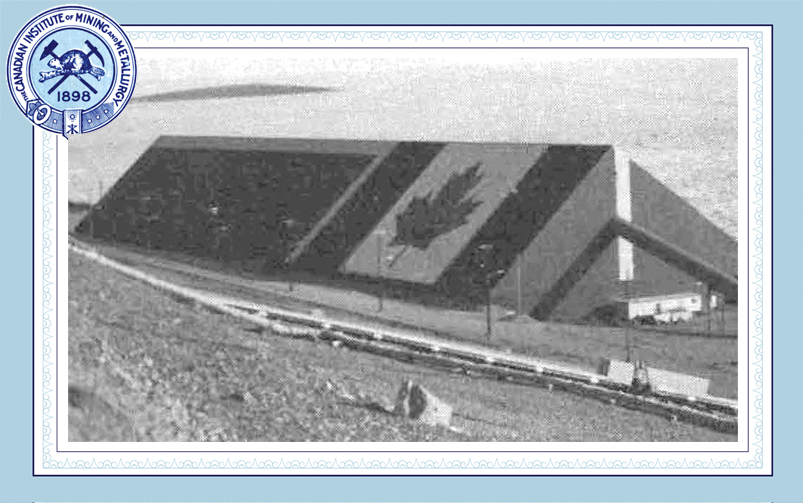
Excavation for the slot to the tailrace portal during construction of the Churchill Falls project (CIM Bulletin, June 1968).
As demand for iron ore rose in the 1940s, so did recognition of the potential of hydroelectric energy to power mining operations in the Labrador Trough. “The Hamilton River is one of the great power rivers of the continent, with a fall of over 1,000 feet in the 16-mile Grand Falls section,” wrote Norman Marr (CIM Bulletin, May 1949).
At the “Iron Ore in Canada” symposium held by CIM’s Ottawa branch in February 1955, John Davis raised the use of “electric power from Grand Falls” as a key advantage for smelting iron ore from Labrador and Quebec due to the “very large quantities of cheap power” available.
In 1958, the British Newfoundland Development Corporation created the Hamilton Falls (Labrador) Corp. to develop a hydroelectric project at the waterfall. When Winston Churchill died in 1965, the river, falls, town and power station were renamed after him, and the company became Churchill Falls (Labrador) Corp. (CFLCo).
H.L. Snyder (CIM Bulletin, June 1968) described plans to develop more than 7,000,000 hp (5,220 megawatts) of hydroelectric power from the Churchill Falls power project. “It features a powerhouse located underground and a 2,700-square-mile reservoir formed by earth dykes,” he wrote. “Exploration was required to prove out a powerhouse location in the general area selected to best develop the full 1,060-ft head available,” he wrote.
Construction began in July 1967; at the time, it was the largest civil engineering project in North America, involving 6,300 workers.
Snyder noted that the project required 22,000 feet of shafts and 3½ miles of tunnels, and that the underground powerhouse would be 1,000 feet long, 75 feet wide and 150 feet high, with an adjacent transformer and surge chambers. “Inclined penstocks, 20 ft in diameter, are needed to bring the water from the surface forebay to each of the 11 units,” he wrote. “There will be two 45- by 60-ft horizontal tailrace tunnels, each a mile long, to return the water to the river, and an additional tunnel for access. Vertical cable shafts and a service shaft complete the underground picture.”
CFLCo signed an agreement with Hydro-Québec in 1969; Hydro-Québec agreed to purchase 31 billion kilowatt hours of electricity per year at a fixed price for a term of 40 years (automatically renewing for a further 25 years) in exchange for a 34.2 per cent stake in CFLCo.
On Dec. 6, 1971, the station delivered its first power and it went into full-time production in 1974.
In June 2025, the Innu Nation of Labrador and Hydro-Québec signed a Reconciliation and Collaboration Agreement that included a settlement of $87 million and a three per cent dividend from CFLCo.
In December 2024, Newfoundland and Labrador signed a memorandum of understanding with Quebec to terminate and replace the 1969 contract; it also included provisions to include the Innu Nation in future energy projects.