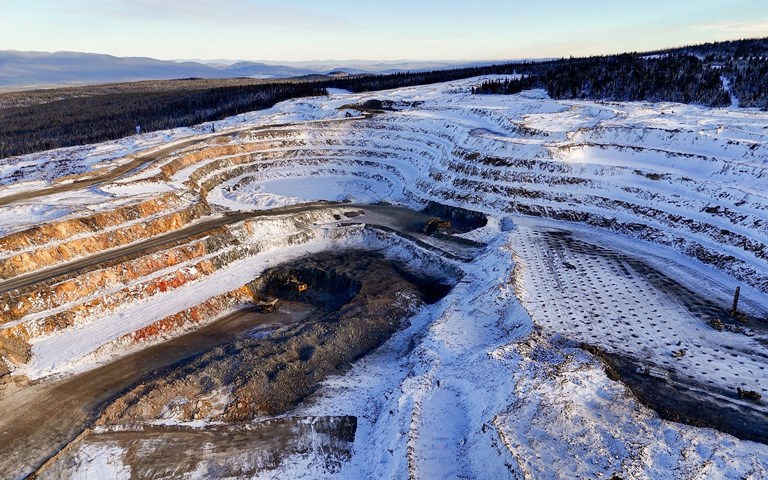
Artemis Gold’s Blackwater gold mine is located about 160 kilometres southwest of Prince George, B.C. Courtesy of Artemis Gold.
Artemis Gold has given the green light to a roughly $1.44 billion Phase 2 expansion at its Blackwater gold mine in central British Columbia, which the company says would position the operation among Canada’s largest gold mines.
The expansion project, called EP2, would enable Blackwater to produce an average of 500,000 to 525,000 ounces of gold per year over its first 10 full years of operation, targeting all-in sustaining costs of between US$800 and US$1,100 per ounce.
In a Dec. 15 press release, Artemis president Jeremy Langford called the decision “another major milestone for the company,” noting that since achieving commercial production in May, Artemis has been working to optimize and right-size the EP2 plant design while also advancing construction of Phase 1A.
Phase 1 of the Blackwater mine established a six million tonnes per annum (Mtpa) open-pit mining and processing operation, with a Phase 1A expansion now underway to lift throughput to eight Mtpa by late 2026. Artemis estimates that the Phase 1A upgrades will cost about $110 million.
The EP2 expansion would add a new processing facility with a design throughput of 13 Mtpa beside Blackwater’s existing Phase 1 plant. Combined with the Phase 1 expansion, EP2 would increase total processing capacity to 21 Mtpa by the end of 2028, up from the 15-Mtpa design scenario originally outlined in a 2024 expansion study.
Dale Andres, CEO of Artemis Gold, told CIM Magazine that the company decided to approve EP2 now rather than wait until Phase 1 is completed, to capture the benefit earlier from the cost efficiencies that come with operating a larger plant, especially while gold prices remain high.
He added that designing the EP2 processing facility as a separate, standalone facility adjacent to the existing Phase 1 processing plant “will allow for the segregation of Phase 1 operating activities from EP2 construction activities,” which will create “minimal disruption to current operations during EP2 construction and commissioning.”
Front-end engineering and design for the Phase 2 expansion were completed this month. Early works for EP2 are expected to begin in January 2026, with major construction slated for the third quarter of 2026 and lasting about two years. First gold is anticipated in the third quarter of 2028, and Artemis expects to reach full production rates before the end of 2028.
The EP2 processing plant will include primary crushing with a gyratory crusher, followed by twin secondary cone crushers. The crushed material will be stored in a covered stockpile and conveyed to a semi-autogenous ball mill crusher grinding circuit consisting of an 18-megawatt (MW) semi-autogenous grinding mill and an 18-MW ball mill. The design also incorporates gravity concentration and cyanide leach and adsorption circuits.
Funding for EP2 is expected to be drawn primarily from operating cash flow. A final investment decision is conditional on formal confirmation from BC Hydro that sufficient hydroelectric power will be available, which Artemis expects early next year.
At peak construction, the expansion is expected to create 1,500 direct construction jobs. Once construction is complete, the mine is expected to employ about 1,200 direct employees and contractors.
“Around 75 to 80 per cent of our direct employees through the build of Phase 1 and now into operations are from B.C., and we hope to see similar stats as we build EP2,” Andres said.
Once EP2 is complete, Blackwater’s mine life is expected to extend to 2043, with the final five years consisting of stockpile processing. Artemis also said there is potential to extend the mine beyond 2043 and to further expand processing rates.
The project hosts proven and probable reserves of 334 million tonnes grading 0.75 grams of gold per tonne, containing about 8 million ounces of gold. Artemis expects to update its mineral resources and reserves next year.