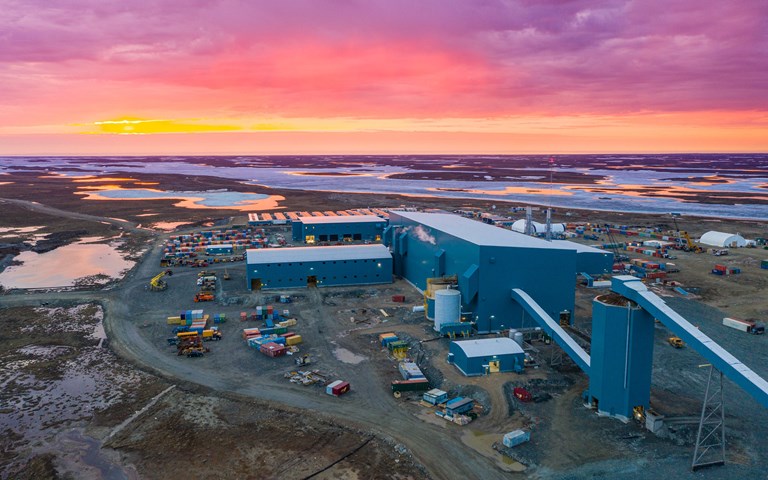
Agnico Eagle and Nukik Corp. signed an agreement this week to advance the Kivalliq Hydro-Fibre Link, a project that could cut diesel use and Scope 1 emissions at Agnico’s Meliadine gold mine in Nunavut, which used about 2.1 million gigajoules of diesel-generated energy in 2024. Courtesy of Agnico Eagle.
Welcome back to your weekly mining news recap, where we catch you up on some of the news you may have missed. This week’s headlines include a court ruling prompting amendments to B.C.’s Declaration on the Rights of Indigenous Peoples Act, Saskatchewan securing a rare earth offtake partnership, and Canada’s potash exports facing possible U.S. tariffs.
Agnico Eagle signed a memorandum of understanding this week with Nukik Corp., an Inuit-owned company, to advance the Kivalliq Hydro-Fibre Link project—a roughly 1,200-kilometre corridor that would connect Nunavut’s Kivalliq region to hydroelectric power and fibre-optic networks in Manitoba. It could deliver up to 150 megawatts of electricity and 1,200 gigabits per second in fibre-optic capacity to five Kivalliq communities and Agnico’s Meliadine gold mine, cutting diesel use and Scope 1 greenhouse gas emissions. Nukik is aiming to have the link in service by 2032.
Anglo American and Teck shareholders approved Anglo’s roughly US$20-billion takeover on Tuesday, clearing a major hurdle for the proposed deal, which was announced in September. The merger still faces Investment Canada Act approval and antitrust reviews in several countries before it can close. The transaction comes at a critical moment for Canada’s mining sector, testing Ottawa’s tougher stance on foreign takeovers while potentially creating a top-tier copper producer aligned with federal ambitions to strengthen domestic critical minerals supply chains, Trish Saywell reported for CIM Magazine.
Quebec’s environment minister Bernard Drainville said the province will overhaul its environmental assessment process, cutting the maximum timeline from 18 months to nine, The Montreal Gazette reported. Under the updated plan, officials would meet developers early, alongside earlier public and Indigenous consultations and a paper-free process to save time. However, the nine-month assessment period would start only after a written proposal is filed.
British Columbia’s NDP government will amend the Declaration on the Rights of Indigenous Peoples Act (DRIPA), which was passed in 2019, after the B.C. Court of Appeal ruled the province’s mineral claims system is inconsistent with DRIPA requirements, The Globe and Mail reported. Premier David Eby said changes are needed to clarify that aligning laws with DRIPA is the government’s role, not a decision for the courts.
The Saskatchewan government and the Saskatchewan Research Council (SRC) have signed contracts with REalloys Inc. to help build a fully integrated North American rare earth supply chain, Canadian Mining Journal reported. A five-year offtake agreement will see REalloys buy most of the annual output of neodymium-praseodymium metal and dysprosium and terbium oxides from SRC’s rare earth processing facility in Saskatoon, which is slated to be fully operational in early 2027. The partners will also run a feasibility study for a larger processing, separation and metallization complex in Saskatoon.
U.S. President Donald Trump said he may impose “very severe” tariffs on Canadian fertilizer imports, raising alarm in Saskatchewan’s potash sector, which exports heavily to the United States, CBC News reported. Fertilizer Canada told CBC News the United States lacks enough potash to meet domestic demand, even if tariffs are used to spur fertilizer production. Saskatchewan’s main potash competitors are Russia and Belarus, and the Saskatchewan Mining Association warned tariffs could push U.S. buyers toward other suppliers, with Russia as the most likely alternative.
Sagamok Anishnawbek and KGHM International signed a production impact benefit agreement for the proposed Victoria underground copper-nickel mine near Sudbury, Ontario, Northern Ontario Business reported. The agreement outlines employment, training and business opportunities as well as environmental protection commitments, and will involve ongoing engagement and consultation with the nation. The company is currently preparing to sink an exploration shaft at the project as well as work required for project permitting.
The U.S. Army, working with Idaho National Laboratory and Perpetua Resources, plans to develop a fleet of small-scale refineries to produce critical minerals used in bullets, armour and other weapons, Reuters reported. The plan is aimed at reducing reliance on overseas supply chains long dominated by China, with antimony as the first mineral targeted for refining. Perpetua’s Stibnite gold-antimony project, currently under construction in Idaho, is expected to be a key domestic source of antimony sulphide for munitions production. The program could later expand to refine tungsten, rare earths and boron.
Contango ORE and Dolly Varden Silver agreed to an all-stock merger creating Contango Silver and Gold, valued at around $1.1 billion, Mining Weekly reported. The deal combines Contango’s 30 per cent stake in the Manh Choh gold mine in Alaska with Dolly Varden’s Kitsault Valley silver-gold assets in B.C. The companies expect the deal to close in late February or early March 2026.
Five years after the Global Industry Standard on Tailings Management was released, industry experts say it is improving safety and top-level oversight, but adoption is uneven and challenges persist, Jax Jacobsen reported for CIM Magazine. Ongoing issues include unclear compliance interpretations, shortages of engineers of record and community engagement that lags despite the standard’s aims. To strengthen accountability and consistency, the independent Global Tailings Management Institute launched in January to audit compliance, clarify protocols and develop a certification process.
That’s all for this week. If you’ve got feedback, you can always reach us at editor@cim.org. If you’ve got something to add, why not join the conversation on our Facebook, Twitter, LinkedIn or Instagram pages?