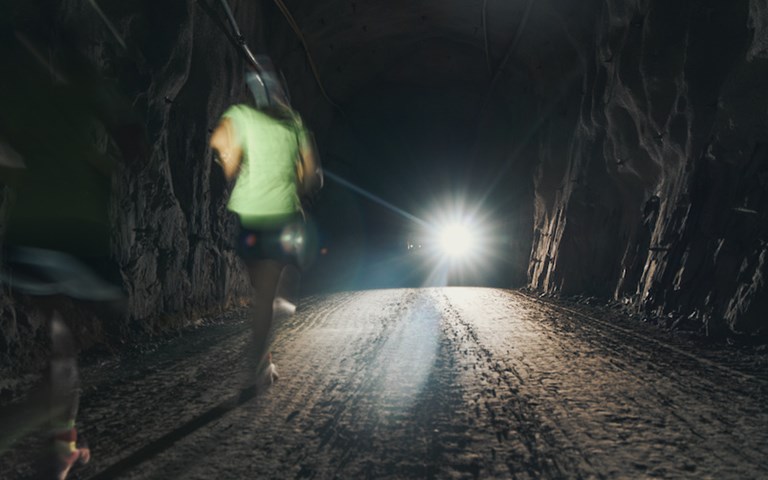
Ready, set, go—runners make their way through a tunnel 1,140 metres below sea level during the world’s deepest marathon at Boliden’s Garpenberg mine in Sweden. Courtesy of BecomingX/World’s Deepest Marathon.
In October 2025, a group of 55 mining professionals and seasoned and first-time runners laced up their shoes for what was likely one of the most unlikely marathon settings to ever take place: deep underground at the Garpenberg lead-zinc mine in Sweden, while mining operations continued.
The 42.2-kilometre race, held at 1,140 metres below sea level, is now the subject of a short documentary released in February by organizers ICMM and BecomingX, a professional training and coaching company.
“We really wanted people to experience mining in a way most will never get to do,” said Rohitesh Dhawan, CEO of ICMM, who developed the idea alongside BecomingX co-founder and CEO Paul Gurney.
A 17-person film crew went down into the mine equipped with low-light 4K cameras and drones to capture the event. While part of the motivation for the marathon was to break the Guinness World Record for the deepest marathon run (which they did), Dhawan said the bigger purpose was to challenge perceptions around mining, inspire participants to push their limits and raise money for charity.
“You may never want to watch a documentary about mining,” Dhawan told CIM Magazine. “But you would be interested in a crazy challenge like a marathon in a mine. We wanted to use the marathon as an entry point into [learning about] mining...[and to] make people rethink their assumptions and question what they thought mines were like.”
Mining is often perceived as unsafe, but Boliden’s Garpenberg mine offered a setting for what modern mining looks like with health and safety leadership at the forefront. Boliden has gone 17 years without a fatality across its operations, a record Dhawan described as “extraordinary.”
The site’s safety leadership, combined with its depth below sea level, made it an ideal location for the event.
“It started with a very detailed health and safety risk assessment that we did ahead of the event, which covered every potential risk that could occur,” said Dhawan. The mine’s general manager and staff mapped out potential hazards and contingency plans.
Participants also received detailed safety briefings the night before the race and again on the morning of the race, said Dhawan.
Along the route, hermetically sealed rescue chambers were positioned every few hundred metres, each capable of sustaining up to six people for 72 hours with food, water and air supply. Runners wore high-visibility clothing from head to toe, along with specially designed lightweight helmets to protect against potential rockfall. Participants were also tracked and monitored through lap timing mats and personal tracking devices attached to the back of their helmets.
“Everything from start to finish had a safety lens on it,” Dhawan said.
He added that the most common question from participants who were not in the mining industry was whether there would be enough oxygen underground. Thanks to the mine’s ventilation system, fresh air was continuously pumped underground.
“[What is] really interesting is that if you compare the air quality down in the mine relative to the air quality on the surface, we were breathing significantly cleaner air than if we ran the London Marathon or the New York Marathon,” said Dhawan. “That, again, just goes to show how far mining has come, how clean and safe mining environments can be.”
Clean air, however, did not actually make the run any easier.
For Dhawan, a seasoned runner completing his 15th marathon, this was the hardest run he said he had ever completed. The race route consisted of a two-kilometre stretch of tunnel that runners had to go back and forth 11 times to reach the full marathon distance. One direction featured a steady two-degree incline before descending on the return. The temperatures hovered around 27 to 28 degrees Celsius with 70 per cent humidity.
“Normally, when you run a marathon, you can see trees and people, and there are people clapping for you,” he said. “[At Garpenberg,] it was totally dark, which meant you had no visual stimulation.”
Amid the challenging conditions of the run, “the best part of the marathon for me came right towards the end,” said Dhawan, when one runner struggling to complete her final laps was joined by three participants who had already finished but decided to turn back to run alongside her and help her across the finish line.
“Once you finish, you just want to get out because you’re so tired,” Dhawan said. “And yet those three guys said, ‘No, we’re going to run with you and help you get across the finish line.’ It really did showcase human kindness and friendship at its best.”
Beyond breaking a Guinness World Record, the marathon raised US$600,000 for charity. Funds were split between the BecomingX Foundation, which supports skills and education initiatives in Africa, and the Wild at Heart Foundation, which focuses on animal welfare worldwide.
Whether the underground marathon will come back for another year remains uncertain. “I don’t know if and when it will happen again,” Dhawan said. “It was such a special thing to do once. That being said, it feels like it would be a shame not to at some point repeat the exercise.”