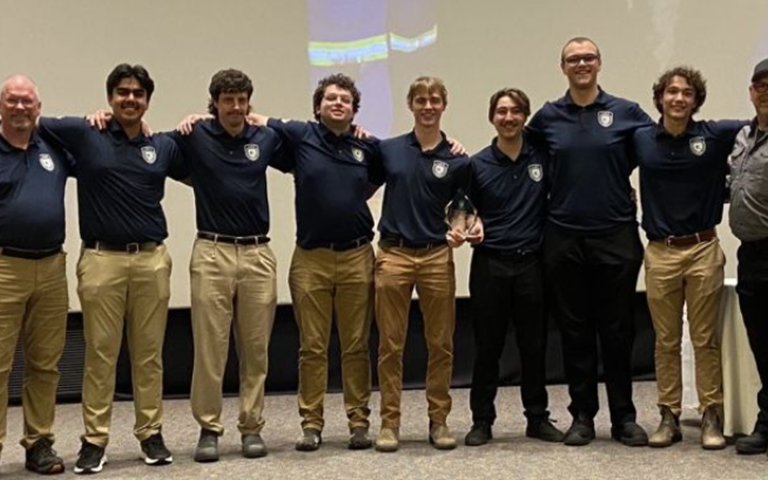
The Laurentian University Mine Rescue team. Courtesy of Laurentian University via LinkedIn.
The Laurentian University (LU) Mine Rescue team took first place at this year’s Intercollegiate Mine Emergency Response Competition (IMERC), held February 17 to 20 in Sudbury, Ontario. The event brought together approximately 80 participants from nine post-secondary mine rescue teams from across Canada and the United States.
The teams from West Virginia University and Colorado School of Mines placed second and third, respectively. Other participating teams included the University of Alberta, the University of British Columbia (UBC) #1, UBC #2, Montana Technological University, the University of Arizona and Queen’s University.
The annual competition location typically alternates between the Colorado School of Mines and UBC, but this year marked the first time it was hosted in Sudbury by LU. The competition featured several challenges, including an immersive underground scenario, a first aid scenario, a confined space challenge and a technician challenge. The event concluded with a closing banquet announcing the final results.
“This competition represents the culmination of nearly a year's worth of dedication and commitment from the entire LU Mine Rescue Club, with extensive planning and coordination led by our team and alumni,” David Langley, IMERC 2026 lead student coordinator and club executive of the LU Mine Rescue Club, said in a February 12 news release. “[It] brings together students from across North America in a shared passion for mine rescue, fostering camaraderie, collaboration, and learning from one another.”
The underground scenario simulated a full-scale mine emergency, giving teams a single two-hour attempt inside the tourist mine at the Dynamic Earth Science Centre. Team members were provided with limited information about the “emergency” they were responding to and had to rely on critical thinking to address challenges that arose throughout the scenario, which could include firefighting, search and rescue, rope rescue and more.
The first aid challenge, held at the Ontario Mine Rescue Station in Sudbury, presented a pre-determined scenario in which teams took turns demonstrating their first aid strategies. This component of the competition involved a mass casualty incident, where the number of casualties exceeded the available responders, requiring teams to act quickly.
In the technician challenge, one or two team members were tasked with a faulty standard mine rescue breathing apparatus. They had to analyze, diagnose, isolate and repair the issue as quickly as possible while minimizing errors.
Finally, the confined space rescue challenge utilized Ontario Mine Rescue’s modular enclosed training trailer to test teams’ ability to navigate a maze in low-visibility conditions, emphasizing communication and teamwork. Teams were scored based on speed, success in locating objects within the maze, and overall safety.
“Opportunities like this really make a difference in our education as students, and help us to become better, smarter and more safety-focused engineers,” said Langley.
The 2027 competition is scheduled to be hosted at the Colorado School of Mines.