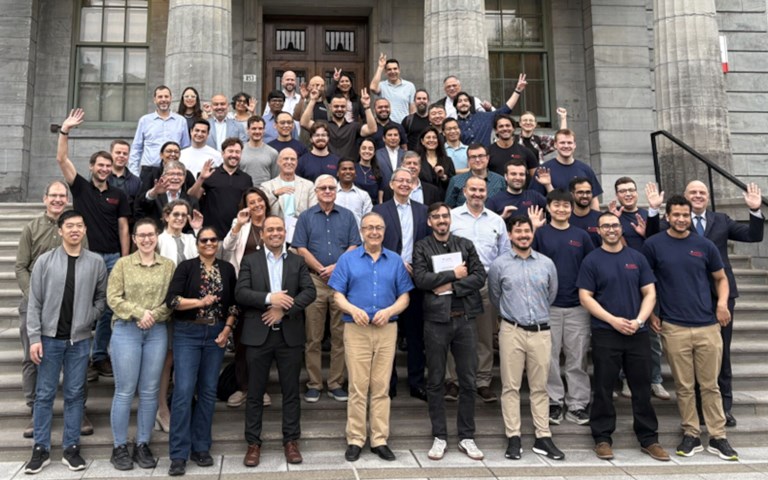
The 20th anniversary celebration of McGill University’s COSMO Lab in June brought together current students, alumni and industry partners to celebrate its contributions to research and collaboration in stochastic mine planning. Courtesy of Julian Haber
The COSMO Stochastic Mine Planning Laboratory, part of the Department of Mining and Materials Engineering at McGill University in Montreal, marked its 20th anniversary on June 23.
The engineering lab was launched in September 2006 with a focus on geostatistically modelling ore bodies, quantifying mineral deposit uncertainty and variability, and optimizing mining complexes from extraction through the value chain to the sale of mineral products. The lab collaborates with a consortium of mining companies, including AngloGold Ashanti, BHP, Iamgold, Newmont Mining and Vale, as well as organizations such as CIM, AusIMM and SME.
Stochastic mine planning forms the foundation of the work being done at COSMO, using probabilistic modelling and optimization to support mine planning and operations under geological, economic and operational uncertainty. Rather than relying on a single predicted future, stochastic mine planning generates decisions designed to perform well across multiple possible scenarios. This can help mining companies make more informed decisions and better manage risk in complex, uncertain environments.
Modelling uncertainty
Roussos Dimitrakopoulos, director of the COSMO Laboratory and professor in McGill’s Department of Mining and Materials Engineering, said the lab was founded to address a major challenge in mine planning: mining companies were developing long-term plans using single, deterministic geological models despite the inherent uncertainty of mineral deposits.
After seeing how the petroleum industry used probabilistic scenarios and simulation methods to make decisions that incorporate uncertainty, Dimitrakopoulos recognized the need for new optimization approaches in mine planning that could account not only for multiple geological scenarios, but also for economic and operational uncertainties such as commodity price fluctuations and changing market conditions.
This realization led him to make stochastic mine planning the focus of his research. In 2004, support from BHP helped establish the Canada Research Chair at McGill that laid the foundation for the creation of the COSMO Lab in 2006.
Building on this foundation of research, the lab has since translated these stochastic optimization methods into practical tools for the mining industry. In collaboration with KPI Mining Solutions, COSMO released the KPI-COSMO Stochastic Mining Optimizer in January 2023. The optimizer, initially designed for open-pit operations, became the first commercialized product to emerge from the lab and represents the first in a planned suite of stochastic optimization software solutions for mining companies.
Future versions of the software are expected to incorporate underground mining methods and operations, further expanding its applicability across diverse mining environments.
By integrating multiple geological scenarios and uncertain variables such as future commodity prices, the software is designed to optimize the mineral value chain, improving mine production schedules and helping companies to make better decisions under uncertainty while aligning with operational and financial forecasts.
From lab to industry
One of COSMO’s most vital contributions to the industry, according to Dimitrakopoulos, has been training the next generation of mining professionals, with many of its students going on to apply the knowledge gained from the lab in their own careers.
Since its establishment in 2006, the lab has supported the education and training of 30 graduate students through fully funded research opportunities.
“We would like to see mining programs everywhere introduce the basic concepts [of stochastic mine planning] in their undergraduate programs,” Dimitrakopoulos said. “One of my biggest efforts during the last couple of years has been to touch base with other universities and help them adapt the [necessary] materials for their classes.”
“Last November, for example, I was in Brazil and I met with several professors. I gave them materials and assignments to facilitate the integration of the new developments into [their curriculum],” he added.
One example of COSMO’s impact on the next generation of mining professionals is former graduate student researcher at the lab, Ryan Goodfellow, who is the current director of mine optimization at Newmont Mining.
Goodfellow recalled that his undergraduate studies at McGill lacked a focus on mine planning. During a 2008 internship with Metso in Australia, he identified this gap and began exploring the field further. His research led him to Dimitrakopoulos’s work at McGill’s COSMO Lab, where he was encouraged to take a course in stochastic ore body modelling. Inspired by the subject, Goodfellow pursued graduate studies and later completed a PhD in 2014 under Dimitrakopoulos’s supervision. During his PhD studies, Goodfellow and other students helped to develop the KPI-COSMO Stochastic Mining Optimizer.
“COSMO and [its] relationship with industry sponsors opened up a lot of opportunities, so I was lucky enough to be able to do short courses with Dimitrakopoulos, and go to a bunch of different mine sites in Brazil and other places,” he said.
He explained that the technical skills he developed at COSMO, including optimization and scheduling, have been directly transferable to his current role at Newmont. Beyond these technical capabilities, he praised Dimitrakopoulos’s ability to also teach students essential soft skills, such as effective communication. This included teaching students how to take highly complex research concepts and present them in a clear, accessible manner, which Goodfellow considers to be crucial now that he works in a role where his audience is often not technical.
Looking back on his time at COSMO, Goodfellow said students should approach the experience with curiosity and an openness to the opportunities that come from being part of the lab’s broader community.
“Doing research always assembles an incredible, diverse set of people in the lab with different skill sets,” he said, adding that you never know, in the moment, how the colleagues you work shoulder to shoulder with will shape and influence your career years down the road. “Also make sure you really take advantage of [connecting] with industry sponsors because a lot of them are COSMO grads, so they’re all incredibly supportive and want to see you succeed.”
More recently, COSMO’s research has expanded into artificial intelligence (AI) and reinforcement learning, with the goal of creating “learning mining complexes” that use real-time data to continuously adapt and improve short-term operational decisions. Dimitrakopoulos emphasized that AI is not intended to replace existing mine planning methods, but rather to enhance them by providing adaptive tools that help respond to changing operational conditions and support better decision-making.
While still a developing area, he believes these approaches will have a significant impact on the future of mining.