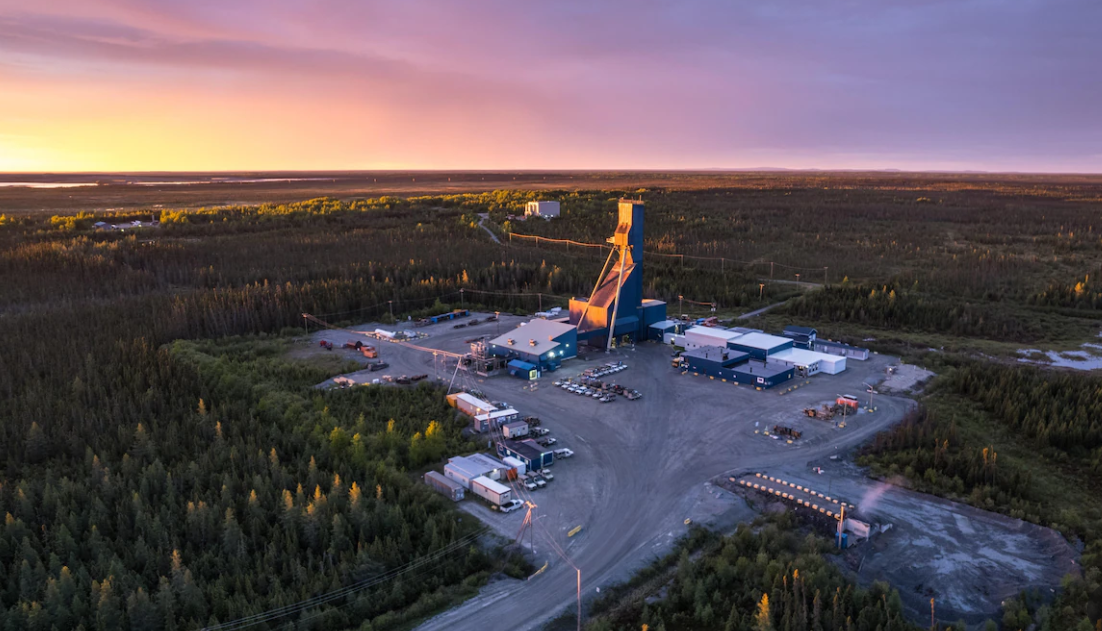
Fortune Minerals and the Tłı̨chǫ Government will receive up to $50 million in federal funding to build a key access road linking the NICO cobalt-gold-bismuth-copper project in the Northwest Territories to the territorial highway system, advancing the project toward a potential construction decision. Courtesy of Fortune Minerals Limited.
Welcome back to your weekly mining news recap, where we catch you up on some of the news you may have missed. This week’s headlines include a rock movement incident at Agnico Eagle’s Canadian Malartic gold complex, a new underground mine experience opening at Sudbury’s Dynamic Earth and funding for a new learning centre at the Britannia Mine Museum in British Columbia.
The Canadian federal government is investing up to $73 million across 12 projects to develop critical minerals, reduce mining emissions and expand Indigenous involvement in mining and infrastructure development. Funding includes up to $50 million for the NICO Project Access Road in the Northwest Territories, a joint Tłı̨chǫ Government-Fortune Minerals initiative that would connect the NICO cobalt-gold-bismuth-copper project to the territorial highway system. Another project involves $5 million for battery-electric vehicle demonstrations at Hudbay Minerals’ Lalor mine in Manitoba to test underground electric equipment and reduce diesel use.
On Thursday, the Alberta government proposed the route for a new oil pipeline that would run not to British Columbia’s north coast, but to a port near Vancouver. The project will now be referred to the federal Major Projects Office to determine if it should be fast-tracked as one in the national interest. There are a number of conditions connected to the proposed pipeline including that it be funded by the private sector.
First Mining Gold announced on Tuesday that it has secured federal environmental assessment approval for its Springpole gold project in northwestern Ontario. The company also reached an agreement with Slate Falls Nation to support collaboration on regulatory, environmental and participation matters for the project. A 2025 updated prefeasibility study for the project outlined a 30,000 tonnes per day open-pit operation averaging around 330,000 ounces of gold annually in the first five years and around 281,000 ounces per year over a 9.4-year mine life.
Agnico Eagle reported a rock mass movement at the Barnat pit at its Canadian Malartic gold complex in Quebec on Wednesday, prompting a temporary suspension of mining operations in the pit. No injuries or environmental damage occurred. The affected area is under geotechnical review, while processing of ore continues using stockpiles. The company expects 2026 production from Canadian Malartic will be reduced by between 60,000 to 80,000 ounces of gold.
Science North unveiled a $14.9-million expansion on Tuesday at the Dynamic Earth science centre in Sudbury, Ontario, featuring a new underground mine tour, immersive multimedia show and event space. The expansion introduces the Next Generation Mine Tour, a 45-minute underground experience showcasing how mining is evolving through automation, electrification and emerging technologies. Backed by government and industry funding, Science North expects the attraction to draw more than 90,000 visitors this year.
The Britannia Mine Museum in British Columbia is receiving a $3 million donation over three years from Wheaton Precious Metals to establish a Modern Mining Education Centre. The centre will offer hands-on learning opportunities for elementary through post-secondary students and the public to introduce them to the modern mining industry. As part of the funding, a visitor-accessible Caterpillar 793C haul truck donated by Finning Canada has been installed at the museum. The donation will also support a new collaboration with the University of British Columbia for field-based learning.
Cameco temporarily suspended mining at its Cigar Lake uranium operation in northern Saskatchewan on Wednesday after Orano’s McClean Lake mill, which processes ore from Cigar Lake, shut down its sulfuric acid plant for repairs. The mill is expected to restart in about two weeks. Cameco said it does not expect 2026 production to be affected, though longer delays could still impact the outlook.
Denison Mines said on Thursday that the Peter Ballantyne Cree Nation has withdrawn a judicial review application related to Saskatchewan’s environmental approval for the Phoenix in-situ recovery uranium mine and now formally supports the Wheeler River project. The company said the change follows further engagement with the Nation. Wheeler River, in northern Saskatchewan, received a construction licence in 2026 from Canada’s nuclear regulator, clearing the way for construction, with first uranium production expected in 2028.
The U.S. Army has conditionally approved long-term leases with four companies to build and operate critical mineral processing facilities on military bases. The projects would support domestic production of materials like lithium, graphite, boron and rare earth elements used in defence technologies. This marks the first time that commercial processing facilities will be located on U.S. Army installations, with formal lease agreements currently under negotiation.
Canada’s critical minerals are increasingly central to economic security, clean technology and defence, but the legal frameworks governing foreign investment and ownership have not fully adapted to match this shift, argued Carlos da Costa for CIM Magazine. He noted that current rules mainly focus on discrete foreign investment transactions rather than cumulative or indirect influence, creating potential gaps in oversight of ownership patterns.
That’s all for this week. If you’ve got feedback, you can always reach us at editor@cim.org. If you’ve got something to add, why not join the conversation on our Facebook, Twitter, LinkedIn or Instagram pages?