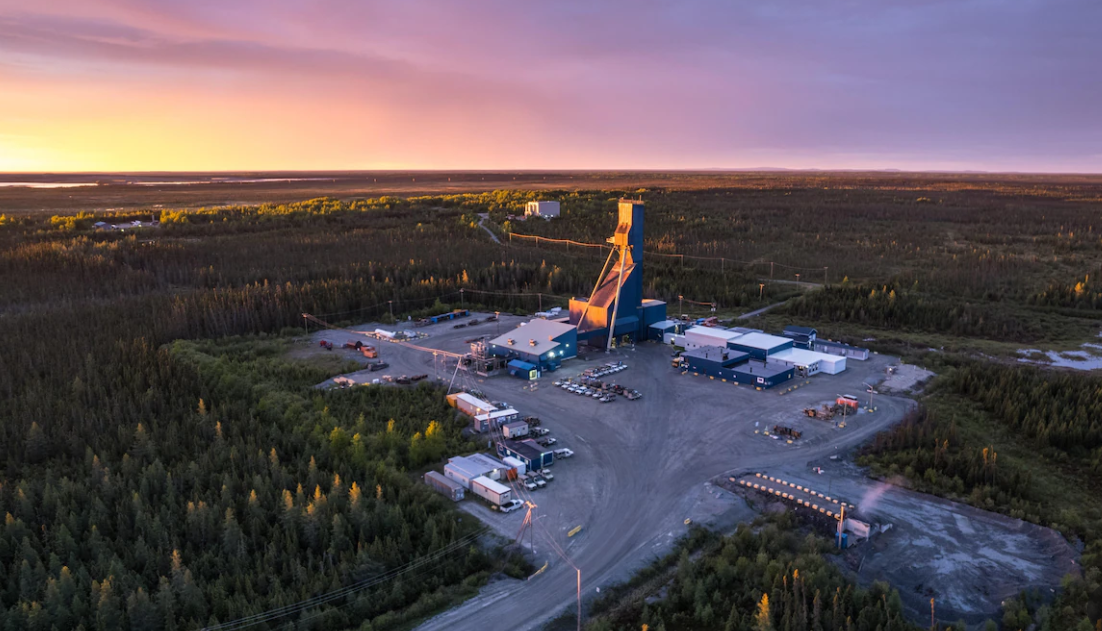
Torngat Metals’ Strange Lake project in Quebec is one of Canada’s few advanced-stage rare earth projects. Courtesy of Torngat Metals.
Evolving geopolitical pressures and supply chain concentration in rare earth elements, vital for energy, defence and advanced technologies, were a key focus of the latest Mission Critical webinar, a series from CIM Magazine and SGS Natural Resources.
The rare earth market is “small and niche” compared to other elements such as copper, but remains highly valuable because so few players operate in the space, said David Anonychuk, global vice-president of natural resources at SGS Natural Resources and co-chair for the Critical Mineral Council under the Canadian Chamber of Commerce. He highlighted three key application pillars: magnets used in wind turbines; defence applications such as fighter jets and submarines; and everyday technologies, including cell phones and electric vehicles, which account for the largest share of demand.
Policy responses
According to the International Energy Agency (IEA)’s 2025 Global Critical Minerals Outlook, the refining and processing capacity for critical minerals and rare earth elements is increasingly concentrated in a small number of countries, despite calls for diversification across G7 nations. The report noted that the top three refiners—China, Indonesia and the Democratic Republic of the Congo—account for approximately 86 per cent of global refining capacity in 2024, up from about 82 per cent in 2020.
Looking at how this concentration has evolved over the past several years, Anonychuk highlighted rising geopolitical tensions, such as China’s export restrictions, as a key driver behind recent policy responses in Canada and the United States aimed at strengthening national and economic security and diversifying supply chains.
He noted that beginning in late 2024 and particularly throughout 2025, there was a marked shift towards new strategic alliances aimed at what he described as “supply chain realignment.” This included U.S. executive actions to accelerate critical mineral supply chains, alongside expanded international cooperation with allies, which culminated in the June 2025 G7 meeting in Alberta, where members agreed to a strategic alliance framework to strengthen partnerships between resource-rich countries and those with processing capacity.
Building on this momentum, Canada’s November 2025 federal budget introduced measures tied to the Defence Production Act, granting the federal government new powers to directly support the critical minerals sector. These include entering into offtake agreements, providing purchasing support for strategic materials and establishing a Critical Minerals Sovereign Fund with $2 billion over five years to help finance domestic projects. One key early offtake agreement included federal support for scandium oxide production at Rio Tinto’s metallurgical complex in Quebec.
From resource to production
He highlighted that one of the biggest challenges in producing rare earth elements is the difficulty of separating and refining them, as they are typically found together in the same ore.
Mining is only the first step, and producers must decide how far to take the material through the production chain, whether to stop at a concentrated product or advance to further stages such as “cracking,” a process that uses heat and chemical treatment to produce an intermediate compound. From there, additional processing is required to isolate individual elements or grouped oxides through methods such as solvent extraction.
Anonychuk added that, because each mineral behaves differently during processing, companies must rely on detailed mineralogy to understand exactly how the elements are distributed and how best to extract them. He emphasized that early-stage geological analysis is critical to designing an effective and economically viable production process.
Canada’s rare earth project landscape
There are around seven rare earth projects across Canada that are currently in the advanced study phase, including Defense Metals’ Wicheeda project in British Columbia and Torngat Metals’ Strange Lake project in Quebec.
Anonychuk noted that the ore in typical Canadian projects contains about one to three per cent total rare earth elements, meaning only a small fraction of the rock is made up of the target minerals.
He stressed that advancing rare earth projects in Canada will require coordinated action across government, industry and investors. He emphasized that though governments are already taking a more active role through targeted funding, infrastructure support and defence- and industry-related strategies, attracting foreign direct investment and building international partnerships will be essential to move projects forward.
He also pointed to ongoing challenges in bringing projects from concept to production, noting the importance of aligning technical work financing and execution at each stage of development. He stressed that while policy and investment support are expanding, project advancement ultimately depends on disciplined development and getting the fundamentals right early in the process.
"We need diligent, robust piloting and studies because [rare earths] are multi-element and complex, but there's a lot of economic value to be unlocked,” he said. “We need to [make sure] the right funding is happening pre-construction, because accelerating and skipping steps is not going to serve anyone. If we’re going to accelerate, accelerate with discipline.”
A recording of the webinar is available on CIM's Youtube channel.