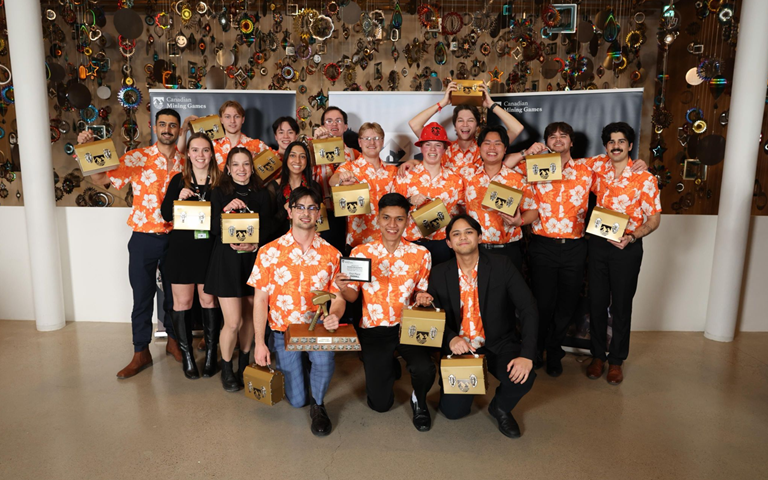
The University of British Columbia’s Norman B. Keevil Institute of Mining Engineering team took first place in this year’s games. Courtesy of UBC Mining Games via LinkedIn.
For the third year in a row, the University of British Columbia’s (UBC) Norman B. Keevil Institute of Mining Engineering team snagged first place in the 2026 edition of the Canadian Mining Games (CMG). The University of Saskatchewan and Université Laval placed second and third, respectively.
The 36th edition of the games took place at the University of Saskatchewan in Saskatoon from Feb. 19 to 21.
The schools that participated included the British Columbia Institute of Technology, the University of Alberta, the University of Saskatchewan, the University of Toronto, Queen’s University, Laurentian University, McGill University, Polytechnique Montréal, and Université Laval. Each team consisted of 16 students, for a total of 160 participants competing across 27 events.
Leading UBC’s winning team were co-captains Malcolm Salamon and Dies Nursadih, both of whom had previously competed on and won with the university’s past CMG teams.
Salamon noted that each year the competition features a diverse range of around 30 practical, technical, and presentation-driven mining challenges. These may include developing a detailed drill-and-blast design, selecting appropriate mobile equipment based on specific mining parameters, operating heavy machinery in simulations (such as a backhoe simulator) or participating in a comprehensive mine rescue scenario that incorporates emergency response, firefighting, and first aid.
Nursadih explained that to prepare for this year’s games, the team held biweekly meetings to review strategies and coordinate event-specific training. For certain events that Salamon and Nursadih described as more “hands-on,” such as jackleg equipment handling, the team reached out to sponsors in hopes of arranging training opportunities. The team was unable to secure any sessions this year, but they adapted by looking at past competitions to guide their preparation, identifying areas where they could improve or refine their approach.
“I’d say the most rigorous [event] from this year was the underground design [challenge],” Salamon told CIM Magazine. He explained that Nursadih was the one who participated in this event, noting that this particular challenge is around eight hours long, with participants receiving a block model where they are expected to make all the stopes, run all economics, and more.
“[That challenge] was super intense, and our team won, which was huge for us,” Salamon said.
Salamon explained that while the team felt “prepared for anything and everything” that came their way, they were surprised to find that some areas they had studied for, such as mineral processing, were not included in the games this year. Additionally, the team encountered a few unexpected “mystery events” this year, which, while unanticipated, sparked their excitement.
The annual competition typically concludes with a single large mystery event, but this year, eight smaller mystery events were held, Nicholas Landry St-Onge, secretary for the CMG, told CIM Magazine.
When asked about how Salamon and Nursadih split the co-captain responsibilities this year, they explained that it all comes down to the team selection. “We chose people for their specific skills in particular areas, so then the division of labour comes about pretty easy after that.” Salamon added that one of the benefits of that is you do not have too many people on one team who are good at the same things, so it “becomes obvious” who should tackle which event.
Salamon explained that the event was also a great networking opportunity for the team, through both the actual competition and the networking events following the games.
“I think [the networking aspect] is quite important, not just for [game participants] but I think it creates a bit of a sense of connectivity within our program as well,” adding that the games were a big discussion topic among students from UBC, sparking conversations even among those who had not attended. He noted that some first- and second-year students in UBC’s mining engineering program are now eager to participate next year after hearing about this year’s games.
When offering advice to those hoping to compete in a future edition of the games, Nursadih emphasized the importance of trusting not only your own abilities but also the strengths of your teammates, while remaining open to learning something new along the way.
“I think at every point [of the competition] you learn something new,” he said. “It’s a learning process.”
The 2027 games will be held at the University of Toronto.