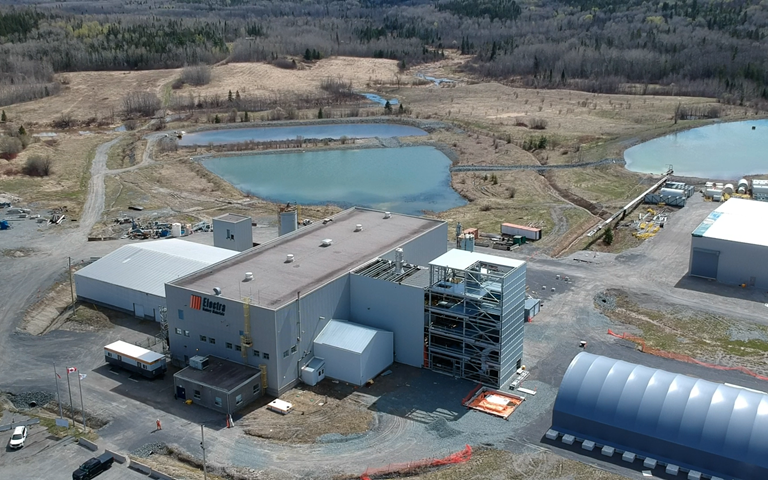
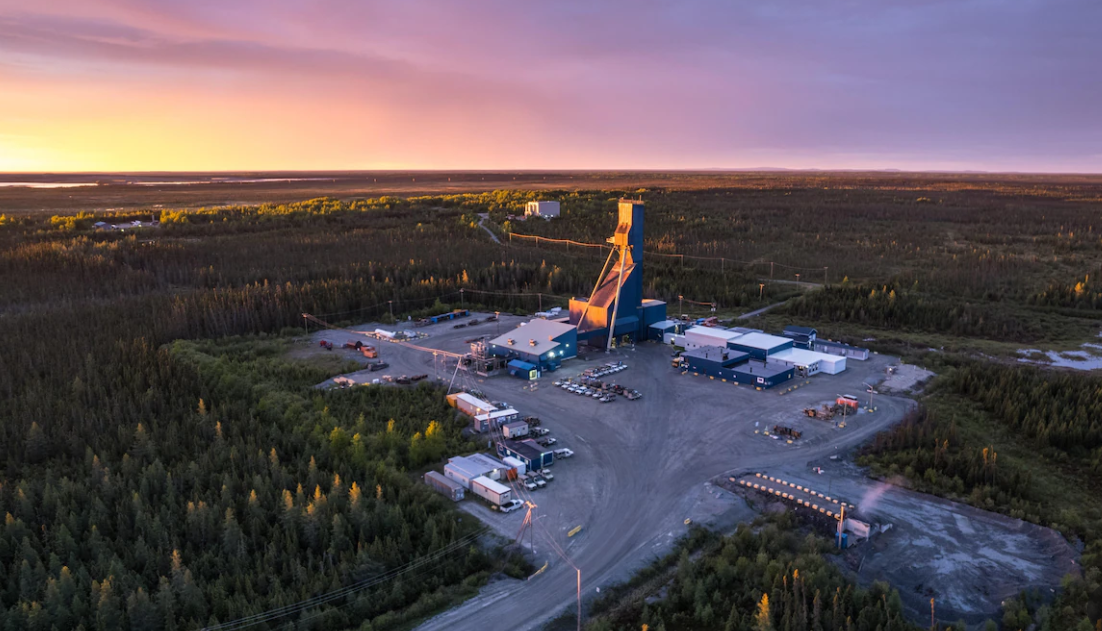
This week, Electra Battery Materials approved the construction budget for its cobalt sulfate refinery, which will be built at the company’s existing Ontario hydrometallurgical facility. Courtesy of Electra Battery Materials.
Welcome back to your weekly mining news recap, where we catch you up on some of the news you may have missed. This week’s headlines include three projects receiving support from B.C.’s critical minerals office, Sandvik breaking ground on a Saskatoon equipment facility, and the latest milestone in advancing a key Ring of Fire access road.
Electra Battery Materials approved a US$73 million construction budget on Monday for its planned cobalt sulfate refinery in Temiskaming Shores, Ontario. Construction of the facility is expected to begin this year, with first production expected in the third quarter of 2027, ramping up to commercial production by the fourth quarter of 2027. The fully permitted brownfield facility is expected to initially produce 5,120 tonnes of battery-grade cobalt sulfate annually, increasing to nameplate capacity of 6,500 tonnes per year by 2028.
Barrick’s plan to spin off its North American assets is facing a setback after Newmont, its joint venture (JV) partner in Nevada Gold Mines (NGM), issued a notice of default, Mining.com reported. Newmont claims Barrick diverted resources from NGM to advance its Fourmile gold project in Nevada, allegedly breaching their 2019 JV agreement—a charge Barrick disputes. If Barrick’s spinoff plan proceeds, the company would launch an initial public offering of a subsidiary holding its North American assets, including its stakes in NGM, the Pueblo Viejo mine in the Dominican Republic and the Fourmile project.
Denison Mines made a final investment decision on Tuesday to move forward with the construction of the Phoenix in-situ recovery uranium mine at its Wheeler River project in Saskatchewan. Last week the federal government gave its approval to the Phoenix mine. Site preparation and construction are set to begin next month, with first production targeted for mid-2028. According to the company, the project will be Canada’s first new large-scale uranium mine in over 20 years.
B.C.’s critical minerals office (CMO) announced that it will provide early-stage support to help accelerate the advancement of Northisle Copper and Gold’s North Island project, Surge Copper’s Berg project and Defense Metals’ Wicheeda project. This support will involve identifying regulatory requirements early and improving the projects’ readiness for environmental assessment and future permitting. FPX Nickel’s Baptiste project was selected in 2024 by the B.C. provincial government as the first project to be included in its CMO concierge service.
Sandvik Mining began construction on a roughly $51 million mining equipment manufacturing and servicing facility in Saskatoon on Monday, Global News reported. The facility will unify mechanical cutting, parts, service and aftermarket support, creating 30 new jobs and relocating manufacturing work that was previously done overseas to Canada. Construction of the facility is anticipated to wrap up by year-end.
Marten Falls First Nation has filed an environmental assessment for the proposed all-season Community Access Road that would connect the remote northern Ontario community to the provincial highway network and the Ring of Fire region. The province is aiming to begin construction as early as August this year. In November, the Ontario government and Marten Falls First Nation signed a partnership agreement to advance road construction, committing up to $39.5 million for community infrastructure and the environmental assessment.
The Pathways Alliance has rebranded as the Oil Sands Alliance to reflect its broader role in “promoting and expanding” the oil sands industry, The Globe and Mail reported. Though largely known for its Pathways carbon capture and storage project featuring a 400-kilometre pipeline that would transport carbon captured at oil sands operations to an underground storage site, the group also wants to be recognized for its work on environmental protection, land-use planning and reclamation.
Companies exploring helium projects face disclosure uncertainty since helium is neither classified as a “mineral project” under NI 43-101 nor as a hydrocarbon “product type” under NI 51-101, explained Staci Rollefstad and James Whyte for CIM Magazine. When helium is a byproduct of oil or gas, NI 51-101 may apply; otherwise, disclosure should follow the principles of NI 51-101 without implying compliance. Companies can report helium “reserves” with clearly defined technical terminology, ensuring transparency and compliance with applicable securities laws.
That’s all for this week. If you’ve got feedback, you can always reach us at editor@cim.org. If you’ve got something to add, why not join the conversation on our Facebook, Twitter, LinkedIn or Instagram pages?