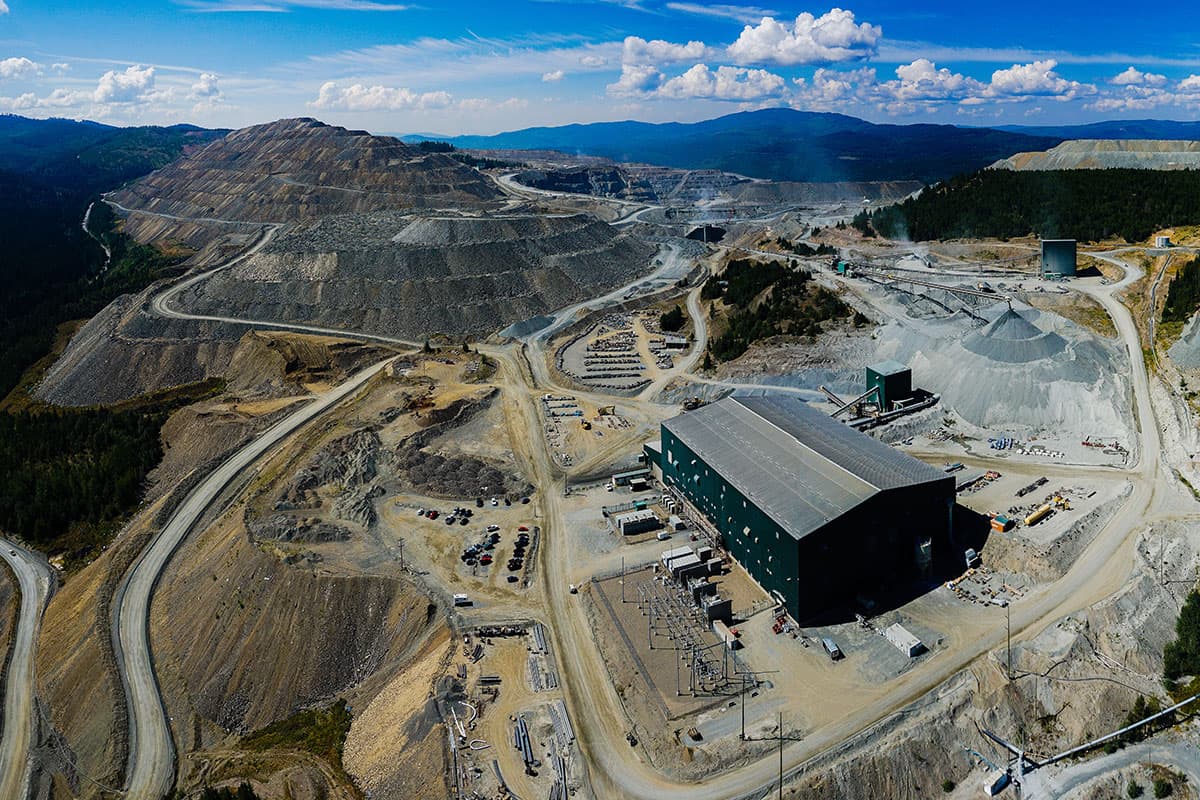
Hecla Mining entered into an agreement this week to sell its subsidiary Hecla Quebec and the Casa Berardi gold mine in Quebec to Orezone Gold. The operation produced 91,160 ounces of gold in 2025. Courtesy of Hecla Quebec.
Welcome back to your weekly mining news recap, where we catch you up on some of the news you may have missed. This week’s headlines include Canada strengthening energy and mining partnerships with India, Vizsla Silver reporting worker abductions at its Mexican project, and Hudbay expanding a Manitoba exploration agreement with Japanese partners.
Gold surged past US$5,000 an ounce for the first time Monday amid mounting geopolitical uncertainty and a weaker U.S. dollar, CBC News reported. Silver also jumped to an ounce this week. Prices for both metals, however, fell hard on Friday. On Thursday, copper prices hit a record above US$14,000 per tonne, marking their biggest one-day gain in more than 15 years.
Skeena Resources has received environmental assessment approval for its Eskay Creek gold-silver project in northwestern British Columbia. The decision marks the first time in Canada that a mining project has been jointly approved by a provincial government and an Indigenous nation under a Section 7 agreement, which embeds Indigenous consent directly into the environmental assessment process. Skeena has also secured a B.C. Mines Act permit for Eskay Creek, with final Environmental Management Act approval under review and a decision expected next month, paving the way for first production in 2027.
Hecla Mining has agreed to sell Hecla Quebec, its subsidiary that owns the Casa Berardi gold mine in Quebec, to Orezone Gold for up to US$593 million. The deal, expected to close during the first quarter of this year, would support Hecla’s strategy to focus on advancing its primary silver assets. This year, Casa Berardi is expected to produce 83,000 to 91,000 ounces of gold.
Minister of Energy and Natural Resources Tim Hodgson wrapped up a visit to India this week aimed at diversifying Canada’s trade relationships while advancing long-term energy and mining ties. During the visit, he endorsed a joint action plan on energy cooperation and met with senior government and industry leaders to support trade and investment in critical minerals initiatives, including potential supply agreements and joint ventures.
Canadian junior miner Vizsla Silver said that 10 employees were abducted on Jan. 23 from its Panuco project site in Sinaloa, Mexico, amid ongoing cartel violence, CBC News reported. Mexican authorities are investigating, with state and federal forces involved. Vizsla has suspended some operations at the site while crisis and security teams respond.
Hudbay Minerals has signed an agreement with the Japan Organization for Metals and Energy Security (JOGMEC) and Marubeni involving three exploration projects near Flin Flon, Manitoba. Under the deal, JOGMEC could earn a 10 per cent stake by funding at least $6 million in exploration over three years. The agreement builds on a March 2024 deal that allowed Marubeni to earn a 20 per cent stake by investing $12 million. If both options are exercised, the projects would be run as a joint venture, with Hudbay holding 70 per cent, Marubeni 20 per cent and JOGMEC 10 per cent.
Barrick Mining’s plan to spin off its North American assets depends heavily on joint venture partner Newmont, which holds key rights over Nevada Gold Mines (NGM) in the U.S., Reuters reported. Newmont has first refusal if Barrick tries to sell its stake in NGM and must approve share transfers, limiting Barrick’s flexibility. The proposed initial public offering from Barrick would include NGM, the Pueblo Viejo gold mine in the Dominican Republic and its Fourmile gold discovery in Nevada. The company is expected to outline its restructuring plans in February.
The U.S. government plans to invest US$1.6 billion in USA Rare Earth as it steps up efforts to strengthen its domestic supply chain of rare earth elements and curb reliance on China, The Associated Press reported. The investment from the U.S. Commerce Department would help advance a magnet manufacturing facility in Oklahoma, which is expected to reach commercial production in the first half of this year, along with a rare earths mining project in Texas slated to begin production by 2028.
MIRARCO opened a 10,000-square-foot pilot facility in Sudbury, Ontario, in October 2025 to develop and test biotechnologies that recover critical minerals from mine waste, I, Ashley Fish-Robertson, reported for CIM Magazine. Building on two decades of research, the facility aims to bridge the gap between early-stage laboratory research and industry adoption, support sustainable mining and strengthen Canada’s critical minerals capacity.
That’s all for this week. If you’ve got feedback, you can always reach us at editor@cim.org. If you’ve got something to add, why not join the conversation on our Facebook, Twitter, LinkedIn or Instagram pages?