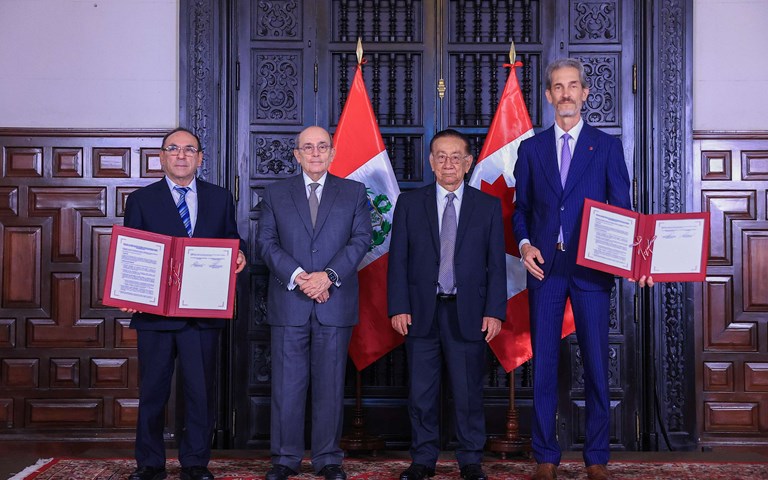
This week, Peru’s Minister of Energy and Mines, Angelo Victorino Alfaro Lombardi (far left), and Canada’s Ambassador to Peru, Jean-Dominique Ieraci (far right), signed an agreement for cooperation on critical minerals and sustainable mining. Courtesy of Natural Resources Canada.
Welcome back to your weekly mining news recap, where we catch you up on some of the news you may have missed. This week’s headlines include diesel prices surging amid Iran conflict, a technical report submitted for the Hammerdown gold project and surrounding deposits, and BHP’s incoming CEO announced.
Rio Tinto plans to slow the construction of the Nemaska Lithium processing plant in Bécancour, Quebec, due to rising costs, maintaining a minimal number of staff on site, Bloomberg reported. The facility, over 70 per cent complete, is expected to fully restart construction in 2027. Operations had been anticipated to begin in 2028, but it is now unclear whether that timeline will shift. Last month, Rio Tinto increased its stake in Nemaska Lithium from 50 to 53.9 per cent, becoming the majority shareholder.
Nouveau Monde Graphite (NMG) has secured US$335 million in debt financing from Export Development Canada and the Canada Infrastructure Bank to fund the second phase of its Matawinie graphite project in Quebec. With over 80 per cent of engineering work complete, NMG is advancing towards a final investment decision. The project was referred to the Major Projects Office for consideration in November 2025 to potentially support and accelerate its development toward commercial operations.
Canada and Peru inked a memorandum of understanding this week for collaboration on critical minerals and sustainable mining. The agreement sets a framework for investment, collaboration on technologies for traceability and decarbonization, regulatory improvements, workforce development and more.
Diesel prices in Canada have surged by nearly 30 per cent since the U.S.-Israel conflict with Iran began, reaching $2.19 per litre this week—the highest since 2022, CBC News reported. The conflict and the closure of the Strait of Hormuz have driven crude oil up by nearly 50 per cent, putting pressure on multiple sectors. Rising fuel costs are driving up shipping, production and food prices, and analysts warn prices may climb further as the conflict continues, affecting consumers nationwide.
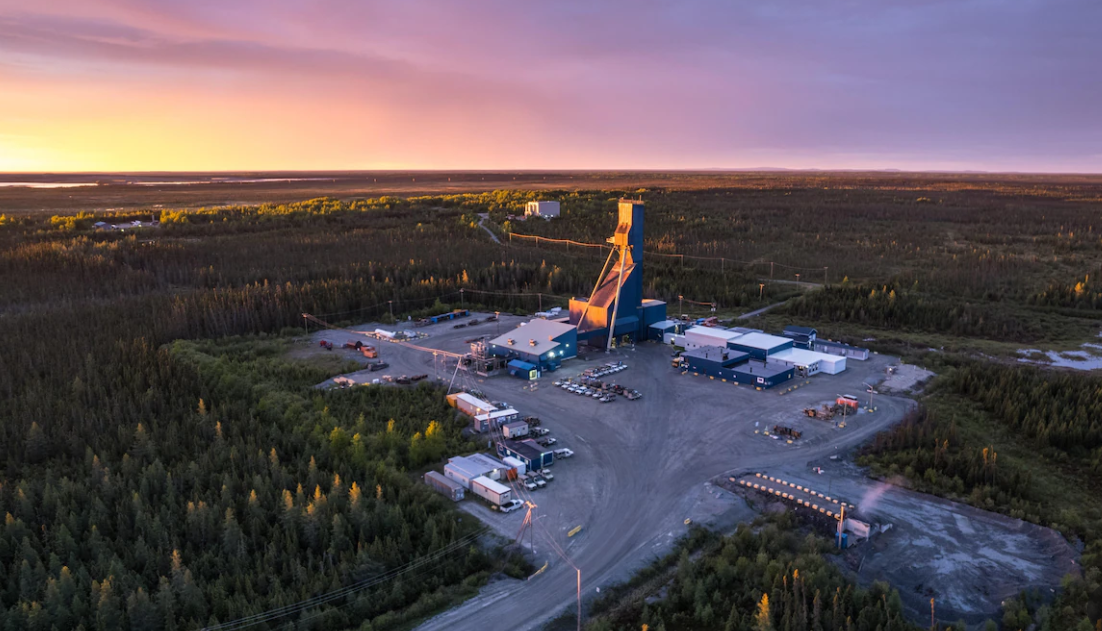
New Found Gold has filed the technical report for the preliminary economic assessment (PEA) it announced in February for its expanded Hammerdown gold project in Newfoundland and Labrador. The PEA, prepared by WSP Canada, outlines 251,287 ounces of gold produced over a mine life of 13 years. The company is also progressing its flagship Queensway gold project in Newfoundland and Labrador, having completed a PEA for the project in 2025.
Brandon Craig will succeed Mike Henry as BHP’s new CEO on July 1. Craig has over 25 years of experience with BHP across a range of roles, and has been president of BHP Americas since 2024. Henry has been CEO since 2020.
Outgoing Mining Association of Canada president and CEO Pierre Gratton, stepping down after more than 20 years with the organization, reflected on the industry’s evolution from a “sunset industry” to a globally recognized, strategic one. He noted how initiatives such as Towards Sustainable Mining, along with broader efforts in sustainability, Indigenous engagement and diversity, have reshaped mining’s reputation, while growing demand for critical minerals drives innovation in tailings management, energy efficiency and technology.
Rio Tinto and BHP’s Resolution Copper joint venture (JV) completed a land swap in Arizona to advance its Resolution Copper project, Reuters reported. The deal, opposed by the San Carlos Apache tribe for over 20 years due to sacred sites at Oak Flat, involved 2,400 acres being transferred to the JV—which Resolution Copper estimates contains more than 18.1 million tonnes of copper—in exchange for 5,400 acres being transferred to the U.S. Forest Service.
The University of British Columbia’s Bradshaw Research Institute for Minerals and Mining offers microcredential programs that help mining professionals worldwide build sustainability and leadership skills, I, Ashley Fish-Robertson, reported for CIM Magazine as part of its new year-long editorial series, Mining for Talent. Launched from successful virtual seminars during the COVID-19 pandemic, its programs—focused on economic leadership in mining and leadership in sustainable mine closure—are designed for working professionals and combine live instruction, group work and flexible online access.
Sidney Mamakwa, from Wunnumin Lake First Nation, shared his non-traditional path to engineering in a Q&A with CIM Magazine. After working in mining and construction for several years, he returned to school as a mature student, earning a mining engineering degree from Queen’s University in 2024 and becoming the first from his community to pursue an engineering career. Now an engineer-in-training at Orla Mining’s Musselwhite gold mine in Ontario, he applies hands-on experience to mine ventilation, safety and planning.
That’s all for this week. If you’ve got feedback, you can always reach us at editor@cim.org. If you’ve got something to add, why not join the conversation on our Facebook, Twitter, LinkedIn or Instagram pages?