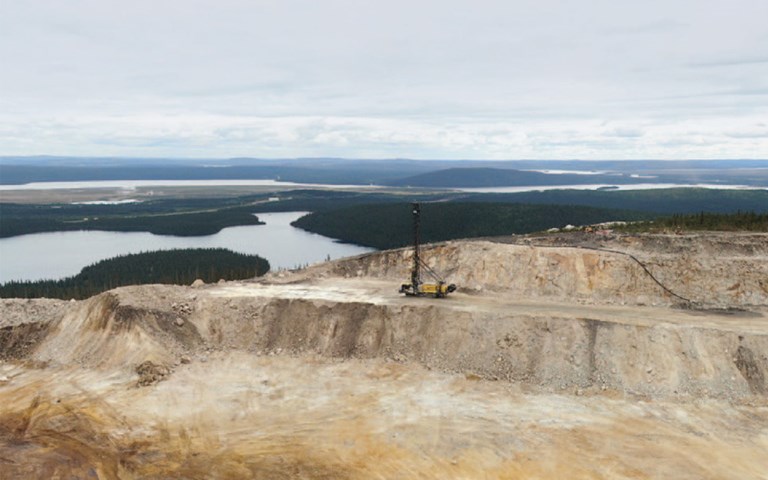
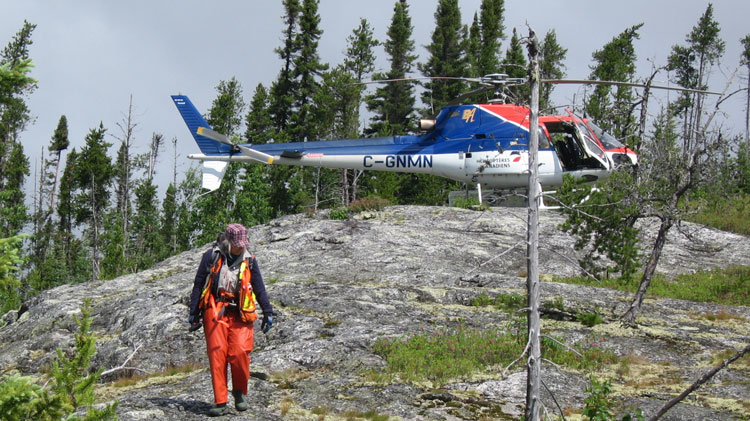
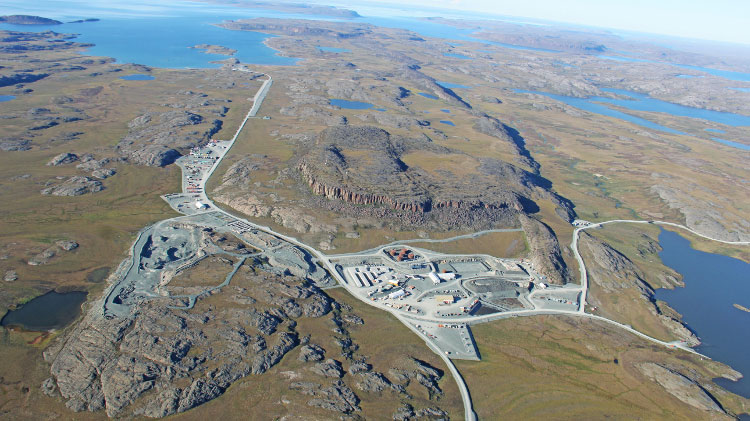
Rio Tinto’s autonomous electric drill at the Iron Ore Company of Canada mine allowed one operator to oversee the drill from a single remote location, improving mine safety and efficiency. Courtesy of Rio Tinto
At the open-pit Iron Ore Company of Canada (IOC) mine in Labrador City, Newfoundland and Labrador, Rio Tinto has piloted its first autonomous electric blasthole drill designed specifically for a subarctic mining climate.
The pilot builds on nearly two decades of experience with Autonomous Drill Systems (Rio Tinto ADS), which Rio Tinto has trialled and operated since 2008 in the Pilbara region of Western Australia as part of its Mine of the Future program. The system enables a single operator to remotely monitor and control up to eight drill rigs from a centralized console across different manufacturers and sites.
The push towards automation has been a consistent priority across Rio Tinto’s operations, driven by the benefits it brings to machine reliability, and overall productivity and safety for its drill rig operators, said Mark Arkell, general manager, mine and ore delivery system at Rio Tinto IOC.
At IOC, however, the company has moved beyond automation technology alone. This latest pilot marks a significant step-change by bringing together advanced autonomous systems with a fully electric drilling platform.
Rio Tinto partnered with Komatsu to help adapt both the automation system and the electric drill platform. Added to the challenge of combining the technologies was that the environment at IOC differed dramatically from the heat and isolation of Western Australia.
“The technology was well proven [based on] what it had done in the Pilbara,” said Jesse Dubberly, vice-president, surface drilling at Komatsu. But the temperatures at the IOC mine can range from summer highs of 50 degrees Celsius to winter lows near minus 50 degrees Celsius. Snow, ice and limited visibility are routinely part of operating conditions that can introduce an added layer of complexity for systems that rely on sensors, cameras and precise control.
The challenge at IOC was taking that autonomous system and integrating it into an electric platform capable of operating reliably in those extreme and changing conditions.
Piloted in partnership
The IOC mine has been operating for 70 years. It is majority owned (58.7 per cent) and operated by Rio Tinto alongside partners Mitsubishi Corporation (26.2 per cent) and Labrador Iron Ore Royalty Corporation (15.1 per cent), and produces premium iron ore pellets and high-grade concentrate. Its operations stretch across the Labrador Trough, with mining and processing operations in Labrador City, and a 418-kilometre railway linking them to port facilities in Sept-Îles, Quebec. The IOC operation currently employs around 3,000 people.
Rio Tinto first deployed two autonomous drills at its IOC mine in 2019 using technology from Indiana-based engineering firm Flanders. That same year, discussions began with Komatsu to pilot an autonomous electric drill at the site, leading to a joint development agreement shortly thereafter, the decommissioning of the original autonomous drills and a switch away from the Flanders technology to the Rio Tinto ADS technology.
“A lot of the [early] development work was to integrate the Rio Tinto ADS technology into the Komatsu vehicle,” said Dubberly. “It went through an installation, prototyping and validation period.”
To further de-risk the system, the Rio Tinto and Komatsu teams completed testing in a controlled environment at the Lannon quarry, near Komatsu’s main plant in Wisconsin, in the winter of 2023 and 2024. “Most of the testing focused on proving that the safety systems, communication and command controls worked,” Dubberly said, noting that Rio Tinto worked closely with Komatsu during this period to ensure the technology was ready for site-based trials.
The collaboration extended into field trials at the IOC mine in November 2024, when the teams conducted formal operational trials to ensure reliable operation in real-world and extreme-winter conditions. The testing phase demonstrated and confirmed its safety, productivity and reliability targets with the IOC team reporting productivity gains of more than 20 per cent during the trial compared to manual drilling.
After the trials, the system was formally handed over to the operations team at IOC in September 2025.
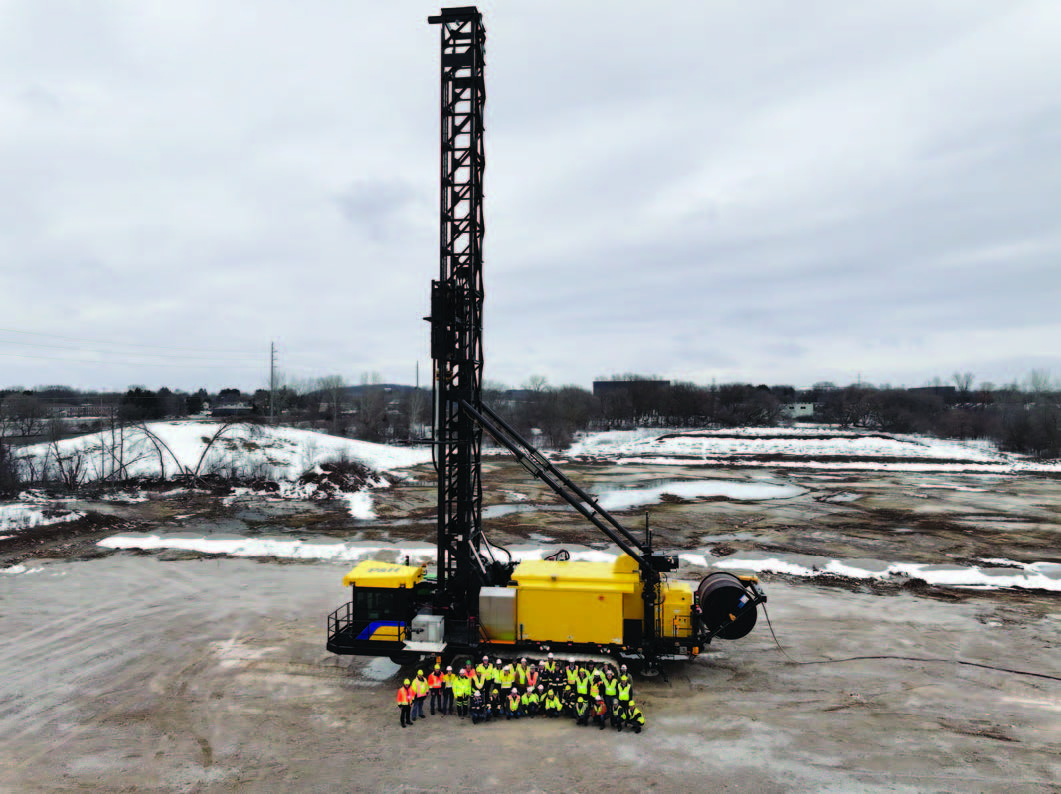 After nearly a year of testing by Rio Tinto and Komatsu, the autonomous electric drill at the Iron Ore Company of Canada mine entered operation in September 2025. Courtesy of Rio Tinto
Engineering for the subarctic
The IOC operation seemed like a good candidate for autonomous drilling in part, said Arkell, because of its harsh operating environment. “It makes sense to bring in technology to help manage those conditions where extreme cold, variable weather and remote operations create additional challenges for conventional drilling,” he said.
But adapting the Rio Tinto ADS technology from the Pilbara to Labrador City introduced a new set of technical constraints due most notably to the cold. Unlike the desert conditions of Western Australia, IOC’s subarctic climate required both hardware and software modifications to ensure the system could operate reliably in snow, ice and extreme temperatures, as well as integrate with IOC’s existing operational and safety systems.
Rio Tinto was able to successfully validate the technology to perform in temperatures as low as minus 50 degrees Celsius, confirming its ability to function under real-world winter conditions.
Beyond the environment, one of the most complex engineering challenges the team needed to work through was the shift in power source from diesel to electric. “About 95 per cent of the drill rigs in Australia run on diesel fuel,” Arkell explained. Though diesel power suffers its own drawbacks—such as refuelling requirements, lower energy efficiency, environmental and regulatory constraints, and carbon emissions—it does allow the rigs to be very flexible in their operation.
Unlike the diesel-powered drill rigs in Australia, the drill rigs at the IOC mine run on hydroelectric power supplied through the grid, which require constant connection to power sources via large trailing cables. While an operator on board a drill rig can easily see and avoid hitting the cables, enabling autonomous systems to do so posed some serious challenges, requiring new sensing and control solutions.
“Through the addition of cable models, cameras and other sensors, we were able to develop solutions to accommodate managing that cable reel and move the drill around safely and effectively and efficiently,” Dubberly said.
Despite the challenges of working around cables, autonomous drill rigs provide much more efficient drilling over time. “Autonomous operations are far easier overall, making up in productivity what you lose from the inflexibility of being tethered to the electric system,” Arkell said, noting that autonomous drilling operations also offer far more reliable and repeatable performance through the variable geological conditions that are experienced at IOC.
“You just don’t know what you’re drilling into in terms of geology,” Arkell added. “The autonomous solution is able to manage that variability better than non-autonomous operation, and results in overall better productivity.”
Part of that productivity is the result of overall consistency of operation, Dubberly said. “Consistency allows companies to plan so that the resources can be allocated efficiently and effectively,” he said. This allows for better management of costs. “It’s incredibly beneficial for the mines.”
Similarly to results during the testing phase, Arkell noted that the IOC mine reported a 20 per cent productivity boost in average drill penetration rate over manually operated drills in the same geology during the first quarter of 2026.
A different way to work
Further to that, autonomously run drills mean a far safer workplace for employees. “It’s worth every dime of investment and every minute of savings to include the fact that you’ve now separated those operators and gotten them completely out of the line of fire,” Dubberly said.
Not only are those drill operators out of harm’s way but they are also shifting to a different way of working. Some operators were retrained to be controllers instead. “They went from operating heavy machinery in the pit areas to operating the same machinery but now in an office-based environment,” Arkell said.
Pit attendants, who work to set up the pit areas for successful drill operations, had to learn to work with the new technology; for example, maintaining a new suite of sensors and adjusting operational procedures to ensure the cable was placed correctly for the drill to operate. Finally, mine managers needed to learn the skills to get the most benefit out of the autonomous equipment.
Change management in an operation the size of IOC is no small task, said Dubberly, adding that organizational change could make or break new technology adoption. “The immediate reaction when people hear ‘automation’ is they think they’re being replaced,” he said. “In fact, existing skill sets remain critical to operations, as new technical skills requirements are added.”
There are 43 autonomous drills operating across various Rio Tinto operations. In the Pilbara alone, autonomous drills have collectively completed over 35 million metres of drilling. The IOC pilot is the latest collaboration in a long-standing partnership between Rio Tinto and Komatsu, which has included the development of autonomous haulage systems and, more recently, collaboration on low-emission mining technologies.
What distinguishes this project, according to Arkell, is the level of integration between the two companies throughout the development process.
“Drill autonomy is one area where we hadn’t seen a path forward before,” Arkell said. “We saw a need when it came to IOC, and I think this has been a real partnership.”
That partnership has allowed for greater possibilities for both parties, Dubberly added.
“Typically, as an OEM, we’re developing products and testing them as much in-house as we can to de-risk them before we can introduce them to customers,” he said. “Having Rio Tinto go along that journey with us step for step, gate for gate, getting that feedback from day one, has really sped that process up.”