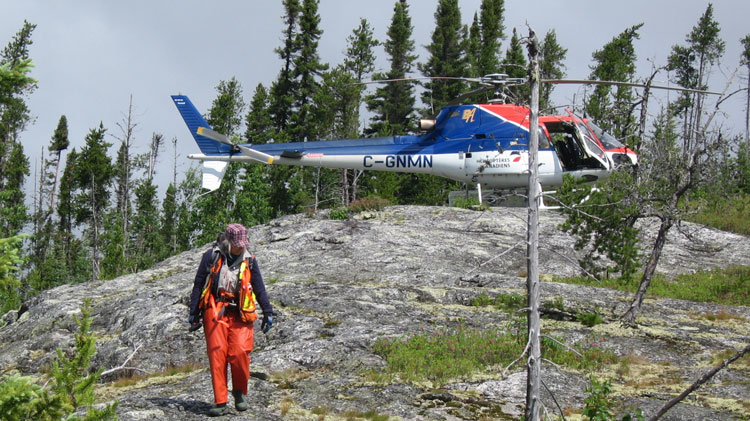
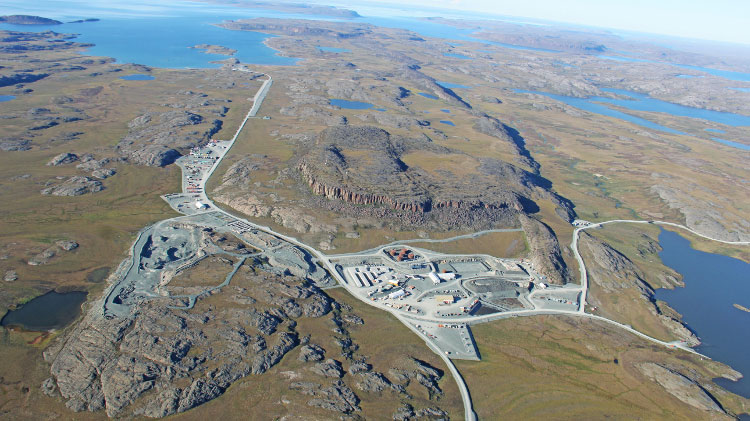
By completing the permanent feeder system, Hudbay is now positioned to reach its targeted plant throughput of 50 tonnes per calendar day. Courtesy of Hudbay Minerals Inc.
In southern British Columbia, a Canadian copper giant is planning to stay strong for the long term. At the Copper Mountain mine, located 15 kilometres southwest of Princeton, Hudbay Minerals Inc. faced a familiar challenge in mining: how to move more ore through an existing processing plant without building an entirely new one.
The open-pit copper operation had a processing plant built around a comminution circuit with a single semi-autogenous grinding (SAG) mill feeding three ball mills. While the set-up worked reliably, it also capped how much material the plant could handle.
Hudbay wanted to increase daily plant throughput from 45,000 tonnes per calendar day (tpcd) to its permitted capacity of 50,000 tpcd—and do it quickly. Achieving that target would help support the company’s plans to extend the mine’s life beyond 2040 while positioning the site for future growth.
But first, the company had to address a bottleneck inside the grinding circuit.
“We identified our SAG mill as the primary bottleneck,” said Joseph Tsoi, head of projects at the Copper Mountain mine. “Adjustments to the circuit were a careful balancing act between discharge grate sizes and downstream circuit stability.”
The plant had excess secondary grinding capacity from the third ball mill that was installed in 2021, prior to Hudbay’s acquisition of a 75 per cent stake in the mine in June 2023 through its purchase of Copper Mountain Mining Corporation. (Hudbay later consolidated its position in March 2025 by purchasing Mitsubishi Materials’ remaining 25 per cent stake, bringing the operation fully under its ownership.)
Prioritization of plant stability resulted in an underutilized third ball mill, said Tsoi. After Hudbay took over operations in 2023, the third ball mill was temporarily shut down while the company reassessed the processing plant’s overall milling strategy.
To solve the bottleneck in the SAG mill, Hudbay came up with a project to shift the plant towards a dual-SAG configuration by converting the underutilized third ball mill into a second SAG mill. The change would create two parallel primary grinding streams capable of handling more competent ore while improving overall plant stability.
The decision for the project came out of a January 2024 workshop on new perspectives in process engineering and metallurgy. Tsoi said the team had come together to identify how best to expand the plant’s capacity to 50,000 tpcd.
“In that workshop, we identified where the different bottlenecks were at a high level and where our best [option] would be in terms of capital spend versus what the value would be,” he said.
The Hudbay team conducted accelerated scoping studies in March 2024 to evaluate different approaches for reaching the 50,000 tpcd processing target, with two potential projects identified. The second project that was under consideration was aimed at improving the screening of upstream material in the crushing circuit.
“As we continued to develop the concept, it gave us a better idea of what it would take to execute this brownfield project in a live operating plant. We had to take careful consideration and planning in order to minimize its impact on production, downtimes associated with critical tie-ins and intense expediting of equipment and material deliveries,” Tsoi said.
In July 2024, the team started feasibility studies to compare the two options in depth, before deciding in September to pursue what they called the “Ball mill three to SAG mill two project.”
Tsoi noted that “the ability to tie the circuit into the existing operation, while minimizing impact to copper production, was the key criterion that led us to this dual SAG pathway.”
An accelerated timeline
Once the team aligned on how to debottleneck the circuit, they faced another challenge: delivering first ore to SAG mill two in less than a year. To meet the timeline, Hudbay adopted a phased approach. Phase one focused on installing a temporary feed conveyor system to mitigate equipment lead time constraints, with a target of bringing it online by July 2025. This ambitious target, said Tsoi, was the project’s biggest challenge.
“The first reaction I got whenever I communicated [it] to various stakeholders and team members at the time was that this was probably one of the most aggressive timelines they’d encountered,” he added.
The tight timeline meant coordinating the timing of engineering, procurement, construction, commissioning and operational readiness in a short one-year sprint. In order to understand and be able to plan for when each part of the project needed to be done, the team worked backwards from their fixed deadline. “[We were also] seeing where we could streamline the activities, while at the same time understanding what risks we were willing to tolerate and what we could do to mitigate them,” said Tsoi.
Another challenge was working with long lead equipment, where, in order to meet the project timeline, the team went to market based on less precise issued for tender (IFT) drawings rather than issued for construction (IFC) drawings from engineers.
“It was an accepted risk that there may be changes from IFT to IFC versions of drawings, and we accepted that we would manage the changes,” Tsoi said. What really helped the team, according to Tsoi, was finding Prince George, B.C.-based metal fabricators, Farr Fabricating, whose team was very detail-
oriented and communicated changes early on and managed those communications with both teams. “They were willing to work [overtime] with us, and we were all working with them, being available after hours and on weekends, to meet our project schedule.”
With the equipment that had long lead times, the team also had to get creative around temporary measures.
“We would not be able to get the required full set of conveyors and have a reclaim tunnel built by July 2025, so we would not have an effective means of feeding material from our live stockpile into the mill,” Tsoi explained.
Instead, the team rented conveyors and staged equipment on the stockpile to feed the material, creating a temporary feed system that allowed them to stay on schedule. Hudbay achieved first ore production on July 10. The temporary setup remained in place from July through December 2025, while the team moved on to the final phase by building the permanent feeder system and getting SAG mill two operating at a limited capacity.
By early January 2026, the plant was fully operational with grinding capacity now available to reach its project goal of 50,000 tpcd.
Managing moving parts
Executing the plant upgrades presented another layer of complexity because most of the work had to be completed inside a fully operational processing plant.
“We were [essentially] doing surgery inside a live operating plant,” Tsoi said. “We needed to identify all of the different streams and energy sources we needed to isolate, while allowing the rest of the plant to continue operating.”
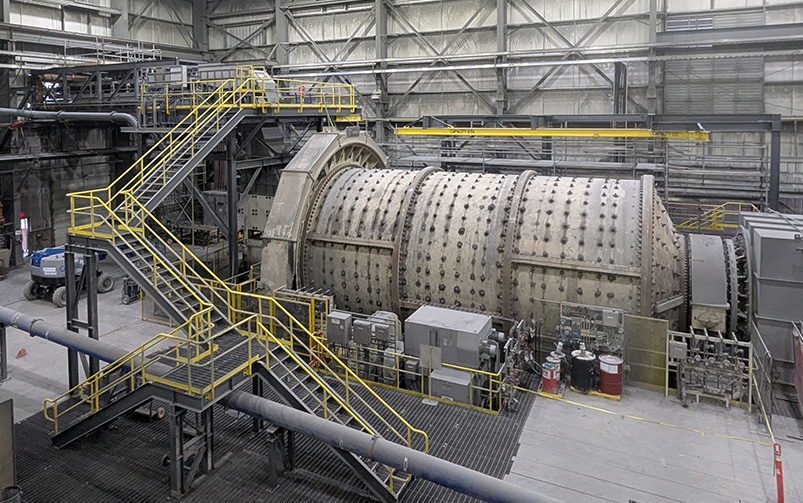 Hudbay converted one of its underutilized ball mills into a second semi-autogenous grinding mill at the Copper Mountain mine. Courtesy of Hudbay Minerals Inc.
Then, the Hudbay team also had to manage the design for the new work and equipment, which included the specifics of when to bring in water sources, how to bring material in and out of the system, how to tie the product from SAG mill two back into the original circuit and manage this with scheduled shutdowns in the process plant.
Digital tools played an important role in the planning process. Technologies such as drones for live capture and three-dimensional (3D) scanning were used to help the team plan out their project work.
“[With drones], we can get really good, accurate material takeoffs for civil works, for example,” Tsoi said. “We can show and communicate on images where we want to do some geotechnical drilling and how it relates to where we plan on having this reclaim tunnel to be installed. I found it [to be] an extremely useful tool, both for my understanding as well as for my ability to convey what actually needed to be done to the people that I report to.”
Yet, there were still surprises that the team did not account for. “There are little, minor scopes that you just don’t capture in a 3D scan or see until your tradespeople are out in the field and are about to put in a pipe, and then it turns out it is tucked behind another beam behind the camera of the scanner,” Tsoi said. “There will always be those little things that remain unaccounted for.”
For Tsoi, one of his major takeaways from the project was that it is possible to execute accelerated project timelines when all stakeholders, from corporate sponsors to the operations team you are working with, are aligned that the business case outweighs the associated risks and risk mitigations.
“Hudbay empowered [us] to meet the business objectives and to identify the risks,” Tsoi said. When the team identified risk mitigation measures that would result in additional costs, they did a high-level financial analysis to determine whether to move forward. “That was probably my biggest takeaway—really seeing the big picture of how a project impacts the business at the end of the day and quantifying what that benefit is.”
Another key learning was the importance of keeping everyone involved in the project aligned throughout the process. “Communication, communication, communication,” Tsoi emphasized. “Making sure that everybody is on the same page, not just within our own internal project team but across all the various internal stakeholders and external partners.”
The 3D modelling and drone images, he added, were also helpful in achieving that alignment. “Having the tools and visuals to illustrate and convey a concept goes a long way as opposed to just using words in meetings [because] everyone can have a different interpretation.”
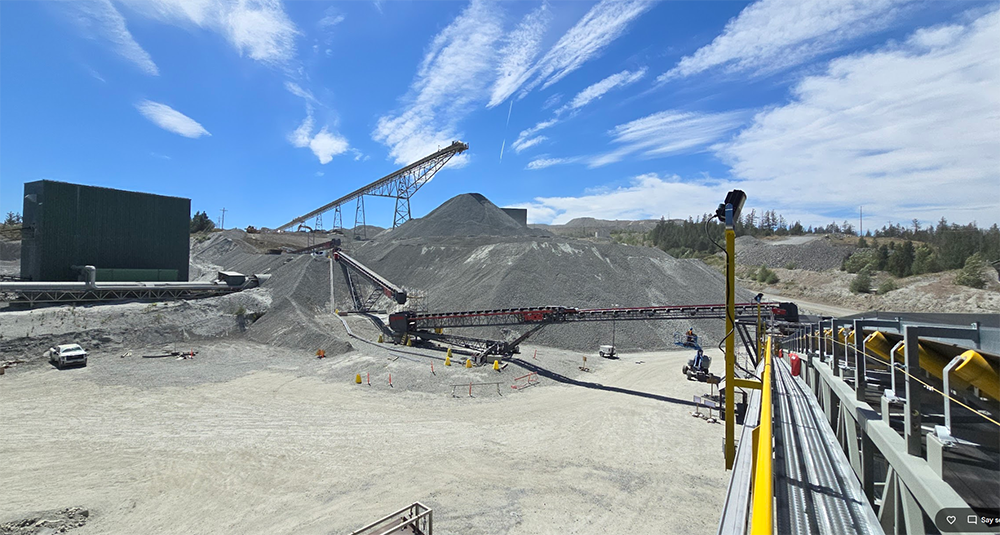 A temporary conveyor system allowed early ramp-up of the semi-autogenous grinding mill two and first ore production while permanent infrastructure was still being built. Courtesy of Hudbay Minerals Inc.
Set up for tomorrow
While there is still the automatic media loading system for SAG mill one and two left to complete by the end of May this year, Tsoi said that all throughput improvement activities tied to the dual SAG conversion were met for phase one’s July 2025 timeline.
With the upgraded grinding circuit now operating at full capacity, Hudbay is turning its attention to the next phase of Copper Mountain’s development, which is to reopen the past-producing New Ingerbelle pit at the mine. Hudbay received the environmental permits for the New Ingerbelle expansion project at Copper Mountain in February, issued by the B.C. Major Mines Office.
“Once we reactivate that deposit, it will add another 12 years based on current reserve estimates to Copper Mountain’s mine life,” Tsoi said. The Copper Mountain mine has proven and probable reserves of 344.9 million tonnes of copper at average grades of 0.256 per cent, as of March 27. It also has measured and indicated resources of 121.7 million tonnes of copper at average grades of 0.210 per cent.
“Over the next two years, we’ll be building the infrastructure that will allow us to do that,” he added.
While the SAG mill conversion project helped the company reach this point, the project’s success is much more than that. Tsoi said that with over 130,000 hours worked, it has had no lost-time injuries (LTI). “Both the Copper Mountain mine and Hudbay Minerals have a strong culture of safety, and I’m pretty proud of remaining LTI free,” he said. “That is really what has helped us achieve our schedule: making sure everybody goes home safe every day. I’m proud of our safety results.”