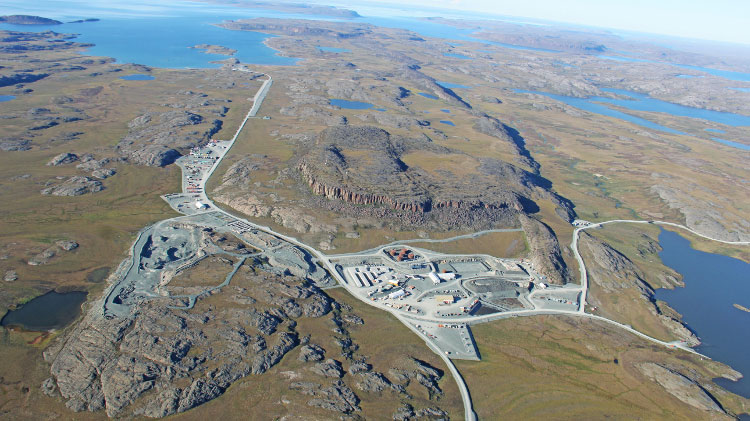
B2Gold’s Goose mine is located in the west Kitikmeot region of southwestern Nunavut, and is not connected by road to communities in Nunavut or to the rest of Canada. Courtesy of B2Gold
This was one of our favourite stories of the year. To see the full list, check out our Editors' Picks 2025.
More than 300 guests flew from Vancouver and Yellowknife to attend the grand opening of B2Gold’s Goose gold mine on Sept 4. The approach was cloudy as our plane descended towards the airstrip, obscuring the view of the distinctive goose-shaped lake that gave the mine its name. Even without the view, though, there was a sense of excitement on board—a shared anticipation of witnessing the official opening of Canada’s newest gold mine in the heart of Nunavut.
It was a ceremony with local inspiration: Clive Johnson, president and CEO of B2Gold, and Attima Hadlari, vice-president of economic development at the Kitikmeot Inuit Association (KIA), cut a sealskin ribbon with an ulu to officially open the mine.
B2Gold is headquartered in Vancouver, and the Goose mine is its first operating asset in Canada. In addition to the Goose mine, the company has three producing gold mines—the Fekola mine in Mali, the Masbate mine in the Philippines and the Otjikoto mine in Namibia.
“Without the success of these mines, the acquisition and development of the Goose mine would not have been possible,” said Johnson at the opening ceremony. “We have brought our expertise and culture home.”
The Goose mine is located in the west Kitikmeot region of southwestern Nunavut, approximately 400 kilometres southwest of Cambridge Bay. The mine is in an arctic climate—typical winter temperatures are around minus 30 degrees Celsius—and it is remote, not connected by road to communities in Nunavut or to the rest of Canada.
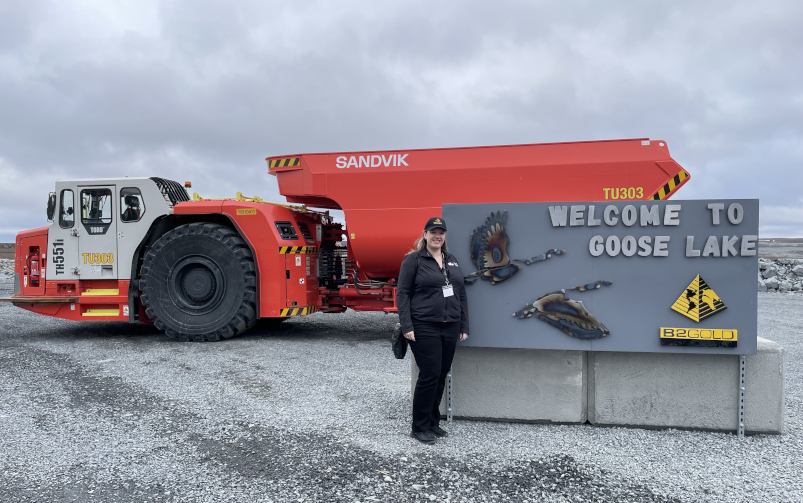 Ailbhe Goodbody visiting the Goose mine in September 2025. Photo: Ailbhe Goodbody
The mine is part of the extensive Back River gold district, which consists of 11 mineral claims groups along an 80-kilometre belt that collectively covers an area of approximately 96,150 hectares.
Gold was discovered in the area in 1982. Exploration work was completed by various operators over the following decades, and the Back River project was acquired by Sabina Gold & Silver in 2009.
The Goose mine is the first operation to be developed in the Back River gold district, and Sabina advanced it significantly, making a formal construction decision in 2022 and beginning initial construction the same year.
In April 2023, B2Gold acquired Sabina and the Back River gold district and was able to accelerate construction work, drawing on the arctic experience that its in-house construction team gained from constructing the Julietta and Kupol mines in Russia for B2Gold’s predecessor, Bema Gold. First ore was introduced to the mine’s processing facilities on June 24, 2025, followed by the first gold pour on June 30. The Goose mine achieved commercial production on Oct. 2.
“We believe the federal government will live up to its commitment to open up the North with infrastructure and a streamlined permitting process for mining projects,” said Johnson. “The North is open for business.”
Community impact
B2Gold has a strong partnership with the KIA, who are the landowners of where the Back River project and Goose mine are located. The Inuit Impact Benefit Agreement (IIBA), which was established in April 2018 under a broader framework agreement between Sabina Gold & Silver and the KIA, is a cornerstone agreement for the Back River project.
The IIBA sets out specific commitments associated with Inuit employment, training and education. The Goose mine currently employs 1,150 people, which includes over 200 Inuit.
“The Goose gold mine has the potential to be a transformative economic development for the Kitikmeot region,” said Hadlari at the opening ceremony. “Kitikmeot Inuit will benefit greatly [from] employment and training opportunities, and directly [from] financial payments.”
Some of the financial benefits in the renewable, 20-year agreement include a one per cent net smelter return royalty on gold production, as well as 2.5 million B2Gold shares and a $4 million cash payment towards regional wealth creation.
Johnson noted that the territory’s housing shortage was a topic frequently highlighted by community members.
At the opening ceremony, Johnson announced a $10 million investment to support the building of public housing across all five Kitikmeot communities: Gjoa Haven, Kugaaruk, Taloyoak, Kugluktuk and Cambridge Bay. B2Gold will also provide sealift support to deliver building materials for the housing projects.
“We will work with Nunavut Housing Corporation to develop a plan for this investment,” he said. “This investment is about showing all Kitikmeot communities that B2Gold wants to be a long-term partner, to make a positive difference across the region.”
Operations
The Goose mine is designed to utilize a combination of open-pit and underground mining. The NI 43-101 technical report released in March this year outlines a life of mine of nine years based on reserves, that includes the extraction of ore from four open pits and one underground mine, with a projected all-in sustaining cost of approximately US$1,547 per ounce of gold. The total capital cost for construction and mine development up to the point of first gold pour was approximately $1.54 billion.
The order in which the four open pits are being developed is staggered to provide a steady source of ore for the mill and to facilitate the strategic use of mined-out pits for tailings deposition.
The Echo pit was the first pit in the Goose mine’s mining sequence. Operations began in 2023 and were completed in May this year. Ben Scott, operations manager—engineering at the Goose mine, pointed out on the site tour that the Echo pit is relatively small. “Typically, you would start with the largest open pit, [but] we started with the Echo pit so that we can also have a tailings facility in preparation for starting the mill,” he said.
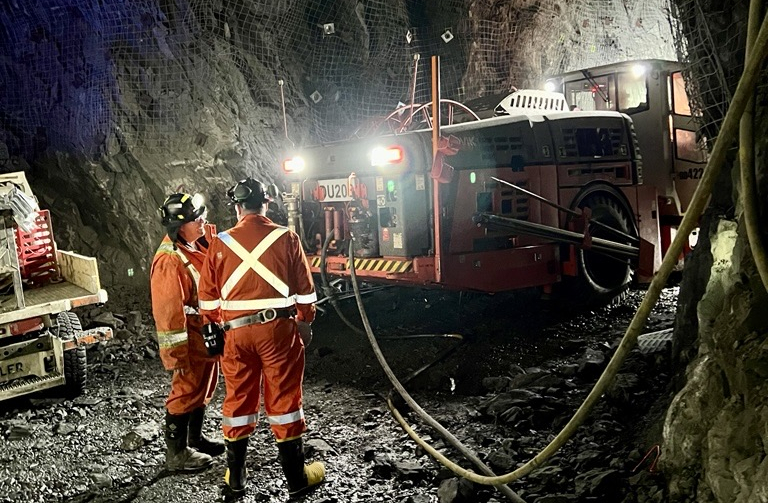 By the time of the Goose mine’s official opening in September 2025, 5.5 kilometres of the Umwelt underground mine had been developed. Courtesy of B2Gold
Removal of overburden at the Umwelt pit started in 2024. “We were able to start [mining] the Umwelt pit early this year,” said Scott. “The main ramp up of the Umwelt pit occurred in April as we started to ramp down Echo.”
Operations at the Umwelt pit are planned to last until early 2028 and then it will also be converted to a tailings storage facility.
Mining at the Llama pit is expected to begin in late 2026 or early 2027 and will continue until 2029. The Goose Main pit is expected to be operational from 2028 through 2032.
Development at the Umwelt underground mine, which is located directly beneath the Umwelt pit, began in 2023. “We have about 5.5 kilometres of total development to date,” said Scott.
The processing plant utilizes a conventional leach and carbon adsorption process. The mill was designed with a nominal capacity of 4,000 tonnes per day (tpd) at an average feed grade of six grams of gold per tonne.
In a commissioning update on Sept. 15, B2Gold revealed that crushing plant capacity had been limited during the third quarter, so the company was adjusting the mine’s 2025 gold production guidance for the Goose mine from 120,000 to 150,000 ounces down to 80,000 to 110,000 ounces. However, in its Oct. 6 release, the company said it believed that the Goose mill can operate near its design capacity of 4,000 tpd through the fourth quarter, and that gold recoveries were expected to average higher than 90 per cent through the fourth quarter and beyond.
The annual gold production for the first six full years (from 2026 to 2031) is expected to average approximately 300,000 ounces per year.
Logistical challenges
The Goose mine’s remote location means that procurement heavily relies on seasonal sea transport and an annually constructed winter ice road (WIR).
“For this project, the challenges really revolve around logistics,” said Bill Lytle, senior vice-president and chief operating officer at B2Gold. “We have to order all of our materials at least 15 months before we need them. Just to put that in context—for 2027, we’re starting to get stuff ready right now.”
The majority of transport fuel, equipment and supplies are shipped to the Goose mine via sealift marine vessels. These travel from Salaberry-de-Valleyfield, Quebec, to B2Gold’s marine laydown area (MLA) on Bathurst Inlet, Nunavut, which is a journey of about 12 or 13 days. The MLA—located approximately 130 kilometres north of the Goose mine—can receive goods via sealift only during the short period of no sea ice, which typically lasts five to six weeks, requiring precise scheduling to offload large volumes of cargo and fuel before the end of September.
A 163-kilometre-long WIR is the primary method for delivering supplies and equipment from the MLA to the Goose mine.
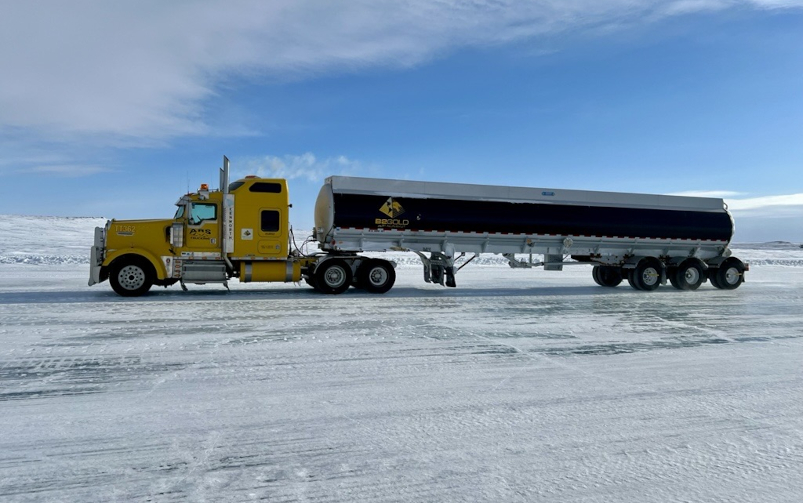 During its 2025 winter ice road campaign, B2Gold transported over 4,000 loads and 80 million litres of fuel from the marine laydown area on Bathurst Inlet to the Goose mine. Courtesy of B2Gold
Construction typically begins in December; they aim to open the road by the first week of February, and it is open for eight to 10 weeks. “Remember, that stuff has sat there since September, in containers,” said Lytle. “Then you’ve got to load it up; February, March, April, you’ve got to go like hell.”
B2Gold has 110 trucks for its annual WIR campaign, half of which haul fuel and the rest haul cargo. According to Lytle, in 2022—the year before B2Gold got involved in the project—Sabina did 80 loads down the ice road. This increased to over 1,200 loads in 2023, and to 2,000 in 2024.
“In 2025, we hauled about 4,000 loads—that includes not only containers, but also metal, equipment and reagents,” said Lytle. “Plus, we loaded 80 million litres of fuel in tanker trucks, which can haul about 40,000 to 42,000 litres of fuel [each].”
During the site tour, Scott pointed out some of the unused equipment that had been delivered to site the previous winter.
“We have a [Cat] 775 haul truck that has been commissioned, but it’s not in use yet,” he said. “It seems surprising to have brand-new equipment not in use, but we only receive equipment one time throughout the year. We received that [during the] last ice road [season], and we expect to start using it later this year.”
Environmental considerations
The Goose mine is in a zone of continuous permafrost that is largely impermeable to groundwater, which makes managing ground conditions and water ingress at the site critical.
The mine implements a comprehensive water management plan that categorizes and manages water flow to minimize impact and conserve fresh water. Water is classified as contact water (impacted by mine workings), non-contact water (unaffected runoff) and saline water.
The permafrost extends to approximately 300 to 350 metres below the surface; below this, the Umwelt underground mine will transition out of permafrost and encounter hyper-saline groundwater, which must be pumped and stored separately in a saline water pond.
“This winter, we will construct the first phase of the saline water pond embankment,” said Scott. “We expect to encounter saline water in the middle of next year, so it’s important for us to complete our embankment this winter.”
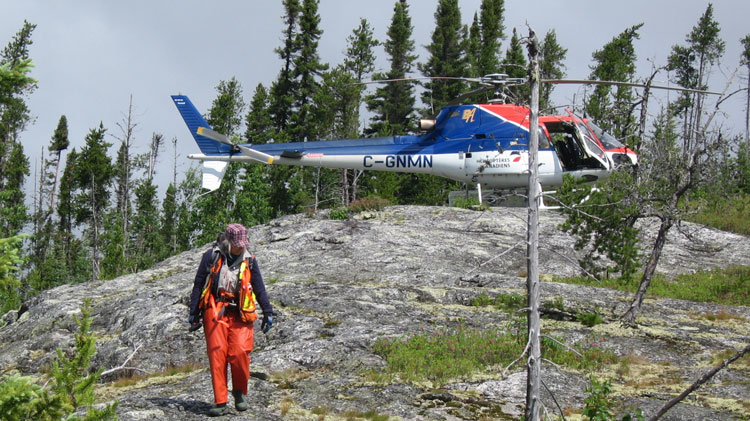
Activities at the Goose mine are also carefully managed to minimize impact on the delicate tundra environment. “We move the drill rigs with helicopters to protect the tundra from damage. While we’re drilling in the summer, people are mobilized via helicopter,” said Scott. “In the winter, when snowpack allows, we are able to transit over the tundra and we can move drill rigs via skids and mobile equipment.”
The mine’s Wildlife Mitigation and Monitoring Program Plan details actions to reduce mine-related effects on wildlife, including robust caribou mitigation measures. The plan incorporates Inuit knowledge through an Inuit environmental advisory committee. B2Gold worked closely with the KIA and Kitikmeot communities to understand and document how the area is traditionally used by caribou.
The primary area that the caribou interact with the project is along the WIR, as it is operational during the time that herds of up to 10,000 caribou are migrating northwards from their wintering grounds towards their calving grounds. Traditional knowledge helped to inform the WIR design to facilitate caribou movement. Truck operators are also trained to stop and give caribou the right of way, ensuring that the animals have successfully crossed before continuing travel.
The future
Following commercial production at the Goose mine, Johnson said the company’s next goal is to increase its exploration activities. “We are further exploring the Goose area and the Back River property and will be pursuing additional exploration and development opportunities in the North,” he said.
B2Gold budgeted US$32 million for exploration in the Back River gold district in 2025. Of this, US$21 million was allocated specifically to the Goose project. This includes 12,000 metres of drilling focused on targeting extensions of the Umwelt and Llama deposits, which are the largest and highest-grade resources at the Goose mine. The company is working on several optimization studies for the mine, and expects to finalize the results later this year.
The company is also exploring renewable energy initiatives across its global operations. In August 2024, it received regulatory approval for its the Back River Energy Centre—a proposed renewable energy facility that would include up to 13 wind turbines of approximately 4.6 megawatts each, along with solar panels and a battery storage system.
Speaking at the opening ceremony, Nunavut Premier P.J. Akeeagok noted that the opening of the Goose mine is important not only for the Kitikmeot region but for the whole country.
“Nunavut is going through some really exciting times, in terms of the challenges that our friends from the south are putting us through,” said Akeeagok. “What Nunavut offers the country is certainty and today is a testament of what we’re able to do to unlock that certainty.”