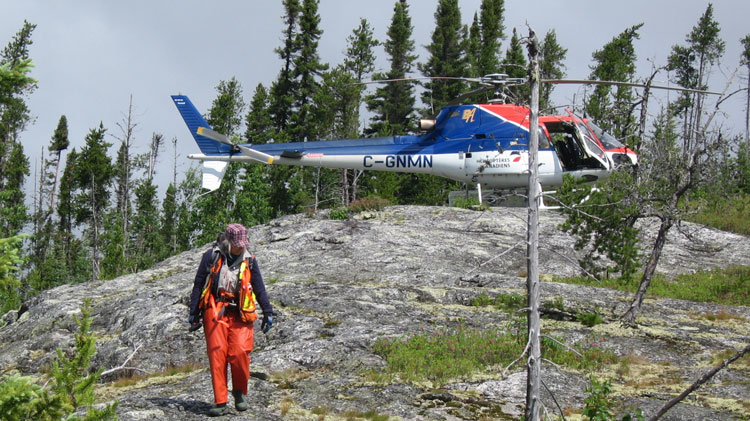
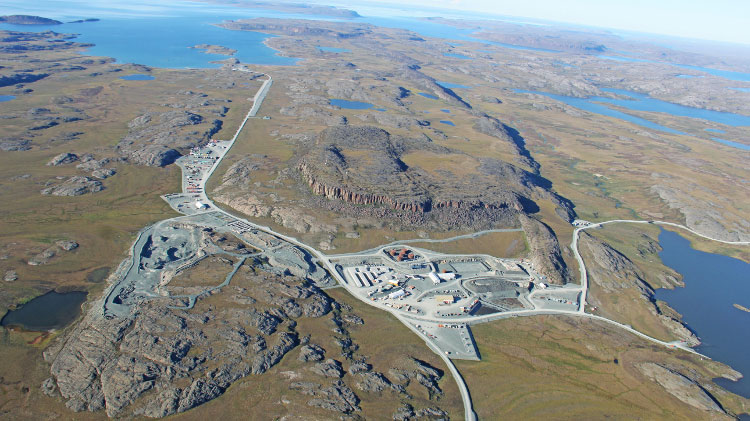
Equinox Gold expects its Valentine mine to reach nameplate production in the second quarter of 2026, which would make it the largest gold mine in Atlantic Canada. Courtesy of Equinox Gold
Throughout its history, Newfoundland and Labrador has not been a significant gold mining destination. There were a few gold mining projects over the decades, but for the last quarter of a century, no new major gold mine had been brought online in the province.
That changed in a big way in November 2025 when Vancouver-based Equinox Gold’s newly constructed Valentine gold mine—on track to be the largest gold mine in Atlantic Canada—achieved commercial production. The achievement marked more than just a major milestone for the project and the company; it also formally announced a transformative moment for the gold mining industry in Newfoundland and Labrador—and for the province’s people and economy.
“This project means a lot for Newfoundland,” said Jason Cyr, Equinox Gold’s vice-president (VP) of operations at Valentine. “It puts the province on the map as a significant gold producer.”
Phase one
Construction of phase one of the Valentine mine, situated in the centre of the island of Newfoundland, began in October 2022, after a decade of exploration and development by Marathon Gold. In January 2024, Marathon Gold was purchased by Vancouver-based Calibre Mining and in June of the following year, Calibre was in turn merged with Canadian miner Equinox Gold. Valentine’s operational team, led by Cyr, remained stable and the project continued to progress smoothly and without interruptions.
Commissioning of the mine began in August 2025 and the new mine poured its first gold on Sept. 14. With the announcement of commercial production on Nov. 18, Equinox Gold reported the Valentine process plant had averaged 5,451 tonnes per day (tpd) during the previous 60 days of operation, representing 80 per cent of its 6,850 tpd phase one nameplate capacity.
“It was a huge achievement to get [the Valentine mine] into commercial production that quickly,” said Cyr.
The mine operates three open pits (Leprechaun, Berry and Marathon) located in an eight-kilometre corridor along a larger 32‑kilometre structure called the Valentine Lake shear zone. The processing plant, which was designed for a 2.5 million tonnes per annum throughput, uses a conventional crushing, grinding and carbon‑in‑leach circuit. The plant is expected to reach nameplate capacity in the second quarter of 2026, and Equinox Gold expects Valentine to produce 150,000 to 200,000 ounces of gold in 2026.
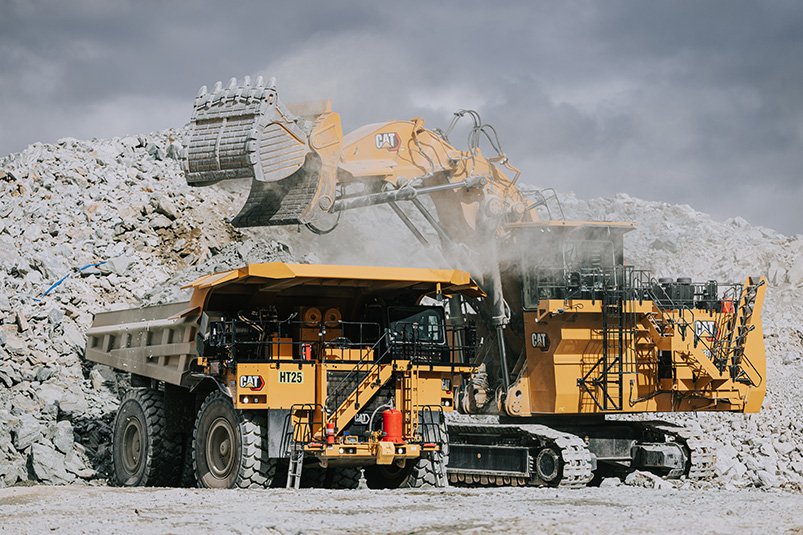 A Cat 6030 hydraulic shovel loading a Cat 785 truck at the Valentine mine. Courtesy of Equinox Gold
“We chose world renowned industry leaders for all our equipment suppliers based on their reputation for performance and reliability,” said Cyr. For the load and haul fleet, that meant largely Caterpillar (Cat) equipment, including four Cat 6020B hydraulic excavators, two Cat 6030 hydraulic shovels, 11 Cat 777 trucks and 13 Cat 785 trucks. For drilling, Equinox Gold selected Epiroc D65 and PV231 production drills.
For the processing plant, equipment includes a Metso crusher, semi-autogenous grinding (SAG) mill and ball mill. “It’s a state-of-the-art plant with all the instrumentation and a control room,” said Cyr. “Everything is controlled by the control room operator, where we can see operating trends and how the process plant is performing.”
Environmental considerations
Environmental management is integrated into the design, operation and closure plans of the Valentine gold mine. Tailings from the operation are managed in an engineered tailings management facility (TMF) designed in accordance with the Canadian Dam Association guidelines and provincial and federal regulatory requirements. The TMF incorporates a fully lined system, controlled deposition and robust water management infrastructure to minimize seepage and protect downstream water quality. The facility is designed for long-term stability, with closure and reclamation considerations integrated into the overall mine plan.
Cyr noted that the Valentine mine’s environmental management is also designed for the long-term stability of the local wildlife. One of the most closely managed aspects of its environmental program involves mitigating potential impacts of mining activity on migratory caribou, which pass through the region twice each year.
“We have two migration periods annually—one in the spring and one in the fall—and we’ve invested a lot of time, effort and funding to make sure our activities don’t interrupt those movements,” he said.
To support that effort, Equinox Gold has implemented a GPS collaring program, fitting approximately 30 to 40 caribou with tracking devices. The real-time data allows the operations team to monitor herd movements.
“As the caribou prepare to migrate, we can identify which activities need to be slowed or shut down so they can move through the area without disruption,” Cyr said.
The data collected through the collaring program is shared with the Government of Newfoundland and Labrador. “That information is something the province can leverage for other projects in the future,” Cyr added. “By investing in the collaring program, we’re contributing data that benefits wildlife management across Newfoundland and Labrador.”
 The mineral reserves and resources for the Valentine mine as of Nov. 30, 2022. Source: Equinox Gold
Newfoundland and Labrador’s gold belt
Along with the Valentine mine, projects such as New Found Gold’s Queensway exploration project and newly re-opened Hammerdown mine, as well as Big Ridge Gold’s Hope Brook project, are helping to position Newfoundland and Labrador for a potential gold boom.
Nicholas Capps, Equinox Gold’s VP of exploration in Newfoundland, noted that while gold mining in the province has historically been sporadic and relatively small scale, with long gaps between operations, the start of production at Valentine reflects decades of exploration in an area previously known for base metal deposits such as the Buchans mine.
The first indication of precious metals at Valentine was found by BP Canada prospectors Tim Froude and Gerald Harris, who came across “visible gold just sitting in outcrop” in 1986 while soil sampling near what is now the Leprechaun pit. This remarkable finding—and the clues about the province’s geology—were mostly ignored at the time due to the low price of gold. When Marathon Gold initially got involved with the Valentine project, gold prices were beginning to surge, but it was not until the late 2010s that interest in gold in the area really spiked.
“If you look at the [geological] structures that you see all across the island, they’re very similar to a lot of the major orogenic gold belts that you see around the world,” said Capps. “I think the only difference between them and Newfoundland and Labrador is really that we’re still in the early stage of exploration.”
The Valentine mine’s story is testament to Capps’s view of the province’s potential. When Marathon Gold acquired a 100 per cent interest in the Valentine project in 2012, its measured and indicated gold resources stood at 6.45 million tonnes containing 424,000 ounces of gold at 2.05 grams per tonne (g/t) and inferred resources of 5.74 million tonnes containing 305,000 ounces of gold at 1.65 g/t.
By the time the company filed the technical report and feasibility study in late 2022, it had built up Valentine’s mineral resources and reserves to proven and probable reserves of 51.6 million tonnes containing 2.7 million ounces of gold grading 1.62 grams per tonne (g/t). It also had measured and indicated resources of 28.5 million tonnes containing 1.3 million ounces of gold grading 1.45 g/t and an additional inferred resource of 20.3 million tonnes containing 1.1 million ounces of gold grading 1.65 g/t. “It’s been a pretty impressive growth story,” said Capps.
Supporting local workforce and economy
The Valentine mine is also having a positive impact on human migration by helping reverse the decades-long trend of Newfoundland’s skilled miners leaving the island to find work in other provinces, especially Alberta’s oil sands.
Equinox Gold committed to a minimum 85 per cent provincial workforce at the Valentine mine. Today, that amounts to 1,100 jobs but that is expected to grow to some 1,400 in phase two of the project. Equinox Gold has already surpassed its commitment. “We are currently at 95 per cent,” said Cyr. “‘Come home’ is a Newfoundlander’s slogan and it’s definitely what we’re doing.”
The mine is supporting an estimated $2.9 billion contribution to the provincial gross domestic product and approximately $750 million in income to local workers and businesses, while allowing a new generation of Newfoundlanders to build mining careers without leaving the island. But the contribution is not just for the short term, according to Cyr.
“I’ve seen too many times when mines donate money to build up hockey rinks and such things, and when the mine shuts down, the community is left with a tax burden,” he said. “What we want to do is really focus on how we can leverage this asset to create new business opportunities, get these communities to develop further with what will give them the skill set, businesses and opportunities to continue thriving post-Equinox Gold and post-Valentine gold mine.”
Cyr cited the example of a local contractor, Millertown-based Blundon’s Trucking & Excavating, with which Equinox Gold established a partnership. The company went from three employees to more than 115. In addition, the Valentine mine has attracted businesses, such as B.C.-based assay services company MSALABS, to the province. “Now, they’re opening a shop here in Grand Falls and are hiring 22 local people to support our project, but that will also benefit other projects,” said Cyr.
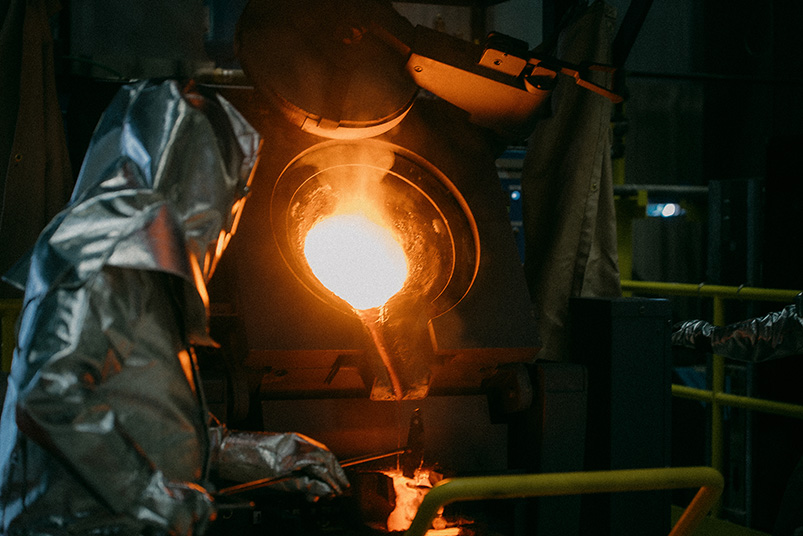 The first gold pour at the Valentine mine took place on Sept. 14, 2025. Courtesy of Equinox Gold
Phase two—and beyond
Equinox Gold believes the growth story has just begun. The company is advancing plans for a phase two expansion that would increase throughput to more than 4.5 million tonnes per annum, which could increase production by 25 per cent to 225,000 to 250,000 ounces per year.
The company is targeting completion of its phase two feasibility study by the end of the first quarter of 2026. If all goes as expected, Valentine will be upgraded with a twin crushing line, an additional ball mill and a pebble crusher circuit to process material from the SAG mill more efficiently. The mine’s fleet will also be expanded with additional haul trucks to support higher production.
Even this expansion, however, is likely not Valentine’s complete growth story. The company has budgeted to drill approximately 100,000 metres on the property this year, focusing on the Frank Zone, located just one kilometre southwest of the existing Leprechaun open pit. Drilling to date has intercepted significant near-surface high-grade gold mineralization and broad zones of continuous mineralization, delineating a gold corridor more than one kilometre in length along trend from defined reserves and resources.
“Over the next four or five years, we’re going to try and really pinpoint where the next resources are going to be, and how much mine life they can actually add,” said Capps. “And that’s only along the same main section of the Valentine Lake shear zone, which is the main structure that controls mineralization here. That’s not talking at all about any of the greenfield targets we have outside of that [zone], which are showing some good potential right now as well.”