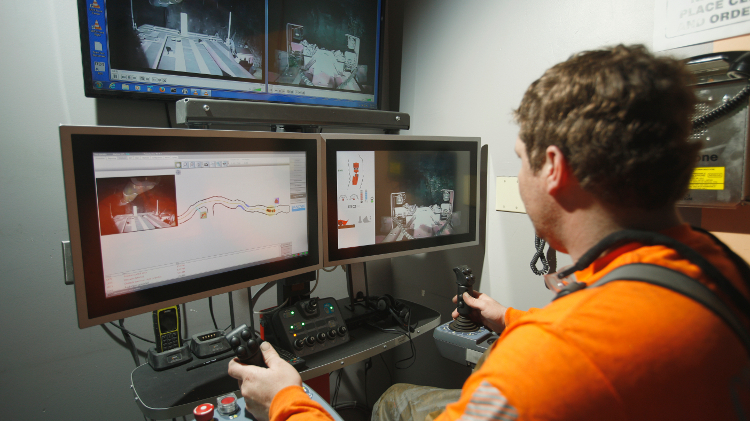
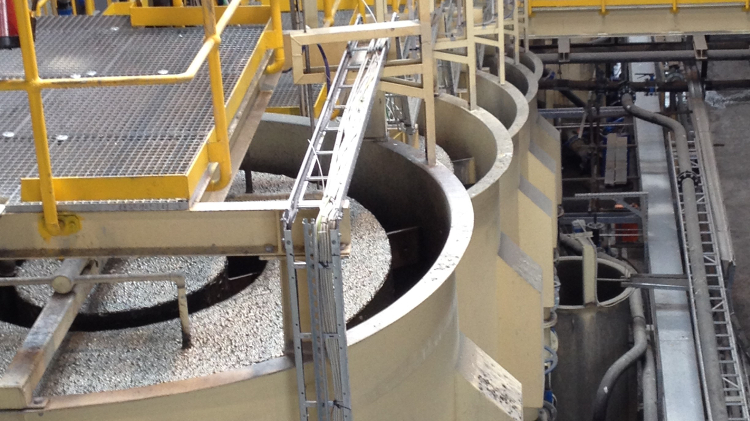
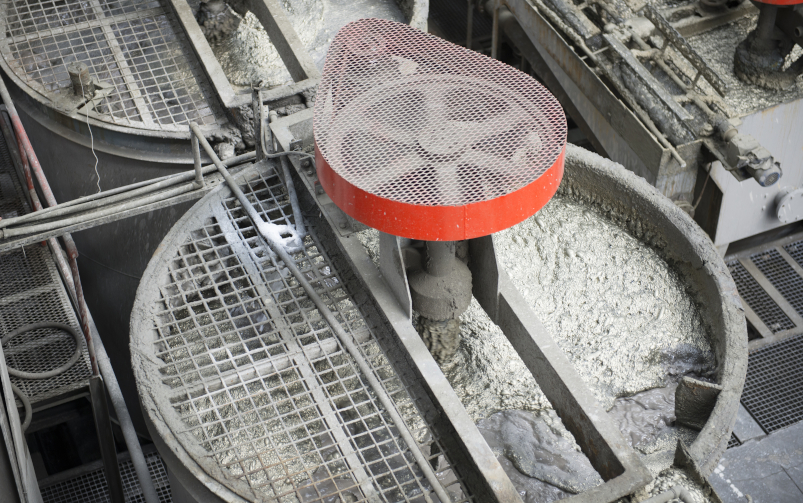
Glencore Technology’s Jameson Cell, now in its fifth generation, continues to improve its capabilities in fine particle flotation. Courtesy of Glencore Technology
At a time when miners are facing new and increasingly complex ore bodies and aging assets in need of revitalization, new technological solutions are more important than ever.
In mineral processing, flotation technologies play a central role in separating valuable minerals from waste by using air, chemistry and controlled hydrodynamics to selectively float targeted particles to the surface.
Whether it is recovering fine and ultra-fine or coarse particles, improving ore recovery or enhancing flotation circuit monitoring, different flotation technologies are helping miners unlock new possibilities in mineral processing.
Fines and ultra-fines recovery
Flotation is critical across all particle sizes, but its role in fine and ultra-fine particle recovery has grown significantly in recent years, driven by the finer grinding required for lower-grade and more complex ores.
One example of a flotation technology is the Concorde Cell, a high-intensity pneumatic flotation cell first developed in the early 2010s by engineer and emeritus professor Graeme Jameson, previously director of the Centre for Multiphase Processes at the University of Newcastle in Australia. Unlike mechanical cells that rely on a mechanically driven impeller to agitate a mineral slurry, disperse air into fine bubbles and create a froth to extract valuable minerals, high-intensity pneumatic flotation cells use forced air to generate bubbles through a high-velocity air-slurry mixture. This approach can deliver more efficient separation, lower energy use and improved froth quality.
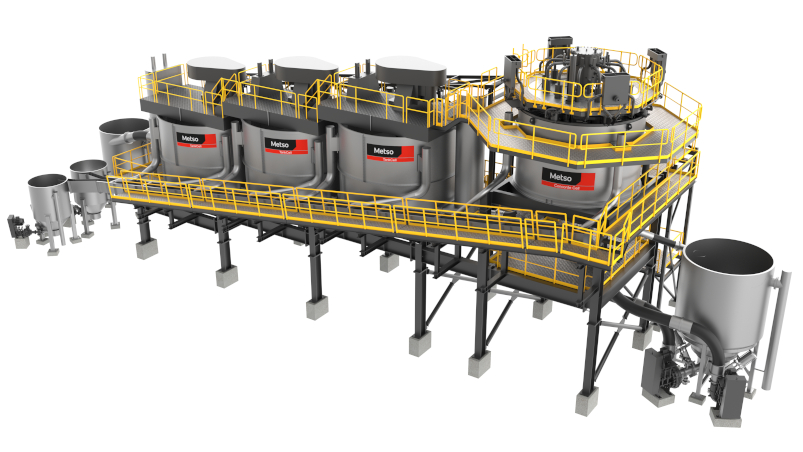 Metso’s Concorde Cell uses high-intensity pneumatic flotation to generate ultra-fine bubbles. Courtesy of Metso
When Metso acquired the licence for the Concorde Cell in 2017, the company set forth on further developing the product, taking it from a laboratory concept to an industrial cell. Concorde Cell technology was launched by Metso in 2021 after the first commercial installations were operational for over a year.
Raghav Dube, technical sales manager for flotation at Metso, explained that while the basic design fundamentals of froth recovery technology remain unchanged, what makes the Concorde Cell unique is that it generates smaller bubbles in a much higher shearing environment than other flotation cell technologies, which leads to a greater probability for particle-bubble collision and overall recovery rates.
“Having more bubbles means having more froth surface area, and having more froth surface area helps to recover those fine particles more effectively, while the high-shear environment forces fine particles and bubbles to collide, which they wouldn’t do in a less turbulent environment,” Dube explained.
According to Dube, the Concorde Cell leads to higher recovery but also higher-grade concentration. This can help miners reduce their processing plant footprint, as fewer flotation cells are needed to achieve the same results. “Everyone is trying to optimize how we get the same plant built with lower capex,” Dube said. “This technology helps with that because if you reduce your [building size], you save a lot of money on concrete [and] construction costs, and that leads to a significant overall capital reduction.” The technology also helps miners minimize their energy and water consumption by reducing the number of cells necessary to reach the targeted metallurgical performance.
The Concorde Cell can support a variety of flow rates through different sizes of the pressurized blast tubes, which impact the size of the cell. “The biggest Concorde Cell we have can handle up to 3,450 m3/h of slurry, so a single cell can handle a lot of volume going through the unit,” Dube explained. However, Metso recommends using the Concorde Cell in tandem with existing mechanical cells. “Because conventional cells are still very proven technologies, mixing proven technology and [our] new technology still gives a significant layout and capital savings,” Dube said. “It helps build a less risky and high reward type of flowsheet.”
Metso is also looking to improve the flotation process on the other side of the particle size spectrum with coarse particles. Marly de Avila Carvalho, product manager for coarse particle flotation at Metso, has been working on developing a new coarse particle flotation cell, which the company plans to launch in 2026; the name will be officially released at the same time.
While the upcoming technology is focused on coarse particle recovery, it is also designed to work with full particle size distribution. What makes this technology unique, according to Carvalho, is that instead of introducing particles to the cell in the slurry phase, the cell will be fed on top of the froth phase so that particle separation happens in the froth phase. “What is good about this principle is that you don’t need to add water for the fluidization, and by not adding water in the cell you don’t add additional stages to the flowsheet like classification or dewatering,” Carvalho explained.
The technology has been tested in different applications with over 30 ore types in both laboratory and pilot scales, said Carvalho. Metso is currently testing the product at industrial scale with an associated copper concentrator in Chile. “We wanted [to make] something that is simple, easy to operate and commission, and that does not take a lot of effort or money from the customer,” said Carvalho. “This is it.”
Established but innovating
Glencore Technology’s Jameson Cell—similarly originated by Graeme Jameson—has been around for over 40 years, with the recent commissioning of its 500th cell at New Gold’s New Afton gold and copper mine near Kamloops, British Columbia, demonstrating its lasting effectiveness in fine particle flotation.
The Jameson Cell has three main parts: the downcomer, the tank pulp zone and the tank froth zone. The heart, or what Scott Martin, sales director for the Americas at Glencore Technology, called the brain of the Jameson Cell is its downcomer. When slurry feed is pumped into the cell’s downcomer with high pressure, it creates a “vacuum-like effect,” said Martin. “It sucks in atmospheric air, so there are no blowers and no mechanical air added to it. It’s a small but very turbulent mixing zone that’s very efficient.”
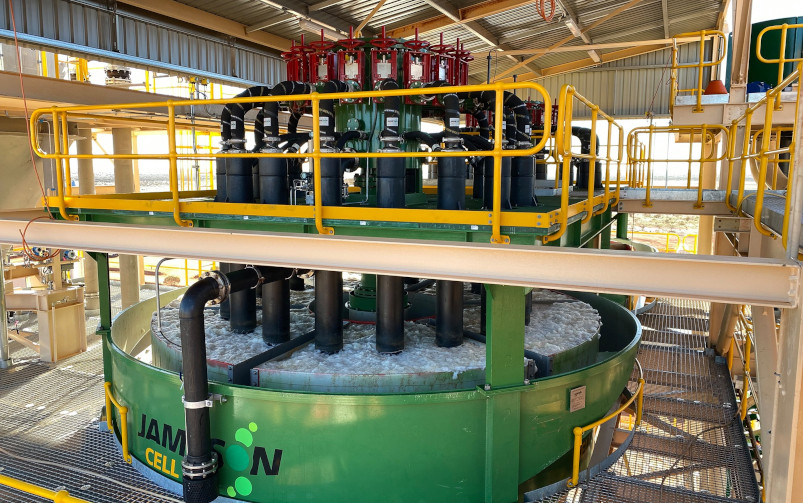 With its compact footprint and minimal moving parts, the Jameson Cell offers mines a low-capex, high-efficiency flotation solution. Courtesy of Glencore Technology
According to Glencore Technology, the resulting small bubbles typically create roughly six times more surface area for particles to collide with and attach to compared with conventional flotation cells.
In the tank pulp zone, bubbles and slurry separate to leave only the mineral-rich bubbles floating to the surface, which are then froth washed in the froth zone to control the concentrate grade. This not only leads to improved concentrate quality, Martin said, but also leads to better recovery, a fast return on investment and reduced plant complexity. Glencore Technology has previously helped miners use less space at their plants; for example, at one flotation plant, it replaced 63 conventional cells with 19 Jameson Cells.
Since fewer units can still achieve target results, the product can help miners reduce their plant footprint and capital costs. “We don’t have a lot of moving parts in the cell,” Martin said. “It’s a very compact footprint, which is very attractive for mines that we’re working with in northern climates like Canada, or existing operations that are looking for a simple expansion.”
The downcomer can be inspected while the cell is operating, so that maintenance can be conducted without going offline. The Jameson Cell can also be tailored to specific sites, with over 15 different models available to deploy, in modular and non-modular designs.
Earlier this year, the Jameson Cell was piloted for rougher duties at Agnico Eagle’s Goldex complex in Quebec to test processing gold-copper as part of the site’s flotation circuit. According to Glencore Technology, the pilot tests showed that the Jameson Cell consistently outperformed conventional cells by matching existing recovery, increasing copper concentrate grade from three per cent to 11 per cent and doubling the gold concentrate grade.
Even with its established track record, Martin said the cell is still being introduced in new operational contexts and has a growing installation base. “Now we have references in roughing and scalping duties,” he said. “We have references in platinum group mineral materials. It’s not just copper or gold, it’s all sorts of different ores that we’re handling.”
Now in its fifth iteration, the team at Glencore Technology is consistently looking at new ways to optimize the Jameson Cell, according to Martin. “We’re looking at different ways to integrate artificial intelligence (AI), [like if we can] use predictive tools to understand how cells will feed to the plant, but also if we can develop sampling systems that can provide instantaneous feedback,” he said.
360 monitoring
Nalco Water, an Ecolab Company specializing in water and process management solutions, developed its Flotation 360 program as a holistic flotation optimization platform to monitor and measure flotation circuits.
The platform assesses froth quality, reagent performance and mechanical health through six pillars: tailored chemistry, smart sensors, monitoring and diagnostics, advanced process control, expert-augmented actions using performance-based insights, and service and expertise through technical consultants and labs.
The platform itself is a tailored solution built to support sites with their specific problems, goals and needs. “We go in and work very closely with the sites to create a roadmap of what the program can solve,” explained Chris Greulich, area vice-president of flotation at Nalco Water. “Ideally we’re trying to help mining operations improve their grade, improve their recovery, improve their throughput, reduce downtime and reduce maintenance challenges.”
 Nalco Water’s Flotation 360 platform uses digital technology to monitor and measure flotation circuit performance. Courtesy of Nalco Water, an Ecolab Company
The first stage involves reviewing a plant’s existing and historical data and assessing if more data needs to be collected through additional sensors in what Greulich calls a “baseline measurement phase.” After this, the platform monitors the flotation process for any changes using machine vision technology.
“Everything can be visualized,” Greulich said. “We have dashboards for this program where we can show the optimum state for each of the cells. [We can] then understand when something moves to a sub-optimum state, quickly identify why and [what the solution is]. If we find that [something in particular] is happening frequently, then we can automate the solution to reduce the amount of downtime for the site.”
Flotation 360 was developed in partnership with Stone Three, an AI-powered mineral processing solutions provider, which created the platform’s sensor technology. One of the platform’s unique features is the in-situ pulp sensor, which allows miners to measure and visualize some of the physical parameters inside the cell, such as bubble size, gas holdup or superficial gas velocity, which have not traditionally been measured and visualized digitally.
The platform’s pulp sensor also provides a first view into the pulp phase of flotation. “For many years, we’ve had top-of-froth sensors that allowed us to see what was happening after the materials were already floated,” said Greulich. The sensor, he said, captures changes early enough for operators to intervene, opening “a new frontier” in understanding physical disturbances before they lead to losses or force a unit offline.
He added that the strength of the system comes from combining Nalco Water’s hydrodynamics expertise with advanced digital tools, sensing technology and “best-in-class chemistry.” Individually, each area has delivered incremental improvements, “but when you pull all those together in a holistic view, that’s where you see outside synergy, and gain peace of mind for the operation and a great path for improved recoveries and results in the future,” said Greulich.