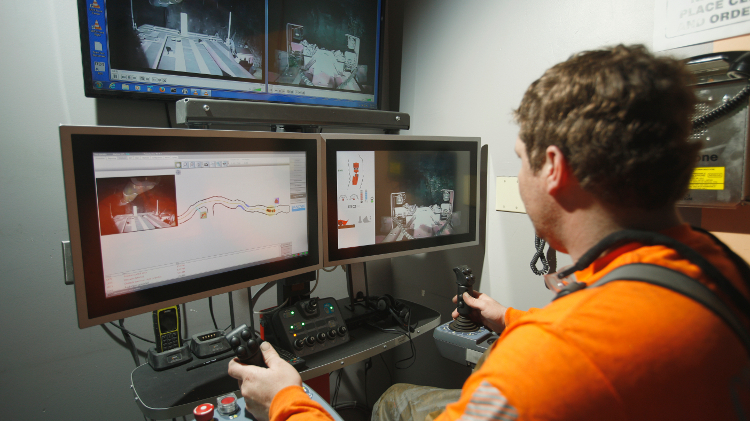
Using artificial intelligence can allow geologists to leverage more data in a shorter time. Courtesy of VRIFY
Artificial intelligence (AI) and machine learning have helped industries—from pharmaceuticals to finance to manufacturing—accelerate processes and improve efficiency.
Naturally, there is a push in mineral exploration to use the technology to perform thousands of calculations to understand geologic formations and determine drill and exploration locations, as well as in analyzing results from drill programs for future development.
Using AI modelling can fundamentally change what this drawn-out process looks like in the field, according to Jean-Philippe Paiement, chief technology officer at VRIFY, which makes exploration intelligence software.
He emphasized the technology’s data-focused approach in identifying mineral deposits more quickly. “You’re not solely relying on interpretations and biases [when using AI], and you’re leveraging more data,” he said, pointing out that errors and blind spots can happen when human specialists look at data.
“This technology gives us the ability to see more data in a really short time—hours instead of months.”
Grant Sanden, CEO and founder of GeologicAI, sees AI as a way to shift drill programs based on new data for better outcomes. “We can now say, ‘Given this outcome at this hole, redesign the next hole.’ It can give real-time responses, and we can get a lot further,” he said.
GeologicAI takes a slightly different approach in using AI to determine drill holes, and it scans rocks from promising land parcels in high resolution to determine the likelihood of mineralization.
For Danny Donahue, TerraAI’s head of growth, the value of AI in mineral exploration is all about reducing uncertainty.
“We can do multiple simulations [of potential decisions] using many geologic models,” he said. “We can quantify and reduce our uncertainty, optimizing decisions across many key parameters in exploration and development.”
Improving the odds and minimizing costs can reshape how investors view mineral exploration, Donahue said. “As we and our partners do a better job of quantifying the risk, and the software gets better, it will allow the industry to become more investible,” he added.
For Greg Tully, vice-president of product at VerAI Discoveries, the power of AI technologies means that deposits hidden by ground-level cover can finally be revealed. “There are a lot of covered terrains throughout mineral jurisdictions that challenge traditional prospecting methods,” he said.
VerAI is focused on revealing accessible mineral deposits throughout the Americas using AI technology. “In favourable mining jurisdictions, that’s where most of the opportunity is,” he said.
He noted that in Chile, large portions of land in mineral-rich areas are covered with gravels and have not been explored sufficiently. Standard geotechnology techniques have not been adept at identifying these concealed deposits, he said, while AI can allow mineral explorers to better understand the subsurface mineralization in these areas.
Though industry experts have long said that global mineral resources are dwindling, Tully believes these estimates do not incorporate the number of potential resources under extensive gravel coverage. “There are many covered deposits waiting to be found,” he said.
In practice
Gold miner Cartier Resources has had success in applying AI technologies to advance its Cadillac gold project in Val d’Or, Quebec. Working with VRIFY, Cartier Resources needed to determine the level of mineralization on newly acquired land.
“There had been 90 years of exploration work, owned by 10 exploration companies,” said Philippe Cloutier, CEO of Cartier Resources. Once Cartier acquired the land, it needed to sift through the reams of exploration data that had been collected over the years.
“Basically, what AI does [is] it stacks all the data and gets from Point A to Point B a lot faster,” Cloutier said.
VRIFY’s AI software for predictive modelling, DORA, would go on to identify a lot of the targets that the company would have generated on its own, Cloutier noted.
“But it went one step further,” he added. “It actually identified areas that we would never have gotten to. It picked up on the fact that [they] had direct signatures or associations for gold.”
The benefit of the technology is its ability to make connections between positive features indicating gold resources between cells hundreds of kilometres away. “It’s essentially Tinder dating among drill holes or datasets,” Cloutier said.
“AI is a disruptive innovation that will literally transform our industry. It can change the way we collect data, it will increase the success rate in discovery and it will make for better decision-making for feasibility studies going forward.”
Potential limitations
However, explorers will still need to do a fair amount of work to optimize their returns from AI, Cloutier said.
Exploration geologists will need to test the targets generated by AI, and then re-input that data into the dataset so the technology can learn from its mistakes or failures.
The data also has to be trustworthy, he noted. Explorers will not be able to use AI intelligibly unless their datasets are reliable and have been sufficiently edited.
Datasets need to be made available for AI to work effectively, he added. The technology “works a lot better for clients like us…who have a wealth of data to calibrate and backpedal, where you can say, ‘is this right?’”, said Cloutier. “You need full collaboration and transparency [for AI to produce the best results].”
VRIFY’s Paiement also thinks that not having centralized databases is another limitation to using the technology as it stands today.
“If you’re not aggregating datasets from different [mining] companies and public sources into one database, it’s hard to train big, general models,” he said.
However, VerAI’s Tully feels more optimism on this front. “Mining jurisdictions in the Americas have invested heavily in acquiring and making public very good data [on potential exploration sites],” he said. “This is a massive opportunity for machine learning.”
Another limitation is understanding geological data. While AI systems are capable of completing complex calculations at scale, the technology is less adept at understanding the geological implications of some data.
“Exploration drilling is expensive depending on where you are,” said Paul Gordon, technical director for mining advisory at SLR Consulting. “You could be wasting time and money if you don’t have the right people with the right experience checking what the AI is doing as you go. The best service providers are doing that.”
The pace of change
The adoption of AI-based technologies throughout the mining industry is expected to be slow, to the frustration of some.
“The pace of mining industrial innovation is the core challenge,” said GeologicAI’s Sanden. “I think the case [for AI] will be so obvious that those who don’t do it will be in trouble, because it is such a structural advantage.”
Explorers who want to adopt AI can only realize its full value by first gaining a basic understanding of how the technology works, VRIFY’s Paiement said.
“Many geologists are still becoming familiar with predictive modelling, and only once there’s a baseline understanding can predictive solutions really add value,” he said. “Without the time to create this familiarity, there’s a risk that adoption will stall; but luckily most tools, like ours, are intuitive and built by experts who understand the science.”
Paiement noted that while disruptive technology will not transform the industry instantly, it can spark meaningful change.
“[AI] brings a level of objective insight that can help you understand the value of your project. It’s powerful to be able to see what’s good—or not so good,” he said. “The industry is still in the early stages of embracing this type of technology-backed decision making, especially when many companies operate with single assets. But we’re seeing traction and know this is an important step towards more confident and transparent exploration.”
For AI to be taken up more widely in the industry, there needs to be several highly successful case studies, SLR’s Gordon said.
“Until this industry starts to see consistent results, there’s not going to be a widespread take-up,” he said. “But potentially [AI] will be adopted more quickly, once it reaches the tipping point.”
Even with more widespread implementation of AI technology, Gordon believes it will have a minimal impact on the state of mineral exploration globally. “There’s no magic bullet for mineral exploration, particularly as grades get lower,” he said.
There are other structural limitations in adopting the technology, he noted. Majors have cut back on greenfield exploration in the last decade, while experts who can provide the necessary context for AI’s findings are in short supply.
“I don’t see it resulting in another golden age of exploration,” Gordon said. The biggest impact AI could have is on limiting exploration costs by increasing efficiency, he added. “That said, I have no doubt that AI will help to see things we haven’t before, due to the sometimes overwhelming amount of data that we have to deal with.”
Explorers still need to consider real-world limitations, such as regulations and the likelihood of securing a social licence to operate, when using the technology, Cartier Resources’ Cloutier said.
“You need to make sure you can mine it,” he said. “If you can’t mine it, don’t bother trying to find it.”
But for now, particularly among service providers, there is optimism about the role AI could play in improving mineral exploration.
“We’re just scratching the surface,” Paiement said. “There’s so much that could be done.”