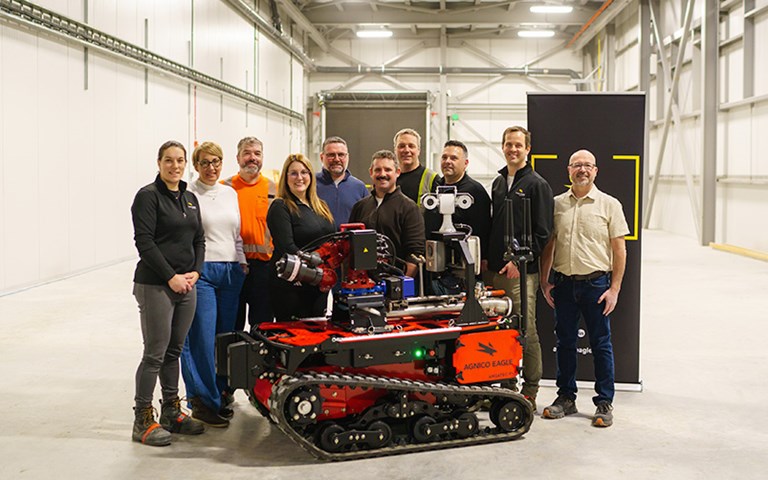
Agnico Eagle Mines has introduced a remote-operated firefighting and intervention robot to support underground emergency response teams at its operations in Quebec. Courtesy of Agnico Eagle Mines
A fire deep underground presents mine rescuers with an immediate problem: getting close enough to attack the flames without putting themselves in greater danger. At remote operations, that challenge can be compounded by limited access to rapid outside support, making strong in-house emergency-response capabilities especially important during complex or prolonged incidents.
Those response challenges are not limited to any one type of incident. As battery-electric vehicles (BEVs) become more common in mines, fires involving battery-powered equipment are adding another layer of complexity: they can be particularly difficult to extinguish, complicating how quickly emergency responders can safely approach and intervene.
At Agnico Eagle Mines, that emerging risk helped to prompt a roughly $1 million total investment in a remotely operated firefighting and rescue robot that is now being integrated into emergency response at three of its underground operations in Quebec: the Odyssey gold mine (situated within the Canadian Malartic complex), the LaRonde gold complex and the Goldex gold complex.
At the centre of the robot project is Angatec’s TEC800, a French-made tele-operated firefighting robot designed to enter hazardous environments. Introduced at Agnico Eagle’s Quebec operations in early 2026 after almost two years of research and testing, the robot intervention system is intended to give mine rescue teams another way to assess and respond to hazardous situations while keeping workers farther from immediate danger.
For Benoît Massicotte, Agnico Eagle’s corporate director of health, safety and security, the robot project traces back in part to the introduction of BEVs at the Odyssey mine, where the company has brought more than 20 BEVs into the operation.
“That [presented] a new risk in our operation because the process of extinguishing a battery-electric vehicle is more and more challenging,” Massicotte said. That challenge gave the company reason to investigate technology capable of getting closer to the source of an emergency before rescuers themselves can safely do so.
Getting closer to the hazard
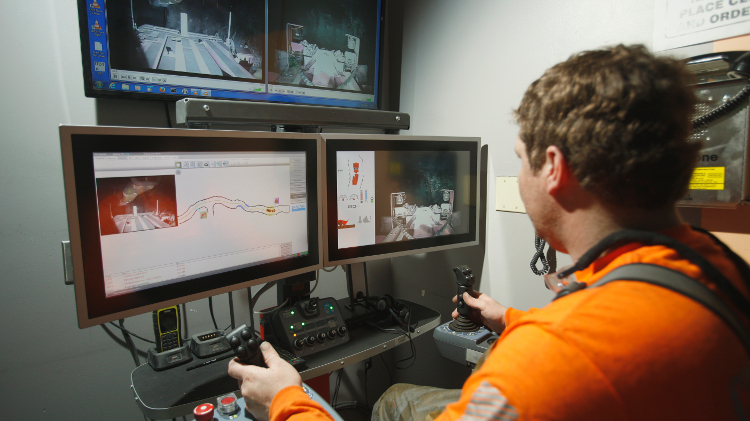
According to Angatec, the TEC800 weighs around 500 kilograms and is 790 millimetres wide, allowing it to move through relatively confined areas. The tracked machine, which can travel at speeds of up to 12 kilometres per hour, is piloted by an operator using a shock-resistant and splash-proof rugged tablet.
The robot can also be configured with equipment including a remote-controlled water cannon, a stretcher carrier and thermal cameras. The cameras can help operators to see through smoke and identify people who may be present in hazardous areas.
According to Annie Guay, health, safety and emergency measures coordinator at Agnico Eagle, the robot is designed to operate in temperatures of up to 700 degrees Celsius. Temperature sensors can warn the robot’s remote operators when conditions become too hot, and a cooling system is designed to be activated before the temperature reaches those limits.
That capability is particularly significant underground, where mine rescue personnel do not approach fires wearing the same personal protective equipment used by municipal firefighters at surface, Massicotte explained. In some situations, responders may first need to lower temperatures in the area by using firefighting foam before they can safely move closer.
The robot, which can tow as much as 300 metres of charged fire hose, can help to overcome that limitation by allowing crews to begin attacking the fire from a distance sooner by remotely bringing water closer to the fire.
“What is the most efficient thing when you try to [extinguish] a fire? It’s [that] direct intervention,” Massicotte said. “It reduces exposure for our mine rescuers, but it is also a more efficient intervention [for extinguishing fires] that gives us the opportunity to [get to] our people earlier,” he said.
Firefighting is only one part of the robot’s intended role. With a payload capacity of up to 800 kilograms, the robot can deliver emergency equipment to workers who cannot be reached immediately by rescuers, while reducing the physical burden on mine rescue teams who would otherwise have to carry heavy gear—such as breathing apparatuses and fire pumps—through challenging underground terrain. The robot can also transport an injured or trapped person using the stretcher carrier, making it useful in other types of underground emergencies, such as seismic events and ground failures.
Maintaining communications underground is also a key feature built into the robot, which operates on LTE networks at all three sites. If the robot nears the limits of its connection, it can alert its operator before proceeding farther. A backup underground communications system can deploy autonomous battery-powered relay antennas to establish its own network if the primary connection becomes unreliable or if mine communications are disrupted.
Preparation for deployment
Agnico Eagle’s robot project did not begin with designing a rescue robot from scratch. Instead, the company looked at technology already being used in other emergency response environments and considered how it could be applied to underground mining operations.
A team of three Agnico Eagle emergency response specialists travelled to France in December 2024 to examine available robotic systems. They visited suppliers as well as firefighting departments with experience using robots and also visited the Channel Tunnel between France and the United Kingdom, where robotic equipment is used as part of tunnel emergency response.
According to Angatec, the TEC800 had already been tested in several demanding environments, including the Mont Blanc, Fréjus and Channel tunnels.
Working alongside the innovation team at Agnico Eagle’s Centre for Support and Development, the emergency response specialists assessed different technologies against a set of criteria before selecting the robotic system that appeared best suited to the company’s needs. Two trainers from Angatec subsequently spent three weeks on-site training Agnico Eagle personnel.
Employees from all three participating sites—Odyssey, LaRonde and Goldex—have now received training. The operating teams consist of electricians, mechanics, IT specialists and rescue team members.
“A main challenge [has been to] train our people, making sure everybody can use it and maintain the equipment as well,” Massicotte said.
Mine rescue teams from the three operations have already had opportunities to operate the robot during several underground scenarios and exercises. The robot has not, however, been deployed during an actual emergency yet, with Agnico Eagle advancing it towards full operational readiness, which is targeted for October this year.
The current testing phase is therefore about understanding how the robot performs underground and determining where its practical limits lie.
Testing also has to account for differences among the communications systems at the three participating sites. Maintenance, operator familiarity and integration into existing mine rescue procedures are other considerations.
Massicotte said Agnico Eagle is also working closely with the robot’s manufacturer to refine the system based on feedback from the site.
A regional resource
The robot is currently based at the Odyssey operation—which is centrally located between LaRonde 40 kilometres to the west and Goldex 18 kilometres to the east—and is kept charged inside a dedicated emergency response trailer. Along with the robot, the trailer carries six breathing apparatuses, a fire pump and other equipment needed to deploy the unit underground.
From the Odyssey mine, it can be transported to support the other two operations when required. This regional approach does not eliminate the time required for an initial emergency response; mine rescue teams still have to mobilize and travel to the affected operation, and transportation time for the robot will vary depending on the site.
Rather, Agnico Eagle sees its value in what happens once the robot and the related equipment arrives: giving responders another way to intervene effectively in a difficult underground fire while reducing their exposure to hazardous conditions.
Although the robot is based at Odyssey, Agnico Eagle does not consider the equipment as belonging to one mine that can simply be lent to the others. It is a shared regional emergency-response capability for Odyssey, LaRonde and Goldex, with personnel from all three operations trained to operate and support it.
“It’s not only a single site project, but a three-site project,” Massicotte said.
The arrangement allows the three neighbouring operations to pool specialized equipment, trained responders and technical expertise as part of a single regional response capability.
Massicotte said other Agnico Eagle regions are watching the robot project, while emergency response organizations and regulators in Quebec and Ontario have also shown interest in the project. The company expects to begin sharing more of that experience as the program matures and plans to showcase the technology more broadly next year.
By learning where remotely operated firefighting technology works, where it does not and how it can be integrated into a functioning mine rescue program, Agnico Eagle could provide a practical example for other underground operations confronting similar risks.
Massicotte sees value in sharing those lessons more broadly as the technology is tested and refined. “I think [this robot project] can help the industry to become better,” he said.