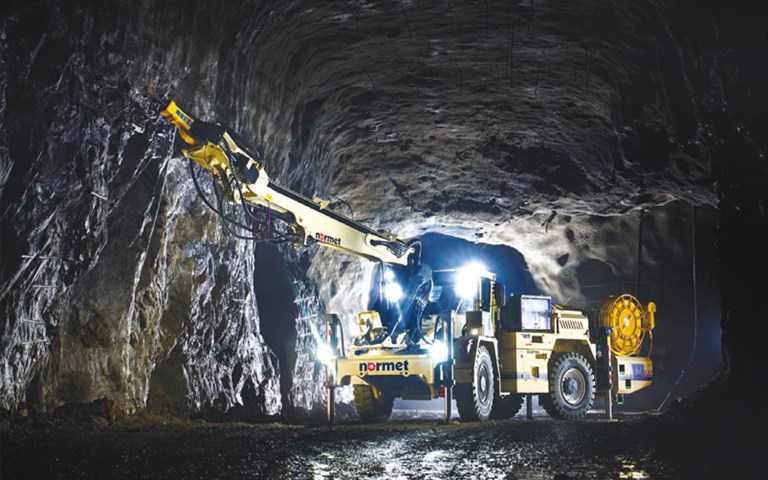
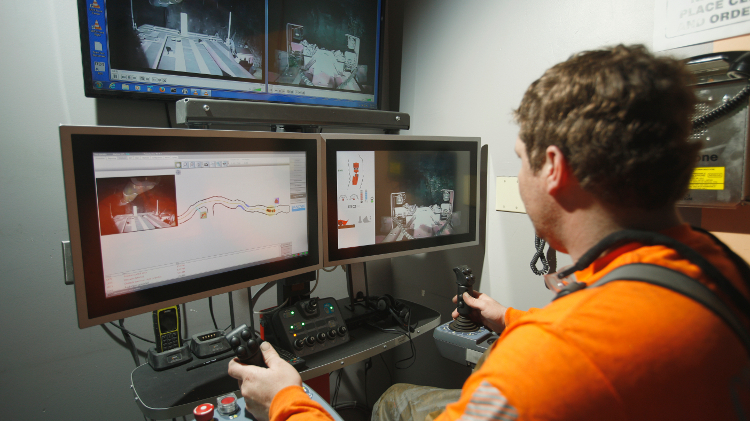
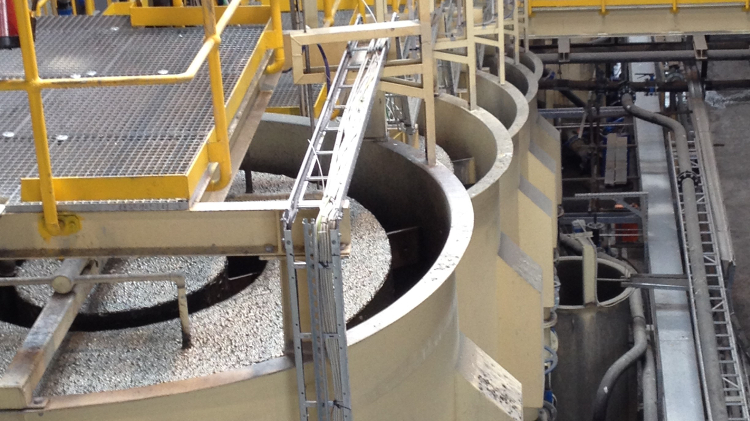
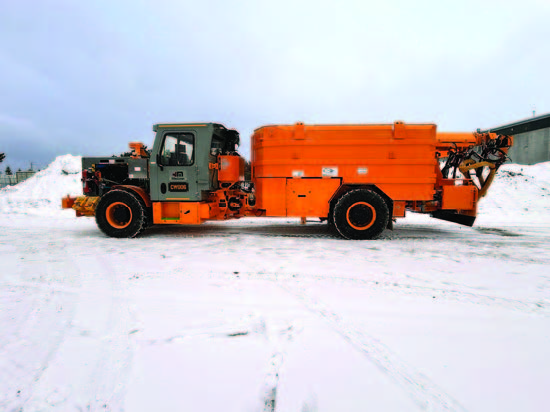
Key features of Normet’s Scamec LC 065 A scaling machine include improved sightlines, ergonomic cab design and emission-free operations. Courtesy of Normet
After drilling and blasting, the rock face can become unstable, leaving behind loose material that can pose serious risks. Scaling, the practice of removing loose rock from the working area, is a vital ground-control practice in underground mining, playing a key role in keeping both workers safe and operations running smoothly.
Effective scaling helps to protect workers from rockfall hazards, prevents damage to mobile equipment and reduces costly production delays caused by unplanned ground incidents. It also contributes to overall mine stability and supports compliance with safety regulations.
As underground mines become deeper and more mechanized, the need for safer and more efficient scaling methods continues to grow.
Next-generation scalers
Scaling was once a labour-intensive manual task that exposed workers to rockfalls, rock dust and the risk of hearing loss from the repetitive impact of hitting rocks with a metal bar. Now, it is increasingly performed using purpose-built machines, which improves operator protection, precision and reach.
In January 2025, Finland-based Normet launched its latest scaling machine: the Scamec LC 065 A, a purpose-built scaling machine designed to deliver safety, visibility, ergonomics and productivity for underground operations.
According to Toni Huttunen, Normet’s vice-president of logistics and scaling product lines, the new generation Scamec carrier and boom was developed and tested at the Kittilä mine in Finland, with feedback from the mine’s operator Agnico Eagle.
With Agnico Eagle, a key redesign focused on the boom, which is the articulated arm used to remove loose rock, and operator sightlines. “The visibility is way better than it was earlier,” Huttunen said. “Now you can see the tool way better where you are scaling and you are able to do a more precise job.” The newly launched Scamec LC 065 A is equipped with the shorter version of the same boom that has featured in previous Normet scaling machines, including the Scamec LC 095 A.
On top of the scaling hammer, the Scamec LC 065 A can be equipped with different kinds of tools for different kinds of needs. Early customer feedback, said Huttunen, also led to some practical refinements, including repainting part of the boom structure from beige to black to reduce glare from work lights reflecting back into the cab.
Huttunen pointed out that many mines still rely on excavators and drilling rigs for scaling, even though they are not designed for the task. A dedicated scaler, he said, can shorten cycle times by completing scaling faster and allowing production equipment to return to work sooner. “If you try to save money by using some non-purpose-built machines, then you’re losing in the total operation,” he said.
Apart from efficiency and increased processing speed, the Scamec LC 065 A provides increased worker and environmental safety. The cabin of the scaler features filtered air, air conditioning and low noise levels. The entire cabin lifts and tilts, on top of the seat being adjustable, which helps to reduce neck strains when working overhead. Huttunen said these ergonomic improvements help operators to remain effective through long shifts while potentially extending their careers, which is important in an industry facing labour shortages.
The scaler can operate emission-free underground when plugging it into the power grid, while also retaining diesel power capabilities when electricity is not available.
Normet is “continuously developing” its scaling solution, said Huttunen. Next, the company is looking to add operator-assist functions and higher levels of automation and future remote-operation capabilities to its scaling machines.
Targeted water underground
Ontario-headquartered MacLean Engineering offers its WC5 water cannon as a solution aimed at improving safety and productivity in underground hard rock mines. As part of the company’s Ore Flow Solutions lineup, the machine is designed to clear blocked drawpoints without sending operators into hazardous areas.
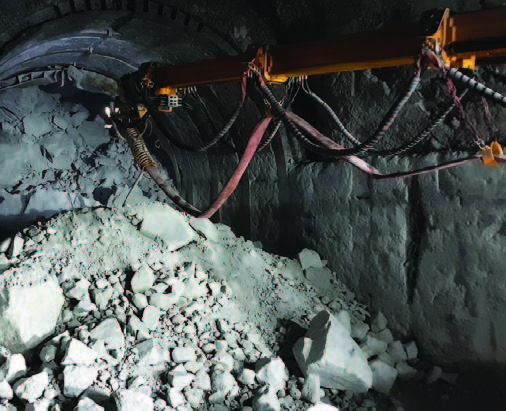 Using high-volume water instead of mechanical tools, MacLean Engineering’s WC5 water cannon can clear hang-ups and bring down loose ground remotely. Courtesy of MacLean Engineering
In mass mining methods such as block and sublevel caving, drawpoint hang-ups remain a constant operational bottleneck. “You can have hundreds of tonnes ready to move, but a single interlocked rock mass—sometimes the size of a minivan—can bring everything to a halt,” said Vivek Bhatt, global product manager, ore flow, drill and blast, at MacLean Engineering. “It’s not just lost production. The stress redistributes into the mine structure, which can lead to damage or instability.”
Traditionally, mines may rely on repurposing available equipment and manual intervention, which carry safety risks and downtime.
Bhatt noted that MacLean’s water cannon instead introduces a remote, controlled, telescopic boom-based rig with water on board. “Instead of sending people into a hazardous zone, you’re bringing the hang-up down by using high-volume water to bring down saturated hang-up, wash off the fines, reduce the interlocking, and let gravity do the rest.”
“In many cases, you’re resolving a hang-up in minutes rather than hours. And even if it doesn’t fully collapse, you’ve made it significantly safer for follow-up work,” Bhatt added.
Beyond hang-up removal, the water cannon can also be used to recover high-grade ore left behind in stopes—and areas that are often difficult to access with conventional equipment. “That’s a direct economic benefit,” he said. “You’re recovering material that would otherwise be written off.”
 The WC5 water cannon is an underground utility vehicle developed by MacLean Engineering to improve safety and production in hard rock mines. Courtesy of MacLean Engineering
The water cannon can operate remotely through MacLean’s remote control packages, ranging from extended line-of-sight operation to full surface tele-operation with video feedback and a safety system. It is also interoperable alongside other OEM equipment under centralized control, with traffic management and electronic barricading, which control access to restricted areas.
“The ‘no boots on ground’ philosophy is critical,” said Bhatt. “With tele-remote and even surface-controlled operation, you’re removing people from the highest-risk areas entirely. That’s a fundamental shift in how mines are thinking about risk.”
Looking ahead, Bhatt pointed to emerging automation features such as autonomous tramming or multi-machine controls. “The direction is clear—more flexibility, more automation interoperability and less direct human exposure underground,” he said.
Low-risk simulation training
While apprenticeships and on-the-job learning remain a large part of underground mining, they come with inherent risks to both the untrained worker and underground equipment. Increasingly, the industry is turning to simulation technology to bridge that gap.
One example is the Fletcher Simulators High Reach Scaler simulator, developed by underground equipment manufacturer J.H. Fletcher & Co. in partnership with the software company Simformotion LLC, which allows trainee operators to learn real-world scaling applications in a controlled virtual environment.
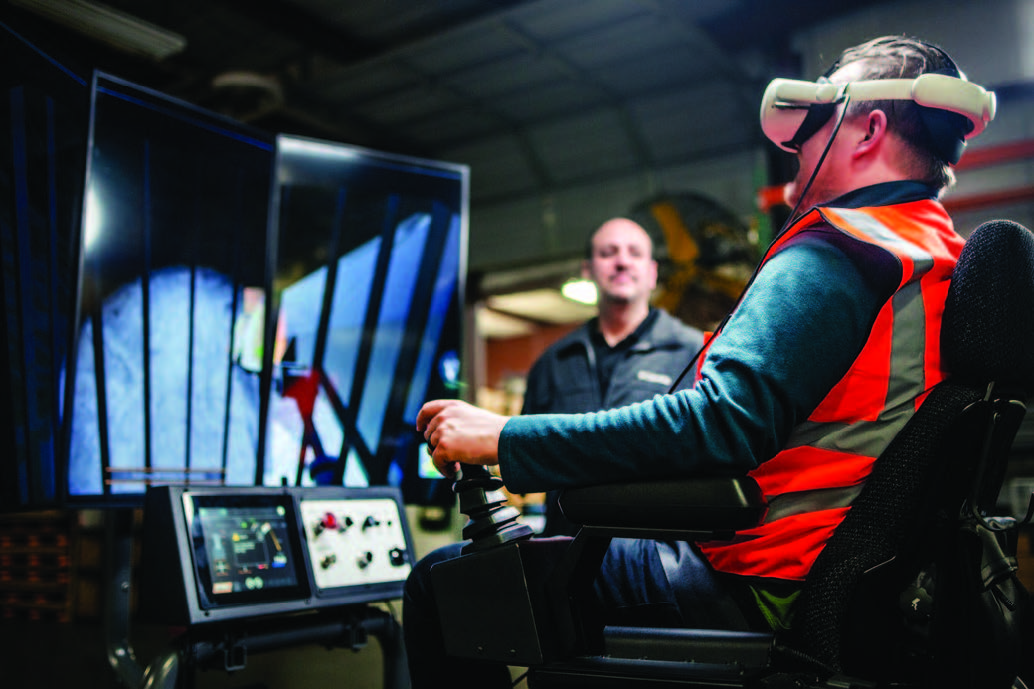 Trainees can learn scaling techniques and machine operations in a controlled virtual setting with Fletcher’s High Reach Scaler simulator. Courtesy of J.H. Fletcher & Co.
The product is an interactive training tool that places trainees in the seat of either a Fletcher model 4250-RD high reach scaler or model 3035-AD remote roof bolter, without putting them in harm’s way in an active mine.
“When you’re sitting in the seat of the simulator and doing the simulation, you’re using everything that you would be using if you were sitting in the cab of our actual machine,” said Ryne Hunt, regional sales manager at Fletcher. “We want this to be as real to the operator as possible.”
The Fletcher simulator uses machine-specific controls that mirror actual cab layouts. The platform is built on a modular base that can switch between the two machine models, allowing multiple training pathways and opportunities without requiring separate simulator units. The 4250-RD model includes optional virtual reality (VR) capability, providing a full 360-degree underground environment where trainees can look around the mine, inspect conditions and operate in a highly immersive setting. The 3035-AD model, by contrast, does not have VR capabilities, said Hunt, and instead depends on touchscreen and dashboard interactions.
Both models follow a structured training curriculum that covers pre-operation inspections, start-up and shutdown procedures, tramming, positioning and scaling tasks such as removing loose rock from backs and walls before crews enter an area. It also incorporates assessment tools that can grade operators on tasks in both open and pass-fail scenarios, including machine positioning and hazard recognition during virtual walkarounds.
Hunt added that future additions to the simulator are already being considered.
“There is clear potential to expand the technology across additional models,” Hunt said, noting that the company is prioritizing the continued success of its 4250-RD and 3035-AD models before introducing it to new equipment.