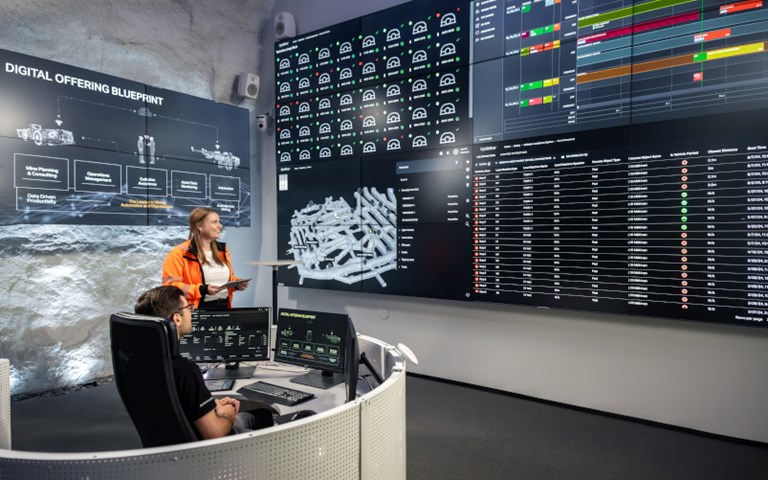
Newtrax's Mining Data Platform allows for real-time monitoring of people at mine sites using its Newtrax Cap Lamp, which enables tracking and proximity detection and can also send emergency distress signals. Courtesy of Sandvik
Modern advancements in safety protocols, operational procedures and regulations have helped the industry make major strides in ensuring injuries and fatalities in mining are kept to a minimum.
Technology companies are also playing a crucial role in making mines safer than ever. From preventing accidents before they happen, to improving emergency response when they do, innovative technologies are transforming how the industry safeguards its workers underground.
Beyond safety, these companies are prioritizing advancing technologies that boost mine efficiency by helping mine operators respond faster to emergencies, minimize downtime and optimize overall operations.
Smart tracking
In underground mining, ensuring every worker is accounted for is critical, but conventional personnel tracking methods often fall short. That is why Sudbury, Ontario-based TopVu developed a comprehensive emergency preparedness system centred around its patented smart eTag Board, designed to eliminate errors in traditional tagboards.
Traditionally, mines have relied on physical tag boards—also known as a check-in-check-out system—where mine workers manually move their identification tag to the “check-in” board when entering a mine and placing it in the “check-out” board when leaving.
“It’s well known throughout the industry that a lot of people don’t trust their tag board,” said Yvan Brulé, technical director at TopVu. “Workers often forget to tag in, and they forget to tag out all the time.”
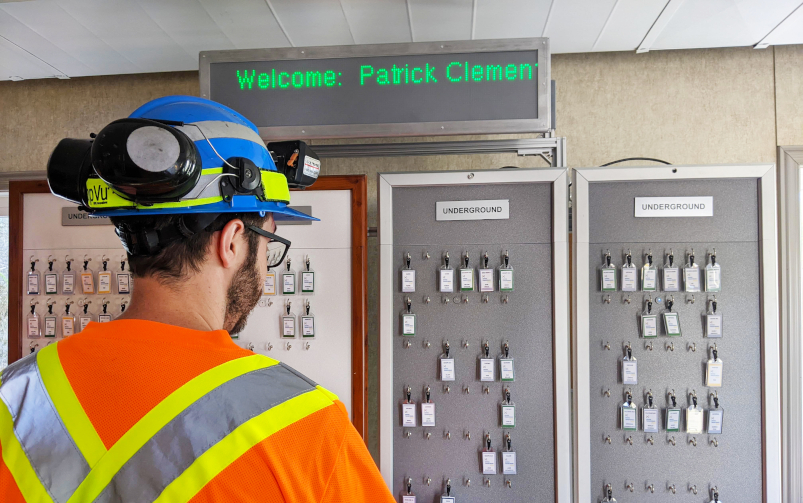 TopVu’s eTag Board sends worker information to TopVu’s web-enabled Q7 software. Courtesy of TopVu
This seemingly innocuous oversight can have life-or-death consequences in an emergency, he added. To solve this problem, TopVu’s eTag Board uses radio frequency identification (RFID) technology embedded in stickers and chips that can be attached to hard hats, keychains and ID tags. A network of checkpoint antenna trackers—positioned at key mine access points like the cage entrance—automatically detects if a miner has failed to check in. The system then triggers alerts via relays, audible alarms, emails and local message display notifications for the worker to correct the mistake.
TopVu further enhances safety in a mining operation with RFID-enabled turnstiles for access control, integrated into its Q7 web-enabled software platform. This platform combines all RFID and location-tracking data into one interface. It includes a watchdog feature that allows mine operators to customize entry permissions based on individual profiles, schedules and training records. This flexibility makes it easy to adjust the system to fit different work requirements and safety rules of a mine’s operations.
“[Our system] is the most efficient and cost-effective way to cover large areas because it requires no batteries or battery maintenance,” said Brulé. “It minimizes infrastructure needs, is scalable and minimizes the pressure of having a complex system. Being both affordable and adaptable, it allows mines to expand as their needs grow.”
The TopVu system also includes muster tap stations, which are designated meeting points where personnel can report to in order to streamline emergency responses. Installed at underground refuge stations or assembly points, these stations allow workers to tap their RFID tags upon arrival during an emergency. It instantly records their location, which is presented in the dashboard of TopVu’s Q7 platform.
Brulé explained that a typical manual check-in process during real emergencies or drills can take up to two hours to account for all workers. With TopVu’s real-time electronic tracking system, that time can be reduced to just 20 minutes.
“Delays could be directly related to loss of profit,” said Brulé. “If we can accomplish that same emergency drill in 20 or 30 minutes and then release the workforce back to work, we can save them that much time and cost of production.”
The system also collects other critical data that is useful in emergency response, including last known worker locations and recent checkpoint activity.
“This provides valuable information that mine rescue teams can use to make educated decisions and better manage the deployment of their resources where they are needed,” added Brulé.
Cap lamp communication
Montreal-based Newtrax, part of Sandvik, has developed an advanced tracking system designed for underground mining.
At the heart of the system is the Newtrax Cap Lamp, which enables tracking and proximity detection and can also send emergency distress signals. When workers check into the mine, they tap their unique RFID tag on a tablet near the cap lamp rack. This assigns them a fully charged lamp and registers their presence underground. Their movements are subsequently tracked in near real-time on a 3D map through Newtrax’s Mining Data Platform (MDP). The Newtrax MDP integrates vehicle collision avoidance, telemetry data, productivity data and real-time personnel tracking into a single, comprehensive platform.
In addition to providing near real-time positioning and tracking, which is dependent on network infrastructure, the Newtrax Cap Lamp is an advanced smart lamp device within the Newtrax product line’s Proximity Detection and Collision Avoidance ecosystem. Equipped with ultra-wideband and other technologies, it enables peer-to-peer proximity detection without relying on any external network infrastructure.
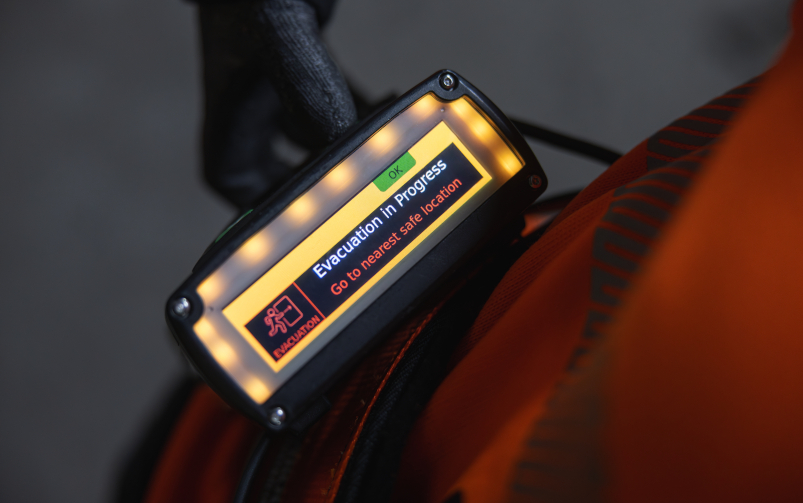 The Newtrax Cap Lamp sends mine-wide instant evacuation notifications. Courtesy of Sandvik
According to Ryan Fusina, business line manager of automation for North America at Sandvik Mining and Rock Solutions, most customers initially approach the company for collision avoidance solutions to prevent vehicle-to-vehicle or pedestrian-to-vehicle incidents. However, he said that its potential for mine rescue remains largely untapped, as many customers are still unaware that the Newtrax Cap Lamp is equipped with a tracking mechanism capable of providing precise location data during emergencies, contingent on the coverage of the network infrastructure.
“The way [Newtrax Cap Lamp and MDP] operates is a combination of either Wi-Fi or LTE coverage, and that is combined with Bluetooth low energy (BLE) tagging underground,” said Fusina.
BLE tagging is a type of battery-powered tracking device that can be attached to an asset and then used to detect the location and movement of people, objects and vehicles using wireless Bluetooth technology.
“We’re able to track the movements and the location of an individual within a few feet of their location,” added Fusina.
From a mine rescue perspective, the Newtrax Cap Lamp and MDP system offers several life-saving advantages.
The system features an electronic tagboard that automates check-ins and check-outs. Newtrax employs BLE technology in wearable cap lamps that tracks the check-in-check-out process when workers retrieve or return their cap lamps. This ensures mine operators can quickly account for all personnel and streamline rescue efforts. It also improves shelter-in-place procedures by locating both the number and identity of workers in designated refuge areas.
The BLE-enabled Newtrax Cap Lamp allows for two-way communication between devices, making it ideal for applications that need current location updates and seamless data exchanges.
“[By] utilizing the cap lamp system with the people positioning, you also have a distress signal that [workers] can send through that cap lamp,” said Fusina. If a lamp detects no movement for a set period (which is customizable by the mine operator), it flashes to alert the worker. If they do not acknowledge the flashing through any movement, the system waits another 90 seconds before sending a worker-down alarm to vehicles close by, and to the surface control room.
Another critical safety feature, Fusina added, is the ability to trigger a mine evacuation alarm from the surface control room. When triggered, the cap lamp will emit both an audible alarm and start rapidly flashing to signal to workers to evacuate.
Beyond safety, Newtrax’s tracking technology is also boosting mine productivity. “Several customers have told us that they’ve seen a 10 to 20 per cent increase in productivity because they’re able to identify where their people are at any given time,” said Fusina. Knowing the exact location of personnel and equipment eliminates wasted time during shift changes and equipment retrieval.
Creating a digital advantage
For North Bay, Ontario-based SafeSight Exploration, the company’s goal was to develop digital tools that enhance mine rescue operations by reducing the risks that first responders typically face when relying solely on manual search methods underground.
“In mine rescue, it’s a four-step process,” said Mike Campigotto, president of SafeSight. “You assess the emergency, you search and rescue, you evacuate and then you wrap up the emergency to get operations back on track. We looked at each one of those phases and asked the question: ‘How might we create a digital advantage in each of these situations?’”
What SafeSight came up with is a suite of digitally powered tools designed to improve safety, efficiency and overall mine productivity during emergency response situations.
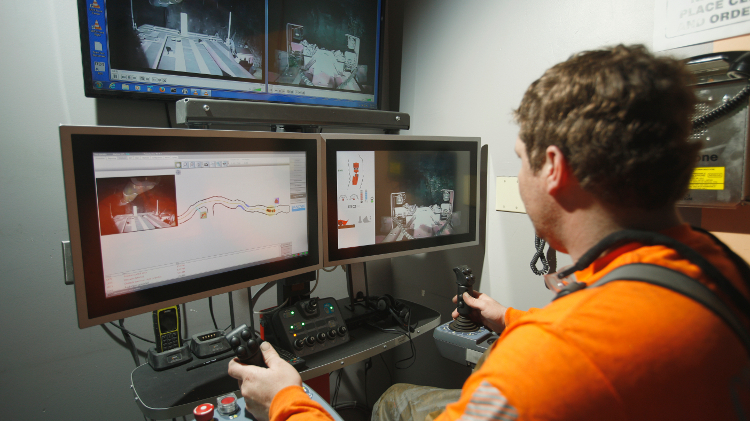
Leading SafeSight’s Emergency Response Tool Kit is DeepTraxx, an advanced robotic ground-based vehicle able to assess underground emergencies, which can be controlled manually from 300 metres away or remotely from the surface using 5G technology.
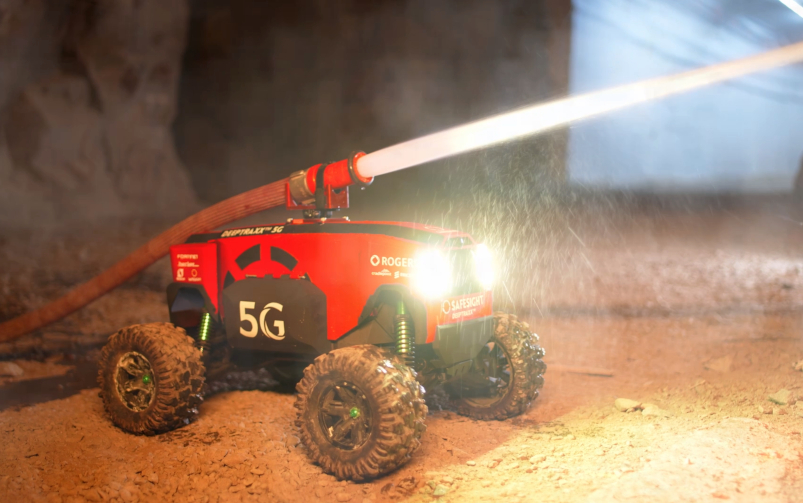 The DeepTrax ground vehicle provides real-time video streaming that supports emergency response. Courtesy of SafeSight Exploration
Equipped with thermal imaging, high-definition cameras and 3D mapping capabilities, DeepTraxx scans emergency zones, locates trapped workers and provides real-time data to mine rescue teams on the conditions underground, allowing responders to stay safely above ground. “Once deployed, it can create a 3D model of the emergency area and help responders map out the safest path to recover people,” said Campigotto.
Over the past two years since DeepTraxx was first launched, the technology has further evolved for emergency readiness. “It can now carry a fire hose and remotely deploy fire responses,” said Campigotto. “I can remotely create a water curtain to protect responders and [DeepTraxx] can go close to a fire to assess the situation without melting.”
In addition, added Campigotto, DeepTraxx plays a significant role in post-incident analysis. “After the fact, teams can use the model to review what happened so they can improve operations and the rescue response in similar circumstances.”
Complementing DeepTraxx in emergency assessment is the company’s SafeScout emergency response drone. Launched three years ago, SafeScout brings the same capabilities as DeepTraxx to the air, from thermal imaging to multispectral sensors and high-definition cameras.
“If you can’t navigate on the ground because of some roadblocks, you can deploy our drone,” said Campigotto.
The final innovation in SafeSight’s Emergency Response Toolkit is the powered Rescue Wheel—an electric wheel that attaches to a rescue basket stretcher that enables responders to evacuate injured workers with greater speed and efficiency.
“In today’s world, rescuing an injured worker involves six people and a carry-out process that consists of stopping every 20 steps to rest while wearing heavy oxygen gear,” said Campigotto. “An evacuation of 500 metres can take half an hour to 45 minutes.”
With the Rescue Wheel, that same evacuation can be completed in just three to five minutes. The device helps to reduce the physical strain on responders and allows them to conserve oxygen. This extended oxygen supply enhances responders’ ability to carry out search-and-rescue operations more efficiently.
“I think of the Rescue Wheel like a defibrillator—it can make the difference between life and death,” said Campigotto. Beyond the life-saving benefits, he added that there is also a compelling business case for adopting SafeSight’s technology.
“If you can get all injured workers out five times faster, you not only improve safety but also reduce downtime. A typical emergency outage in a mine lasts two days. If you shrink that in half, you’ve saved half a million dollars,” said Campigotto. “An investment of our Rescue Wheel is around $13,000. You could recover a half a million dollars in savings just because you are back in the regular operation quicker—not to mention the potential to save lives.”