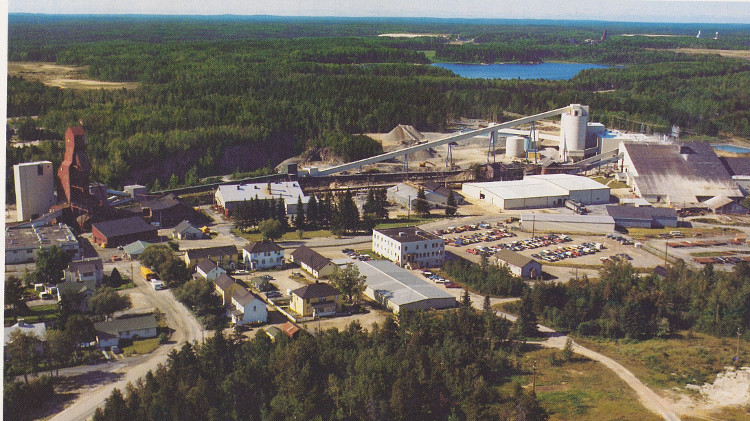
The growing demand for minerals means there are more mining operations being developed in northern and remote regions of Canada. However, traditional mine waste management and reclamation solutions are often not specifically designed for extremely cold temperatures and permafrost conditions, which present unique technical and environmental challenges.
That is what drives Vincent Boulanger-Martel, professor in geoenvironmental engineering of mine waste at Université du Québec en Abitibi-Témiscamingue (UQAT), whose research focuses on developing climate-resilient approaches to mine waste management and site reclamation in cold regions.
“A rock is a rock, and it will stay a rock, and it shouldn’t change too much, geologically speaking,” said Boulanger-Martel. But, he noted, when you mine those rocks and extract the minerals from them, and then store the tailings or waste rock at the surface, they become something else: engineering structures, subject to environmental conditions that change their behaviour. When you throw in additional factors like freeze-thaw cycles and permafrost, safe and environmentally friendly management methods can become complicated.
In June 2025, Boulanger-Martel became the first Canada research chair in geoenvironmental engineering of mine waste in cold regions, a position he will hold for five years with the possibility of one renewal. The chair comes with $600,000 in funding that allows his team to work on the sustainable design and management of critical mining structures under the conditions specific to cold regions, from operation to post-closure.
Boulanger-Martel did not plan to go into mining; he was originally enrolled in an economics program, but one semester in, a casual chat with friends about what they wanted to do after graduation made him realize that he was entering the wrong field. While his friends wanted to wear suits and work in offices, Boulanger-Martel did not. “That was the turning point,” he recalled.
Since his father is a geological engineer and university professor, he understood the kinds of jobs available in the field, so he decided to study geological engineering at Université Laval in Quebec City.
By the time he was considering postgraduate studies, he said, “I wanted to go towards mining, but still wanted to touch the environmental aspects of it.”
That led him to UQAT, where he completed his master’s and PhD in mineral engineering; both focused on aspects of mining in northern regions, including the reclamation of mine tailings storage facilities in arctic conditions, an area he and his students continue to research.
“Knowledge is key,” said Boulanger-Martel. “You don’t fight nature but use it in design. This is the angle of the work that I do—we’re not trying to control nature. We want to adapt our techniques, our approaches, to [the conditions] we have in place currently, and to what’s coming [such as the effects of climate change].”
However, he pointed out, there are a lot of unknowns, from the shear strength and properties of frozen materials to how they react with water from rain or snowmelt, especially in Arctic regions, and that is what his team is working to understand in the field.
“I like to get a little dirty and work with site operators, machinery and stuff like that,” said Boulanger-Martel. “I think of a thesis as having its greatest value when it’s shared and put into action, rather than simply sitting on a bookshelf. Ideally, I like to take the information in those theses and put it to work towards stuff that is useful for science, but also for operators and the overall objective of all this, which is to help the environment around mine sites.”