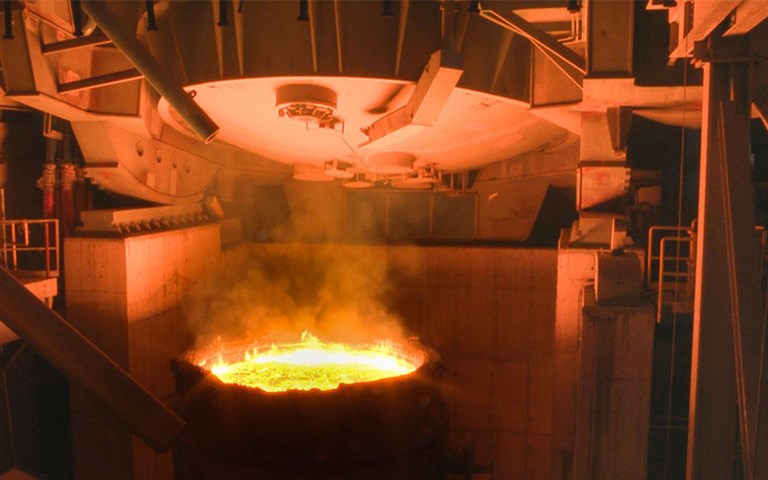
Algoma Steel received loans in 2025 from the Canadian and Ontario governments for its electric arc furnace transition project. Courtesy of Algoma Steel via LinkedIn
T
he global steel industry is under pressure to decarbonize, as steel production generates between seven and eight per cent of global greenhouse gas emissions. Steel producers are turning towards technologies such as hydrogen electrolyzers, which replace the carbon from coal in reducing iron ore to iron, and electric arc furnaces (EAFs) to reduce the industry’s carbon impact.
Canada-based steel producers manufactured approximately 12.3 million tonnes in 2024, according to the World Steel Association, and 12.2 million tonnes in 2023. The Canadian steel market is both an exporter and importer: in 2024, it exported slightly more than 50 per cent of its total production (of which 90 per cent went to the United States). Steel imports to Canada amounted to 8.3 million tonnes, a decline from the 8.8 million tonnes of steel Canada imported in 2023.
In Canada, faith in the green steel transition appeared to take a dent in December, when Ontario-based steelmaker Algoma Steel—which had received $500 million from the Canadian and Ontario governments in late 2025 to install its EAFs—laid off approximately 1,000 workers from its production facility in Sault Ste. Marie.
Algoma cited the impacts of tariffs imposed by the United States in March 2025 on Canadian steel imports as the reason for the layoffs, but for many, it seeded doubt in the green transition of the Canadian steel industry, and whether the sector could afford to make the transition while trade relations with its largest partner are chilly.
Another Canada-based steel producer, ArcelorMittal Dofasco, initially planned to decarbonize its plant in Hamilton, Ontario, by phasing out coal and using direct reduced iron (DRI) and EAFs by 2028. Citing trade difficulties, the company has now pushed back these plans until 2050. Dofasco has secured $450 million in financing from the Canadian government for this project.
The uncertainty facing companies like Algoma and Dofasco reflects a broader question confronting the steel industry: whether the potential long-term benefits of green steel outweigh the short-term financial risks.
Trade tensions between Canada and its largest trading partner may make investment in these technologies difficult, said Colin Mang, an economist at McMaster University who studies the Canadian steel industry.
New investments into green steel technology are “speculative” as a result, he added. “It’s not economical to pursue. The current time is not a good time to be making investments. There’s no need to expand production, because we don’t know where the market is going to go.”
Another disadvantage to greening steel operations is the displacement of workers, Mang said.
There are a lot of benefits to green steel, including a lower carbon footprint and lower operating costs. “But the capital cost is significantly more,” he said.
Arguments for transitioning to a steelmaking process that is less reliant on fossil fuels point to the benefits of becoming a less-carbon intensive industry. It could also create a comparative advantage over other countries that are not embracing these technologies in steelmaking.
But for Mang, this advantage is diminished given Europe’s push for low-carbon steel production.
ArcelorMittal announced in February it would invest €1.3 billion ($2.09 billion) to transition its French operations to green steel, Stahl-Holding-Saar in Germany decided in December 2022 to spend €3.5 billion ($4.9 billion) to transition to low-carbon steel production at its Saarland plant, and Tata Steel UK proposed in September 2023 to spend £1.25 billion ($2.1 billion) to install an EAF at its Port Talbot steelmaking facility in Wales.
“If [green steel] was going to be Canada’s advantage in that market, it wouldn’t last very long,” Mang said.
Jonas Algers, a researcher at Lund University in Sweden who studies the political economy of steel industry decarbonization, believes Canada has an opportunity, as the steel industry moves to less carbon-intensive technologies.
“I think there’s a space for Canadian production of green steel,” Algers said. He believes Canada has a unique role to play not only in manufacturing green steel, but in building its supply chains for green steel inputs such as green iron—iron that has been produced with green hydrogen and renewable energy, avoiding the use of emissions-producing fossil fuels in its production. Producing green iron requires high-purity iron ore that has 65 per cent iron content or higher and low levels of impurities, particularly silica, phosphorus and alumina; Canada’s Labrador Trough in Newfoundland and Labrador and Quebec has an abundance of this type of iron ore.
Green steel commands a “green premium,” allowing producers to generate additional revenue by charging higher prices for lower-carbon steel. These premiums have been created by the European Union’s (EU) Emissions Trading System and Carbon Border Adjustment Mechanism, as well as Japan’s GX-ETS system, which compels the market to reward low-carbon products.
This premium will not last forever, Algers said. “The premium over time will disappear as more companies make the transition, as low-carbon hydrogen-based steel becomes more cost-competitive, and as more competition comes from China,” he said. For Algers, the time for Canadian steelmakers to make the transition is now—as it is not a given that the EU will remain committed to producing green steel. The EU had made strides in establishing green steel production, but recent events—such as U.S. tariffs and the war in Iran—have tempered its support for the technology.
There has been some “backtracking” in Europe on green steel, according to Algers. “There’s [been] a lot of pulling back, and some incentives [to produce green steel] have been removed,” he said.
The eventual loss of the “green premium” does not mean that Canadian steelmakers will have undergone a costly transition phase for few returns, Algers said.
The investment in the new technology and the training of engineers working with these technologies will have a spillover effect, he said.
“If Canada was to move quickly in establishing green iron product in Quebec and Labrador, and getting the infrastructure in place, then the next project might be even easier to do,” he said.
“If there is an established green steel production and green iron production in Canada, that can lead to a spillover effect for electric vehicles, and establishing supply chains before other countries can.”
Canada needs to shift from becoming largely a natural resources producer to a country that connects its natural resources to value-added products, Algers said.
“In this day and age of more fragmented trade, if you stay [as] a natural resource exporter, you’re going to be very vulnerable to trade swings,” he said. “If you can capture more value based on resources, you can have more dynamic trade relationships.”
Sitting out on the green steel transition may not work in Canada’s favour, said Emma Rutkowski, senior analyst at industrial research organization Rhodium Group.
Green steel is a nascent industry, and it is hard to say how quickly things will progress, she acknowledged.
However, if green steel does take off and Canada had opted to stay on the sidelines, it could quickly fall behind. To illustrate her point, Rutkowski pointed to the power sector: “We see what’s happened in China; the U.S. didn’t rush to do solar or battery [manufacturing], and now China dominates those markets.” The same dynamic could play out in the green steel market, she noted.
Leading from inputs
Some analysts argue that Canada could also benefit from the global shift to cleaner steel by producing green iron, sidestepping coal-powered blast furnaces for EAFs. Global demand for green iron is expected to reach between 21 million to 50 million tonnes in 2030, according to projections from the Rhodium Group, further underlining Rutkowski’s point that the industry is in its earliest stages and no one really knows what the ultimate demand will be.
Canada has “an unrealized potential” in this sector, Algers wrote in a May 2025 report analyzing Canadian pathways to greener steel production. In 2022, Canadian mines produced $5 billion in iron, employing 9,000 workers in Baffin Island and in northern Quebec. Existing iron ore mines could adapt to new market demands of cleaner iron, while new mines could also be opened to cater to this demand.
One of several companies looking to produce green pig iron is Strategic Resources. The company is currently developing the BlackRock vanadium-titanium-iron project near Chibougamau in northern Quebec and a metallurgical plant at Port Saguenay. As part of the first phase of development, the company aims to produce four million tonnes of iron ore pellets by 2029; phase two of the project, which includes pig iron, is planned to come online in the early- to mid-2030s.
Sean Cleary, Strategic Resources’ founder and CEO, is a green steel advocate. Its BlackRock project will mine iron, then process it in a direct reduction process using a “special type” of EAF powered by hydroelectricity, Cleary said.
“In North America, around 75 per cent of steel production is electric,” he said. “While in Canada, we still have blast furnaces at Stelco and Dofasco.”
Beyond the high capital costs of installing EAFs, another challenge in switching from blast furnaces to EAFs, as Algoma did, is that it only serves to recycle steel, not produce it from scratch, Cleary said.
“Electric arc furnaces are essentially scrap melters,” he said. “The problem with scrap is that there’s residual contaminants in the scrap, and those residual contaminants have to be diluted out with virgin iron units.”
These virgin iron units can be either DRI, hot briquettes or pig iron, all of which are produced with some amount of fossil fuels, Cleary said.
A gradual transition to green steel production, for Cleary, starts with using scrap as a major input to be transformed into new steel by EAFs. This process should then be replaced by using virgin ore units and green pig iron to create “as low-CO2 steel product as possible, at a cost that makes sense, and which users can absorb,” he said.
This is what Strategic Resources and other companies eyeing green iron inputs are targeting. The company is employing this gradual approach in its own operations, creating pig iron at first by using natural gas. The furnaces currently being engineered by contractors will have the capacity to introduce hydrogen over time, gradually ramping up until they can replace natural gas altogether to produce clean pig iron, Cleary said.
The pig iron Strategic Resources produces with natural gas will still be “highly competitive, from a carbon perspective,” Cleary said, as the iron will be used in furnaces that are electric.
“In time, we’ll release almost zero emissions for pig iron,” he said. “That’s our goal.”
Cleary believes that a carbon-free steelmaking process is possible, but is still in the stage of early-scale testing.
This process would involve creating an integrative project using renewable energy to power the electrolyzers to create hydrogen, that would then be used in a DRI furnace to create zero-emission DRI.
“It’s yet to be proven that this can be operated on a scaled basis,” Cleary said. “But I think it will.”