C
anada is a significant copper producer, but nearly two-thirds of the copper concentrate produced from Canadian mines is exported to Asia and elsewhere for processing.
Now the federal government is examining whether the country needs a new copper smelter and refinery in Western Canada. In December 2025, Natural Resources Canada (NRCan) issued a Request for Information (RFI) on the economic viability, strategic value and potential geographic sites for a copper processing facility in the West.
“Midstream assets—including mineral processing facilities, refineries and smelters—are essential to securing Canada’s supply chains and transforming raw materials into the advanced materials needed for clean energy, defence, digital infrastructure and next-generation manufacturing,” NRCan said in its brief to stakeholders.
In its call for submissions, NRCan invited consultation from domestic and international industry, investors, traders, Crown corporations, government agencies, First Nations and Indigenous organizations, academia, as well as not-for-profit and research organizations with experience and interest in copper mining and smelting.
A rich history of smelting and refining
Today, there is only one fully integrated copper smelter and refinery left in Canada—Glencore’s Horne smelter in Rouyn-Noranda, Quebec, and its Canadian Copper Refinery in Montreal East.
“We let it happen,” said John Steen, director of the Bradshaw Research Institute for Minerals and Mining at the University of British Columbia (UBC). “Western nations abandoned strategy around minerals. The governments of the day saw no strategic reasons why smelting should happen in their countries, and particularly when there was a lot of pollution. But China was doing things for strategic reasons.”
Mining and smelting copper was part of Canada’s early industrial development. By some estimates, nearly 50 copper smelters—many of them quite small and located near mine sites—were put into production between 1849 and 1960.
Some gained international prominence. The Granby smelter in Grand Forks, British Columbia, which opened in 1900, was once ranked as the largest non-ferrous smelter in the British Empire and second largest in the world.
In Quebec, the Horne smelter set a record around the middle of the last century for the hourly copper smelting rate for a single furnace. It maintained that status, over a range of technologies, for nearly 40 years. But major upgrades required to bring the century-old facility up to modern-day standards, including a $300 million investment to reduce emissions, are on hold as the company negotiates new terms with the Quebec government.
The last copper smelter in B.C. closed in the 1980s. Since then, the handful that were remaining across the country have virtually all shut down.
The Gaspé smelter, a copper smelter in eastern Quebec operated by Noranda, closed in 2002, followed by the closure of Inco’s Copper Cliff copper refinery in Sudbury, Ontario, in 2005. Hudbay Minerals’ copper-zinc smelter in Flin Flon, Manitoba, and Glencore’s Kidd Creek copper smelter in Timmins, Ontario, both closed in 2010.
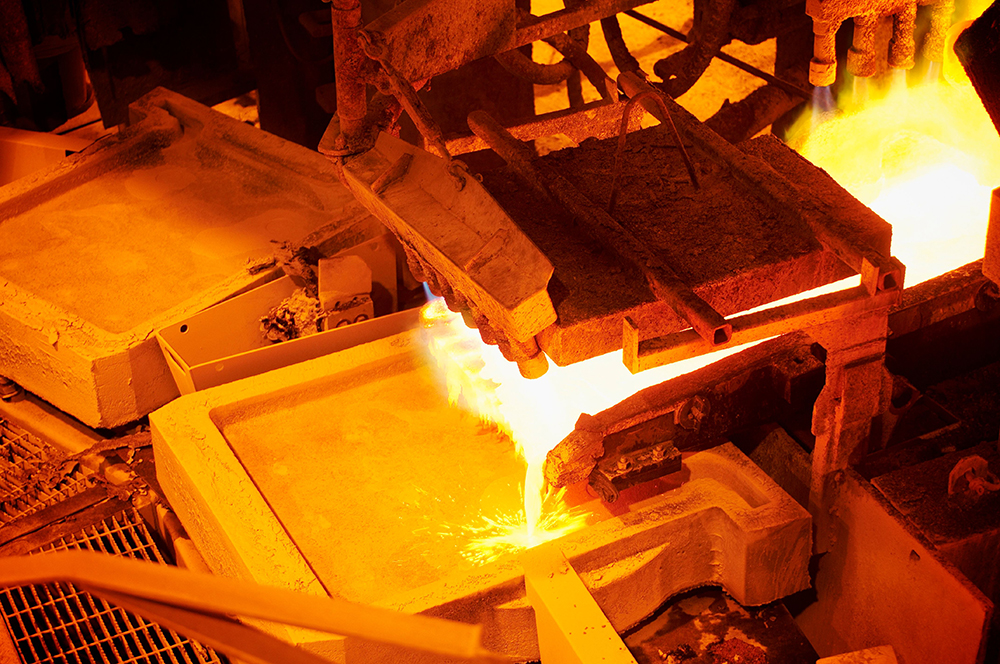 Copper smelting at Glencore’s Horne smelter in Quebec.Courtesy of Glencore Canada
Outsourcing to Asia
China, Japan and Korea now account for on average about 70 per cent of global copper smelting and 61 per cent of global refining, according to the Mining Association of Canada (MAC).
“Asia’s share of global smelting capacity increased from approximately 21 per cent in 1990 to 70 per cent in 2024, while the share in the Americas declined from approximately 39 per cent to 10 per cent over the same period,” MAC stated in its Jan. 27 submission to NRCan’s RFI. “Europe’s share also declined, from 29 per cent to 15 per cent.”
Eighteen of the world’s 22 largest copper smelters are in Asia and none of them are in North America, MAC noted. In terms of copper refiners, 14 of the 20 largest are in Asia, with just one in North America.
Phillip Mackey, renowned metallurgist and inductee into the Canadian Mining Hall of Fame, lamented that Canada’s smelters and refineries are all but gone.
“We must process concentrates at home. We must sell those products. And we can do it efficiently and profitably,” he said. “I don’t think the idea of building a new smelter is something that we can debate about, it’s essential—whether it’s in B.C., Quebec or on the East Coast. We must diversify our trade.”
National security versus market realities
While copper processing assets have strategic value and may meet geopolitical imperatives, the economic reality is that it is challenging to make them profitable.
“There is enormous strategic value having these smelters, but economically there is hardly any value there,” said UBC’s Steen. “It’s really hard to make them profitable, and these things cost several billion dollars. It’s not going to happen without some sort of government support or subsidization.”
Jay Khosla, executive director of economic and energy policy at the Public Policy Forum in Ottawa, agreed. “The business case is not strong in the case of market conditions, but the geopolitical case is off the charts. So, you have to reconcile the delta between those two things,” he said.
“None of this will be done without serious investment from the government so they have to say to themselves, is this the right strategic case for Canada? And if they do invest, will they get paid back? [The] government needs to give some serious thought to this.”
High prices for raw copper inputs, underutilized copper processing capacity and exceptionally low or negative treatment and refining charges—the fees that mines pay to processing operations for converting raw materials into refined metals—are all major challenges to profitability.
“It’s difficult to make a good commercial case when treatment and refining charges are likely to stay low for the foreseeable future—at least for another five to 10 years,” said a trader at an international copper trading house.
“Unless the Canadian government intervenes with a concentrate export ban and/or major financial support for a smelter project, it is unlikely in my opinion,” he concluded.
In addition, global overcapacity of copper processing will remain a roadblock. According to MAC, global copper refining capacity in 2024 was about 32.6 million tonnes and refined copper production was about 27.4 million tonnes. That resulted in an average capacity utilization rate of approximately 84 per cent.
A new copper smelter and refinery would also require that Canada increase its import of copper feedstock to supplement domestic production. While Canada is a significant producer of the red metal, it has less than one per cent of global copper reserves, MAC stated, adding that Canadian copper mines produced about 25 per cent less copper in 2024 than they did a decade earlier.
“We’re not sure current mine production capability in B.C. justifies a smelter and would need a few major projects to get approved to make it worthwhile,” noted the U.S.-based trader, adding that sea freight costs from Canada’s West Coast to Asia aren’t “too bad.”
In January, a new study by S&P Global forecast that global copper supply is expected to fall 10 million tonnes short of demand by 2040, creating a “systemic risk” for global industries. In addition, according to an International Energy Agency report published in May 2025, demand for refined copper will increase 30 per cent by 2040.
“Recent production disruptions at major copper mines have removed significant primary supply from global markets,” MAC warned, noting that other copper mines in countries like Chile and the Democratic Republic of Congo have seen lower production in recent years.
“Combined with strong demand, these disruptions have contributed to copper prices reaching recent highs, exceeding US$13,000 per tonne and surpassing both pandemic-era levels and the 2011 super-cycle peak,” MAC noted.
“Under these conditions, the challenge facing copper smelters and refiners in high-cost jurisdictions is increasingly one of survivability rather than profitability. Sustained margin compression, combined with rising energy, labour and compliance costs, has increased the risk of permanent closures among western smelting and refining facilities.”
For Mackey, the challenges are surmountable. He argued that importing sufficient copper feedstock would not be an issue. Latin American mines produce over 40 per cent of the world’s mined copper and ship most of that concentrate to China, he said, and if Canada had a smelter, some of that concentrate could come here.
He also noted that Canada does not have a single aluminum mine but has a thriving aluminum industry. Aluminum smelters primarily rely on imported bauxite and alumina, largely from Brazil, Australia and Guinea.
New financing structures
In Mackey’s view, there are a number of avenues the federal government could take that would support new domestic midstream processing capacity, including coordinated, policy-driven subsidies, tax incentives, public-private partnerships, equity stakes and offtake agreements.
He pointed to Canada’s offtake agreement for graphite concentrate from Nouveau Monde Graphite’s Matawinie mine in Quebec as a possible concept to build on. In October, the company signed a seven-year offtake agreement with the Government of Canada for an aggregate of 30,000 tonnes per year of graphite concentrate.
The term sheet includes a 15,000 tonnes-per-year take-or-pay commitment from Ottawa, with the balance to be secured from allied countries. Canada’s committed volume includes a 50-50 profit split above the agreed-upon fixed price, net of any losses that the government may incur.
In this scenario, Mackey argued, the public purse would not be supporting these industries. “A smelter isn’t a mine shipping a partially finished product, but conceptually the financing or support and floor price mechanisms could be similar,” he said.
“Once a modern plant is established, it would be as competitive as, say, an existing modern plant in Japan or in Europe,” he added. “In addition, important byproducts such as sulfuric acid, precious metals such as gold, silver and other high-value metals [would] add to the revenue base. Inevitably, such a plant with proper planning could form a hub for a range of manufacturing businesses, creating more jobs.”
In the short- to medium-term, Canada could also provide loans, incentives and permit pathways to getting some of the past-producing processing, metallurgical and smelting facilities up and running again, others argued.
Overcoming NIMBYism with technology
In its call for submissions, NRCan conceded that social licence concerns, and opposition due to potential emissions of heavy metals like arsenic and lead, could derail the future of a new copper smelter and refinery in Canada.
But Mackey argued that today’s advanced smelters in Europe, such as Boliden’s Harjavalta smelter in Finland, are energy efficient and environmentally clean.
“I think that in the public eye, when people say, ‘Oh, we need a smelter in B.C.,’ they think of one of the old-fashioned plants, always built at the mine site, that were not the cleanest and where environmental standards were at a minimum,” he said. “But smelters built today with modern technology are clean and efficient—possibly no different in concept to a manufacturing plant such as an electric vehicle battery plant.”
As NRCan weighs the pros and cons, Heather Exner-Pirot, a senior fellow and director of energy, natural resources and environment at the Macdonald Laurier Institute, wondered whether there is not an intermediate solution.
“Maybe it’s not a globally competitive $5 billion smelter that is competing at that scale, but something smaller, which might not stand on its own two feet, but does provide some supply chain independence,” she mused. “I’m a small-c conservative and believe that it’s good to have industries like vaccine production and auto manufacturing in your country, and it would be reasonable to make the case that copper smelting and refining falls in that category.”
It all boils down to a risk assessment, she said. “How vulnerable are we to having supply cutoff? On its own, it wouldn’t make economic sense, but there is a case to be made that Canada should have some independent copper smelting and refining.”
In the meantime, she said, it is essential to keep the last smelter in the country a going concern.
“Obviously the priority is that the smelter we do have in Quebec stays profitable and financially sustainable,” she said. “That should always be the priority for Canada.”
Are we missing the point?
For Marilyn Spink, a materials engineer and executive director of the Canadian Critical Minerals and Materials Alliance, the debate about whether Canada needs a new copper smelter is misguided.
While the country has built tremendous wealth pushing commodities into the marketplace, she said, the new economy requires specialty materials for advanced manufacturing, clean technologies and defence applications, which are demanded from customers. In her opinion, this is the overlooked economic opportunity.
“China doesn’t care if they make money mining or smelting, because they make their money in the manufacturing by adding value to all the input materials,” she said. “Canada must avoid the resource curse and add value to our wealth of natural resources. We need to start making specialty materials that customers need and can purchase through offtake agreements.”
What the country needs are copper wire drawing, copper plate and copper foil facilities, and to understand exactly what customers need now and might need five years from now, Spink added.
“If we build a smelter but continue exporting commodity copper for others to add value, we are missing the bigger opportunity for our economy,” she said. “To ensure the smelter’s long-term sustainability, we should develop in parallel a domestic copper materials ecosystem that serves customers’ needs right here in Canada.”
There is a fundamental difference between minerals and materials, which often is lost in policy discussions, she continued. Advanced manufacturing, energy systems and military technologies do not use raw materials extracted from the ground; they use highly refined, specification-grade materials produced through complex midstream processing. The strategic bottleneck is refining, chemical upgrading, purification, alloying and advanced materials engineering capacity.
Spink pointed to Canada’s Critical Minerals List to underscore her point. Thirty-two of the 34 minerals and metals on the list are elements or gases that require further refining and converting to produce materials.
“The opportunity isn’t in rocks out of the ground or raw concentrates,” she said. “It’s in the value-added, refined materials that power downstream products and industries. When we continue to treat this as simply a mining story, we risk both our economic prosperity and our economic security.”