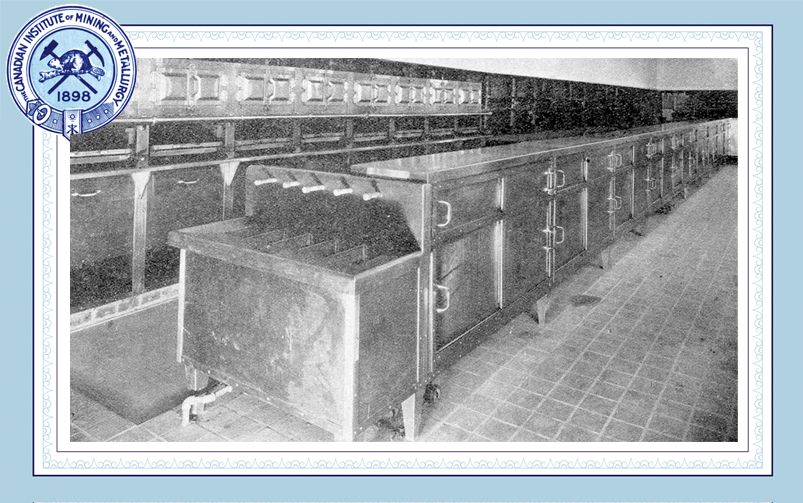
Link-Belt Limited’s display was designed to show the smooth operation of the Link-Belt silent chain (CIM Bulletin, May 1926).
The origin stories of our industry are contained within the digital archives of the CIM Bulletin, the predecessor to CIM Magazine. Explore more of the CIM archives on OneMine.
I
n 1926, CIM’s 28th Annual General Meeting, held March 3-5, featured an exhibition of minerals and mining equipment for the first time. In the February issue of CIM Magazine, we talked about the exhibits that focused on the diverse mineral resources found across Canada; in this issue, we will look at those focused on industrial innovation and operational safety in the Canadian mining industry.
The first exhibition was organized on a modest scale with only 24 booths. The May 1926 issue of CIM Bulletin noted that attractive small-scale exhibits “call for considerable ingenuity and decorative effort on the part of those who make the displays,” adding that “members who attended the Montreal meeting will agree that these requirements were exceedingly well executed by the various exhibitors who took considerable pride and pleasure in dressing their booths.”
Many exhibitors showcased machinery and technical innovations. Some highlights of Link-Belt Limited’s booth were its new Tinken-equipped anti-friction belt idler and its silent chain, named “Paradox,” which was reportedly very favourably commented on by many visitors. “Its interest lies in the fact that although all of the six drives, which it contains, actually travel in the same direction, the Paradox shows an entirely different effect, some of the drives apparently running in opposite directions and others apparently remaining stationary,” said CIM Bulletin.
The Canadian Ingersoll-Rand Company exhibit was designed to show some of the steps involved in the manufacture of a R-72 Leyner Ingersoll Drifter rock drill. “[It] comprised a finished machine of this type, a large photographic cross section showing the arrangement of the various parts and a display of the parts themselves in different stages of completion with cards showing the rough and finished weights and the number of operations required to make each piece,” said CIM Bulletin, noting that the amount of skilled labour required to build a rock drill is not always evident, underscoring how mining equipment was as much about craftsmanship as engineering in the 1920s.
The Coventry Company exhibited the Coventry chain reduction box, which was reportedly being used extensively in mines in England, Australia, New Zealand and South Africa, with some also in operation in Canada.
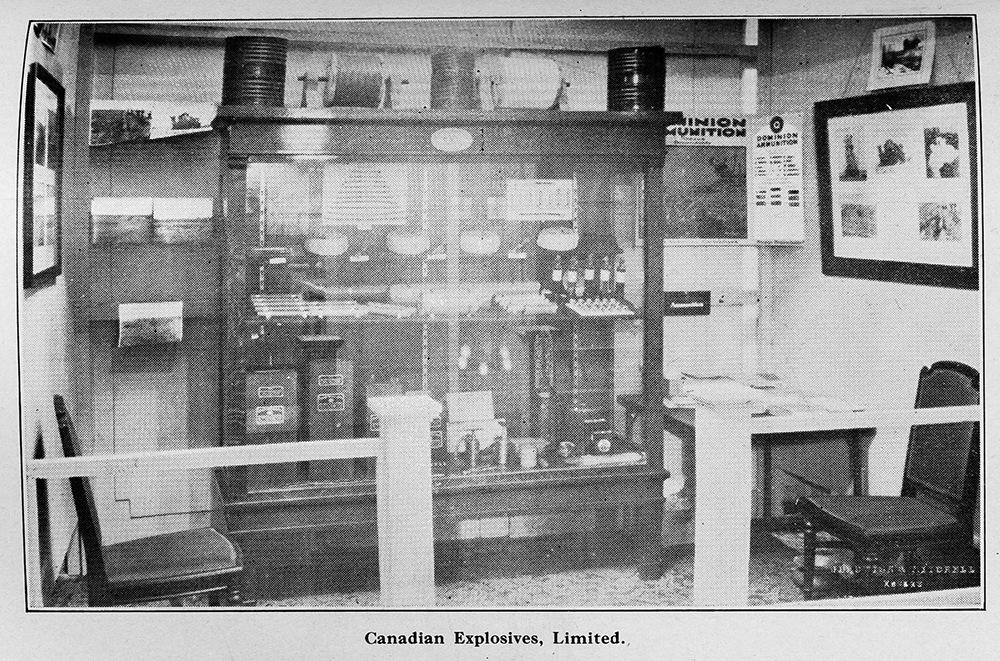 Canadian Explosives Limited’s booth featured photographs of actual large-scale blasts, prompting discussions regarding safety in the use and storage of explosives (CIM Bulletin, May 1926).
Due to restricted space, Mussens Limited was unable to exhibit any machinery on the floor but used a projector to show moving pictures of heavy machinery in active operation, such as Bucyrus steam and electric shovels; Marsh steam and electric hoists; and Vulcan gasoline, electric and steam locomotives. “Their picture of a Linn Tractor with snow-plow attachment for clearing country and town roads attracted a great deal of favourable comment,” said CIM Bulletin. “It is felt that within a short time such a method of clearing snow-bound roads in mining districts will be well established.”
The Canadian Pneumatic Tool Company, Limited displayed several products at its booth, such as the CP-5 Drifter, CP-5D Sinker and CP-10 Sinker from its CP line of rock drills. “The CP-5D Sinker is unique, in that it consists of a standard CP-5D Drifter removed from its shell and mounted on a set of spring handles,” said CIM Bulletin. “This proved of great interest to many visitors, as it permits complete interchangeability of moving parts between Sinkers and Drifters.”
The exhibit by Peacock Brothers Limited covered a wide range of mine and power plant equipment, such as Hadfields manganese steels, DurOmeT balls and liners and Merco Nordstrom lubricated plug-valves.
Elsewhere on the show floor, Engineering Equipment Co., Limited displayed a Mitchell electric vibrating screen. CIM Bulletin pointed out that the company, which was the Canadian manufacturer of this screen, had supplied them to a number of major Canadian companies, including The Mond Nickel Company, Canada Cement Company and Ontario Gypsum Co., Limited.
Beyond machinery, several displays were dedicated to reducing hazards in the mining industry. Canadian Explosives Limited used its booth to educate attendees on the safe storage and use of various blasting materials through photographs of actual large-scale blasts. “These pictures were a source of instruction to consumers of explosives and gave rise to interesting discussion regarding the methods of blasting and the costs of such work,” said CIM Bulletin.
Instead of a traditional showcase, Northern Explosives Limited displayed a miniature fuse, cap and primer house to show “how simply and inexpensively a safe, convenient house of this type” could be installed.
Infrastructure and engineering were also represented. Horton Steel Works Limited, which provided a variety of steel plate structures for mines, had a booth. “Typical installations of standard [process] tanks for the various processes are in service at the mills of the Hollinger Consolidated Gold Mines, McIntyre-Porcupine Mines, Dome Mines, Ankerite mine and the March Gold Mines,” said CIM Bulletin.
The Hamilton Bridge Works Company featured design drawings of various steel structures built by the company, including a rock conveyor bridge, a large headframe and some heavy steel frame buildings; some of these were reportedly built for a leading mine in northern Ontario, although it was not named in CIM Bulletin.
It also showcased a large painting of the Stoney Creek arch bridge in the Selkirk range of the Rocky Mountains, which was built in 1893 for The Canadian Pacific Railway. “After thirty years of continuous service, this bridge is carrying the present-day traffic and is a striking example of the exceptional longevity of structural steel in buildings and bridges even when exposed to the continuous action of the elements,” said CIM Bulletin.
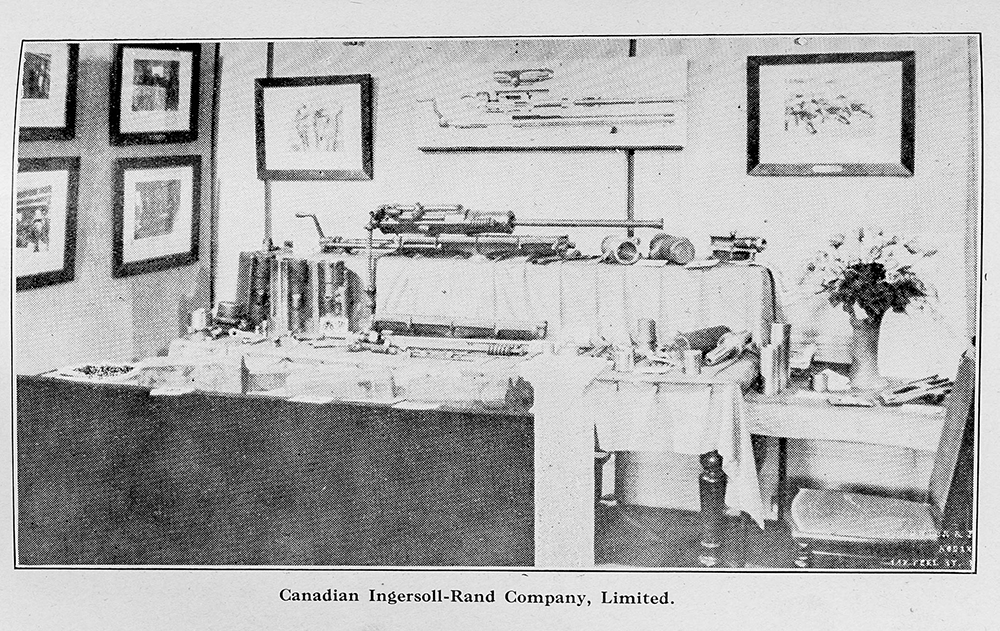 The Canadian Ingersoll-Rand Company’s exhibit showed the steps involved in the manufacture of a R-72 Leyner Ingersoll Drifter rock drill (CIM Bulletin, May 1926).
Joliette Steel Limited’s booth contained miscellaneous pieces of steel castings along with Joliette Orbit and Joliette Tisco castings, the latter of which was a high-quality manganese steel casting being manufactured in Canada under the supervision of the New Jersey-based company Taylor-Wharton Iron & Steel Co. “Many mining operators will be interested to know that they can now secure manganese steel in Canada and they are assured of the same quality that the Taylor-Wharton Company have been supplying in the United States,” said CIM Bulletin.
On the supply side, T. Eaton Co., Limited showcased some of the equipment it provided for miners and prospectors, such as canoes, tents and fishing tackle. “The scene contained the elements of picturesqueness plus practicability: even prospecting miners have their aesthetic moments,” said CIM Bulletin.
“One of the interesting and unusual features of the booth were portraits of mining types of British physiognomies, each expressing in its own way the indomitable character necessary to all who would essay the rigours of prospecting adventure.”
The success of the 1926 exhibition transformed it into a permanent tradition for future CIM Annual General Meetings. “[It] gave rise to considerable enthusiasm and indeed the interest taken by members in the various exhibits was so evident that it is hoped to repeat the idea at future gatherings of the Institute,” said CIM Bulletin.
From 24 booths in 1926 to Canada’s largest exhibition of mining products and services showcasing the latest technologies and solutions, the CIM Expo mirrors the evolution of the mining industry—marking a century of innovation, collaboration and progress.
The origin stories of our industry are contained within the digital archives of the CIM Bulletin, the predecessor to CIM Magazine. Explore more of the CIM archives on OneMine.