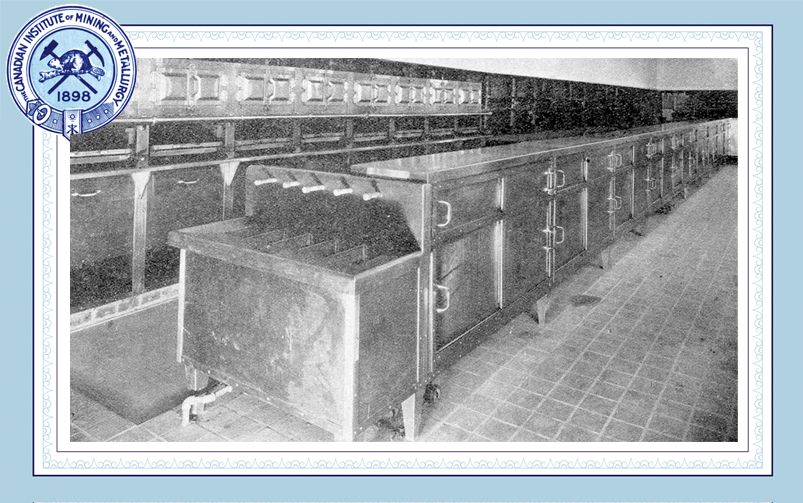
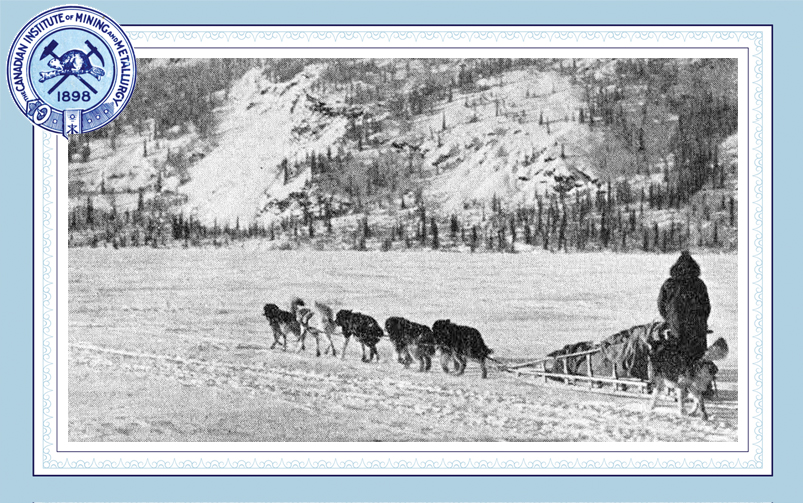
The display by the Canadian Department of Mines illustrated the department’s activities (CIM Bulletin, May 1926).
The origin stories of our industry are contained within the digital archives of the CIM Bulletin, the predecessor to CIM Magazine. Explore more of the CIM archives on OneMine.
The 28th Annual General Meeting of CIM was held from March 3-5, 1926, at the Windsor Hotel in Montreal, Quebec. For the first time, it included a “novel feature”: a comprehensive exhibition of minerals, mining technology and safety equipment that provided attendees with a detailed overview of the evolving Canadian mining landscape and its technical progress.
This new initiative was announced in the February 1926 issue of CIM Bulletin. “An exhibit of minerals, mineral products and mining equipment will be held in the Prince of Wales Salon in the Windsor Hotel during the three days of the meeting,” it said. “The Salon will be divided into twenty-four illuminated and decorated booths which have been allotted to various exhibitors who are going to considerable trouble and expense to make this feature interesting and educative to those in attendance.”
One of the focuses of the exhibition was the diverse mineral resources found across Canada, as well as the scientific work involved in mapping and studying them. The May 1926 issue of CIM Bulletin included brief descriptions of some of the booths and the highlights of their displays.
The Ontario Department of Mines displayed various specimens of mineral resources from the province, and “the discriminating visitor could not but be struck by the excellence of the exhibits,” said CIM Bulletin.
“There were pieces of quartz from the Croesus mine containing gold up to 50 per cent of their weight—not thumb-nail samples, but varying from 10 or 12 pounds to 50 pounds,” it said. “Almost as rich in gold was the collection from a pocket in the Dome mine, and there were a couple of splendid samples from the Vipond mine. The Hollinger was also well represented, and there were ores from Kirkland Lake and from the new field, Red Lake.”
The display also included “wonderful” specimens of silver from the Cobalt, Gowganda and South Lorrain fields. “Particularly interesting were the splendid pieces of ‘sponge’ silver, about 80 pounds in weight, from the Nipissing mine, sheets of native metal from the Coniagas and Frontier, and bundles of wire silver from South Lorrain,” noted CIM Bulletin. “Cobaltite, smaltite and niccolite showed how cobalt, nickel and arsenic occur in these ores. The non-metallic list was represented by a few of the leading products—mica, feldspar, gypsum, etc.”
It added that while small, the collection was unique, and “especially in the precious metals, [it] would not suffer in comparison with exhibits of a like kind from anywhere else in the world.”
An exhibit by the Quebec Bureau of Mines highlighted the metallic resources and potentialities of the province, particularly of the new mining district of Rouyn-Harricana. “The exhibit was very striking and impressive owing to the size of the specimens, which weighed from twenty to fifty pounds each,” said CIM Bulletin. “The copper-gold sulphide ores of Rouyn, Dufresnoy, Duprat and Boischatel were well represented, the labels in many cases containing analyses which gave an excellent idea of the value of the ores.”
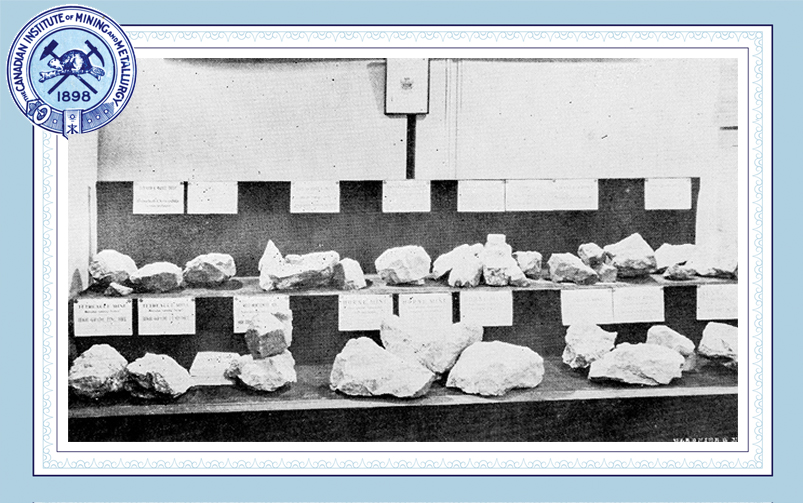 Specimens on display by the Quebec Bureau of Mines (CIM Bulletin, May 1926).
There were also “spectacular” specimens of free-gold ores from Quebec’s Cadillac and Dubuisson districts. “Moreover, the zinc and lead deposits of eastern Quebec were illustrated by representative samples from Portneuf county and from Gaspe; some specimens from the latter showing, on cut and polished faces, the association of the honey coloured sphalerite, galena and gangue material, characteristic of the Gaspe ores,” said CIM Bulletin.
The publication added that the exhibit was accompanied by a mounted geological manuscript map of western Quebec “which was the object of flattering remarks on the part of interested visitors.” The map showed the geological association of the deposits and the area susceptible of mineralization on each side of the Transcontinental railway.
An exhibit of Manitoba minerals by the Mining Bureau of the Winnipeg Board of Trade “while by no means complete was fairly representative, particularly of those sections of the province in which greatest interest has been shown up to the present,” according to CIM Bulletin. “The exhibit was unique in that it contained specimens of the only known deposit of lithium ore in the Dominion; a deposit which has excited interest, not only on this continent but also in various European countries.”
There were also non-metallic minerals at the booth, including “a very good display of Tyndall building stone which is now coming into more general use throughout the Dominion.”
An exhibit by the Canadian Department of Mines provided a broad overview of federal activities, including the work of the Geological Survey, the Mines Branch, the Museum and the Explosives Division. “Concentration products of different kinds of ore, such as copper-zinc and lead-zinc ores, and electrolytically-produced metals illustrated research work in ore testing and metallurgy,” said CIM Bulletin. “Specimens of products derived from the treatment of various fuels, solid and liquid, indicated the trend of research in fuel testing, and various types of test pieces in clay products directed attention to investigations in ceramics.”
The display included mineral and rock specimens, maps and reports, but also reached into broader scientific fields such as mammalogy, botany, anthropology and archaeology. According to CIM Bulletin, “the whole exhibit was unpretentious, but attractive and admirably adapted to the purpose for which it was prepared, namely, to enable the members of the Institute by a cursory examination to get an idea of the scope of the work of the whole department.”
The International Nickel Company’s booth displayed the company’s raw materials and commercial products, including nickel and Monel metal. “A special effort was made to show many of the finished products, alloys, nickel steels and commercial applications,” said CIM Bulletin. “The exhibit embraced such products as nickel coinage, nickel silver, white gold, constantan, nickel bronze, nickel steels, invar, nickel cast iron, nickel chromium alloys, nickel in radio tubes and in the Edison storage battery.”
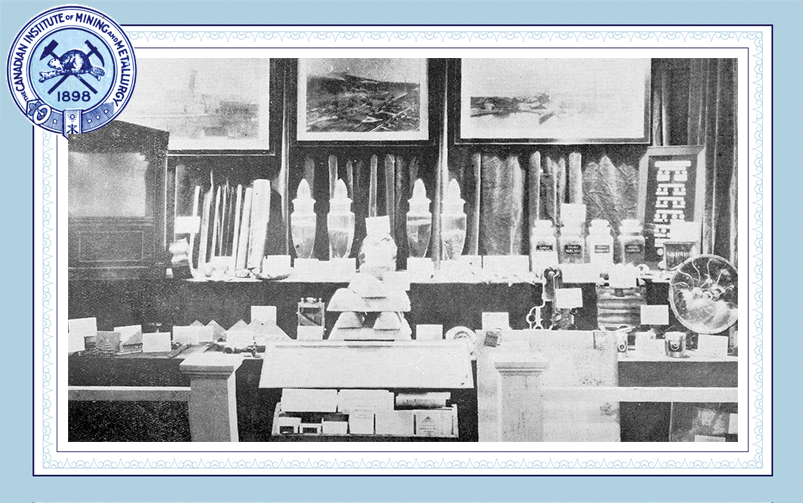 The International Nickel Company of Canada’s booth had both raw materials and commercial products (CIM Bulletin, May 1926).
There was also a special display of the nickel anodes and salts used in plating, as well as examples of plating. “An attract-o-scope showed views of many of the applications of nickel and Monel Metal in practically every known industry,” said CIM Bulletin.
Overall, the exhibit of minerals, mineral products and mining equipment at the 1926 Annual General Meeting of CIM was a success. “Council were in some doubt that this feature could be successfully staged in keeping with Institute savoir vivre but the keen interest displayed by members in the various exhibits, and their enthusiastic comments to the effect that the idea was both excellent and timely, have left no doubt that similar exhibits will be welcomed at future meetings,” said CIM Bulletin.
“This first attempt of an Institute exhibit was carried out on a modest scale and provided for only 24 booths although it transpired later that more could have been disposed of if they had been available. It was, however, deemed inadvisable to plan too generously until some experience had been gained with regard to the arrangements necessary for an exhibit and the reception accorded it by members.”
The origin stories of our industry are contained within the digital archives of the CIM Bulletin, the predecessor to CIM Magazine. Explore more of the CIM archives on OneMine.