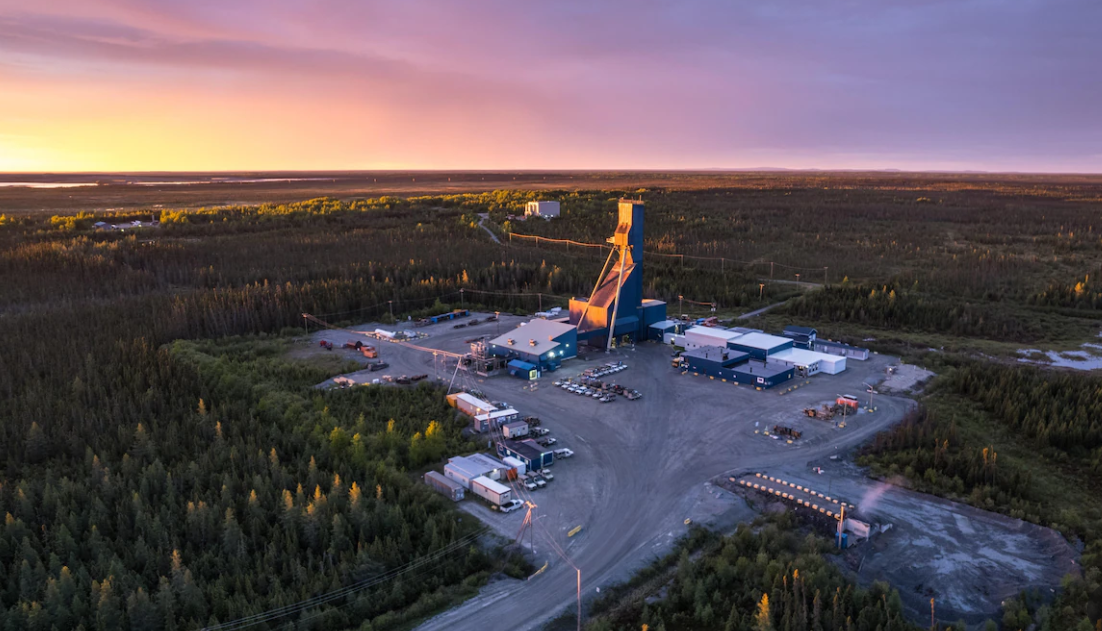
Gold revenue in British Columbia surged in 2025 due to elevated prices and the start-up of Artemis Gold’s Blackwater mine (pictured). Courtesy of Artemis Gold.
British Columbia’s mining industry has long argued that the province was well-positioned for growth. The resource endowment was there; demand was returning, and critical minerals were increasingly becoming more important.
But according to PricewaterhouseCoopers (PwC) Canada’s latest BC Mine 2025 report, something fundamentally different is happening right now.
For perhaps the first time in decades, the mining sector is seeing what Mark Patterson, B.C. mining leader at PwC Canada, described as a “truly unique set of positive circumstances.”
“We’ve got a real alignment between many of the stakeholders that are important to making these projects move forward,” Patterson said in an interview with CIM Magazine.
“We’ve got engagement of the federal government, provincial government in British Columbia around the importance and economic contribution of mining to the province. We’ve got a coalescing of public opinion as well that the industry is really a key economic driver for the province.”
The report argued British Columbia is entering a new phase of mining development where projects are no longer viewed simply as commodities but as strategic national assets tied to energy systems, advanced manufacturing and defence.
That shift is reshaping the province’s mining economy. According to the report, metallurgical coal accounted for more than 60 per cent of B.C.’s mining revenue in 2023. By 2025, that figure had dropped to 40 per cent, while copper’s share of total revenue rose from 19 per cent to 25 per cent. Gold revenue also surged during the year, with gold revenue going from about 13 per cent to 22 per cent, driven by elevated prices and the start-up of Artemis Gold’s Blackwater mine.
Patterson said the broader significance lies not only in commodity prices but in the structural forces now underpinning demand, noting that governments are now thinking more about domestic sources of supply, supply chains with preferred trading partners and geopolitical strategies.
A narrowing window of opportunity While the report is optimistic about the province’s potential, it also calls for a sense of urgency.
“The window for British Columbia to establish itself as a reliable supplier of critical minerals is likely measured in years, not decades,” the report stated.
For Patterson, that urgency stems from the reality that other jurisdictions are pursuing the same opportunity.
“We’re not entirely unique,” he said. “Other governments are looking at these things too, whether it’s Europe, the United States or Australia. They’re thinking about their domestic sources of supply of critical minerals, and their governments are also taking a more active approach to try and figure out how to advance those interests.”
“We can't sit and wait for the moment to take hold. I think it really is an opportunity that we need to capitalize on and actually get things approved and built.”
The report argued that after years of false starts and deferred projects, B.C. now has many of the ingredients necessary for accelerated mining development: stronger policy support, government-backed infrastructure investment, increasing Indigenous participation and growing investor interest.
Permitting to production
Streamlined permitting remains one of the sector’s most persistent constraints.
For decades, mining companies have struggled with lengthy approval timelines, overlapping regulatory systems, and uncertainty around project advancement.
But the BC Mine report noted that the provincial and federal government are showing their interest in turning what has long been derided as a permitting system that is overly complex into one that is a "competitive advantage."
Permitting has become a national agenda initiative. Recent examples to improve the execution of projects include Natural Resources Canada’s Mine Permit Navigator, the federal government’s new Major Projects Office and the approval of Skeena Gold & Silver’s Eskay Creek gold and silver project through an impact assessment conducted in partnership with the Tahltan Nation.
Still, Patterson stressed that acceleration cannot come at the expense of meaningful engagement.
“The permitting process and project components need to move at the speed of trust,” he said. “You can’t go so fast that you start to leave different parties, communities or First Nations behind.”
Instead, he said, successful project development increasingly depends on bringing Indigenous nations into projects from the earliest stages.
“What we’re seeing now is Indigenous governments becoming much more partners in projects rather than simply parties you transact with during the process,” Patterson said.
The report highlights several examples of that shift, including the partnership between Skeena Gold & Silver and the Tahltan Nation at the Eskay Creek project, as well as the Nisga’a Nation and Tahltan Nation’s partnership with Arrow Transportation to acquire the Port of Stewart bulk terminal.
The report said these relationships are no longer peripheral to mining development, but foundational to whether projects advance at all.
Infrastructure as a collective responsibility
Infrastructure investment is also being reframed.
Historically, major roads, transmission lines and transportation networks were often treated as costs individual mining companies needed to shoulder themselves. But the report noted that governments and industry are increasingly seeing infrastructure as a shared strategic investment and regional economic catalyst capable of unlocking multiple projects simultaneously.
Patterson pointed to investments in the North Coast Transmission Line, a proposed 500-kilovolt infrastructure project and discussions around expanding power capacity into B.C.’s northwest as examples of that shift already under way.
“If you have a more collective view of the infrastructure, saying, ‘oh, if we build this transmission line or enhance this port facility, it opens up the opportunity for multiple projects to be developed,” he said.
That same thinking also explained why the Yukon was included prominently in this year’s report for the first time.
While the territory has historically lacked the scale of mining development seen in B.C., Patterson said its untapped resource potential is significant; however, it will depend on overcoming some challenges.
One of the challenges in the Yukon is the capacity, Patterson said. “It’s a smaller population and a smaller government,” so advancing multiple large-scale projects at the same time can be difficult.
Infrastructure remains another major constraint. Roads, energy access and regional connectivity are all essential to unlocking development in the territory, he added, particularly as companies begin thinking about district-scale mining opportunities rather than individual projects.
“The interconnectedness of the energy grid with British Columbia is one of the key things that will help unlock the opportunity that exists there,” Patterson said.
Technology support
The report also highlights technology adoption as an increasingly important “supporting lever” for execution.
Rather than replacing workers, Patterson said digital and artificial intelligence tools are more likely to help mining companies address looming labour shortages and skills gaps as new projects come online.
Employment at B.C. mining operations surpassed 14,000 direct workers in 2025, according to Patterson, and that number is expected to rise further as additional projects advance.
“There’s potentially going to be challenges and skills gaps in terms of finding all the right people to staff on these projects,” Patterson said.
“I think that's probably where one of the places that technology can play a key role in supporting the optimization of projects and operations and then allowing us to make sure that we have the people available to run all these larger mine projects.”