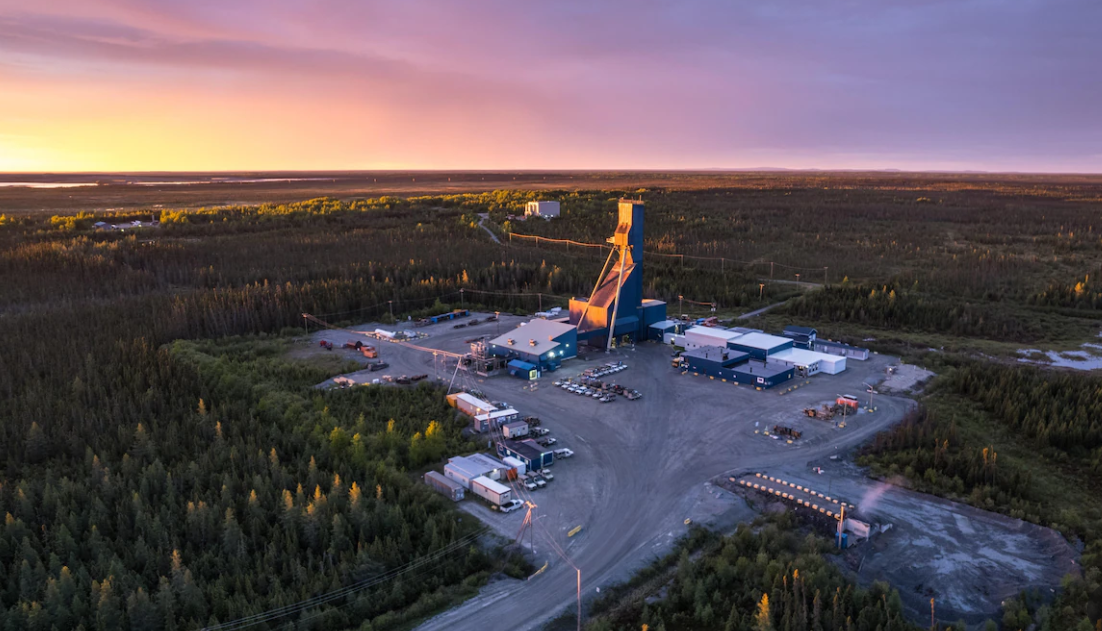
Royal Bank of Canada announced its new Indigenous advisory and finance practice during the First Nations Major Projects Coalition Conference in Toronto in April. Courtesy of the First Nations Major Projects Coalition
A new specialized Indigenous advisory and finance practice at Canada’s largest bank is intended to expand access to capital for Indigenous-owned major projects and other investments as the federal government continues its push to get major mining, energy and infrastructure projects built faster.
Announced in late April at the First Nations Major Projects Coalition (FNMPC) Conference in Toronto, the new practice group at Royal bank of Canada (RBC) will combine advisory services, capital markets expertise and relationship banking support to help Indigenous groups participate more directly in project ownership and financing. The practice also supports nations with little to no previous deal-making experience in developing the capacity to engage in these transactions. The bank said it will hold finance leadership circles in the fall to help nations build financial management and governance expertise.
“We know that securing and attracting capital to major projects requires Indigenous nations and communities as true equity partners,” Dave McKay, the bank’s president and CEO, said in an April 30 press release. “With our Indigenous advisory and finance practice, we are acting on a pivotal moment for the country while reaffirming our commitment to economic reconciliation.”
Indigenous communities looking to become owners of major projects have historically been limited by rules under the Indian Act that prevent First Nations governments and status individuals from using reserve land or assets as collateral. As a result, many have had to borrow the entirety of their investment as an equity loan, leading lenders to charge interest rates that would eat up any possible rate of return.
RBC’s new practice is the latest development in a rapidly maturing financial landscape around Indigenous ownership in Canada, as governments, banks and developers attempt to build financing structures that allow nations to participate as equity partners rather than solely through impact benefit agreements, royalties or hiring and procurement contracts.
The federal government launched the Canadian Indigenous Loan Guarantee Corp. (CILGC) in December 2024 to help Indigenous communities make equity investments in energy, natural resources, transportation, trade and infrastructure projects. Alberta and Ontario have similar initiatives launched prior to the federal government, in 2019 and 2009, respectively. British Columbia, Saskatchewan and Manitoba also have their own Indigenous loan guarantee programs.
Combined, the federal and provincial programs represent roughly $17 billion now available for Indigenous groups. The programs are designed to reduce borrowing costs for Indigenous nations by backing loans used to acquire ownership stakes in major projects, allowing banks and other lenders to finance deals that may previously have been viewed as too risky or too unfamiliar.
The programs are also beginning to change how financial institutions approach Indigenous borrowers.
“We’re starting to see lenders get more comfortable, access the loan guarantee for part of the deal and then do part of the deal outside of the guarantee,” said Mark Podlasly, CEO of the FNMPC, in an interview with CIM Magazine. He pointed to a $740 million deal closed on July 2025 for 38 First Nations in British Columbia to purchase 12.5 per cent of Enbridge’s Westcoast natural gas pipeline system, with $400 million guaranteed by the federal program. “Investors are realizing these are good deals [and] good opportunities.”
According to an RBC Thought Leadership analysis of these Indigenous loan guarantee programs, released in late April, the guarantees have successfully lowered financing costs for Indigenous borrowers by reducing lender risk exposure. However, lenders have not yet fully priced in the power of a government guarantee—leading to spreads of up to 50 basis points in some transactions.
To date, the programs have provided $1.8 billion total in guarantees across 26 deals. The RBC report noted while that represents just 11 per cent of the total funds available, the programs are working as designed. But the report also pointed out there are still structural barriers to be addressed to allow for Indigenous equity participation in “the next generation of Canadian projects,” including capital-intensive liquefied natural gas facilities, critical minerals projects and experimental technologies—such as carbon capture and small modular reactors.
Mining project challenge
In the case of critical minerals projects, particularly those in the pre-construction phase, both commodity price risk and potential cost overruns during construction could make them too risky for Indigenous communities to invest in or for government programs to guarantee a loan, Shaz Merwat, energy policy lead at RBC Thought Leadership and the report’s author, told CIM Magazine in an interview.
If construction costs on a mine or other upstream project blow past their estimates, “you have to pony up for that additional charge,” Merwat said. But when a nation is 100 per cent leveraged on their equity stake, “there’s no buffer for them to provide incremental dollars if the costs overrun,” meaning their initial investment could diminish in value as the total project cost climbs.
That is why most loan guaranteed ownership stakes have been in power generation or transmission infrastructure, or pipelines, said Justin Bourque, founder and president of Âsokan Generational Developments, an Alberta-based consultancy firm focused on partnerships between Indigenous communities and corporations, to CIM Magazine. Bourque is also the founding president of Athabasca Indigenous Investments, a group of 23 First Nations and Métis communities that bought a stake in seven Enbridge pipelines in 2022 with a loan guarantee from the Alberta Indigenous Opportunities Corp.
Pipelines and power infrastructure are “long-term contracted assets” with valuations tied to their utilization. “Until we’ve built out these deep and elaborate balance sheets for nations, the smarter option today is to invest in the more certain, lower-risk type asset classes that create long-term generational wealth to communities, as opposed to plain risk,” he said.
Merwat similarly noted that many Indigenous nations may ultimately prefer established options for economic participation in mining such as royalties, revenue sharing or contracting, given their lack of project risk.
Of the 546 projects across Canada with some amount of Indigenous ownership, just 13 are mining- and minerals-related, according to a 2026 report by the Indigenous Energy Monitor.
Some of the mining-related deals that have come about include the Norway House Cree Nation’s purchase of the Minago magnesium, nickel and platinum group metals project in northern Manitoba from Flying Nickel Mining Corp. for $8 million in October 2024; the Selkirk First Nation’s 22.3 per cent stake in Selkirk Copper Mines, which owns the Minto mine in the Yukon; and the Taykwa Tagamou Nation’s $20 million convertible note investment in Canada Nickel Company’s Crawford nickel project in Ontario in May 2025, a deal that gave the nation a 7.9 per cent stake and a board seat.
By comparison, there were 472 power and utilities projects with some Indigenous ownership, and 34 oil and gas projects.
Merwat said some creative financing solutions are emerging. The 2025 federal budget allowed the CILGC to use convertible debt, which is committed at construction and then converted to equity once cash flow from the project begins. He said there is also the possibility for project proponents to carry a First Nation’s equity during the construction period.
However, there remains a “geographic and sector mismatch,” Merwat added. Loan guarantee programs have been most used in Western Canada, given the established infrastructure and multiple communities with deal-making experience that can bring less experienced nations through the process. Comparatively, in Northern and northeastern Canada, where a glut of critical minerals projects are, communities do not often have the same experience with participating in major projects and may have less access to the advisory networks, institutional relationships and technical expertise that help to facilitate these deals.
“There are mining operations in Quebec and there is a lot of mining potential around lithium, yet we haven’t heard much about a Quebec-based Indigenous loan guarantee program,” he said, as an example.
Podlasly said the FNMPC is hearing from Indigenous communities that are interested in finding a way to invest in mining projects. The coalition released a guide in April for nations about the different ways to get involved in such projects, from environmental performance monitoring to contracting and procurement to equity ownership.
Qasim Saddique, principal consultant at Suslop Inc., a Toronto-based consultancy that specializes in sustainability strategy, project management and community development, said in an interview with CIM Magazine that many of its clients were initially looking at investing in infrastructure or utility-type projects to support a mining operation while generating guaranteed returns. But interest is beginning to shift alongside growing national attention on critical minerals development. Some nations, he said, are now looking at whether mining assets within their traditional territories that may no longer fit a company’s existing portfolio could become viable Indigenous-led development opportunities.
“I’m seeing some of those conversations emerge—‘how do we make new projects happen that might’ve been marginal in the past but if led by a nation could become compelling?’” he said.