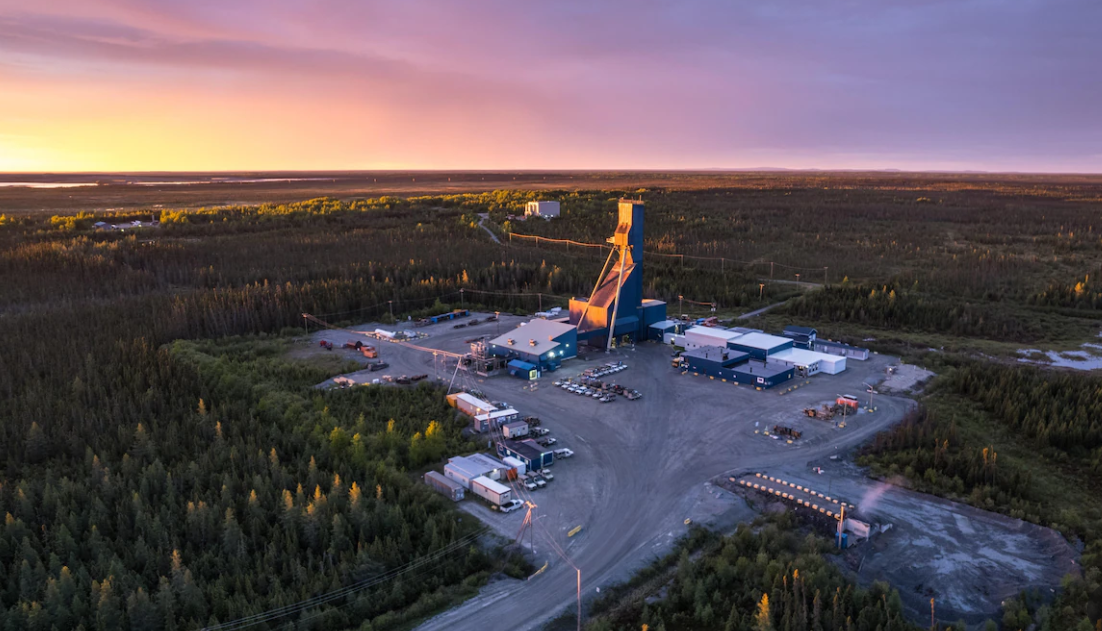
Hudbay Minerals’ New Ingerbelle expansion project at Copper Mountain is set to extend the B.C. mine’s operating life to 2045 while opening up higher-grade copper-gold-silver resources. Courtesy of Hudbay Minerals.
Welcome back to your weekly mining news recap, where we catch you up on some of the news you may have missed. This week’s headlines include funding for Generation Mining’s Marathon project in Ontario, an even bigger budget for Stage 2 of BHP’s Jansen potash project, and a funding lifeline for Mary River.
At the G7 summit in France this week, Prime Minister Mark Carney announced measures to strengthen security and critical minerals supply chains. He highlighted 13 new or recent Critical Minerals Resilience and Production Alliance partnerships, including Italian energy company Eni’s US$70 million investment in Nouveau Monde Graphite’s Matawinie mine in Quebec, an agreement between Denmark’s export credit agency and Quebec’s First Phosphate, and Ucore’s rare earths offtake agreement with Japan’s Sumitomo Corporation. The announcement also outlined a Canada-France critical minerals stockpile initiative.
Hudbay Minerals marked the official groundbreaking of the New Ingerbelle expansion project at its Copper Mountain mine near Princeton, B.C., on Tuesday. The project received key environmental and regulatory approvals from B.C.’s Major Mines Office in February. The expansion project is expected to extend Copper Mountain’s mine life to 2045 and produce about 750,000 tonnes of copper, 900,000 ounces of gold and 5.5 million ounces of silver.
Surge Copper released a prefeasibility study for its Berg copper-molybdenum-silver project in central British Columbia that outlined initial capital costs of $4.7 billion. During its projected 28 year mine life, an open-pit mining operation is expected to produce around 4.9 billion pounds of copper, 602 million pounds of molybdenum and 89 million ounces of silver. The company is now advancing the project towards the environmental assessment process.
Generation Mining secured a $424 million loan package from Export Development Canada, ING Capital and Société Générale on Wednesday for its Marathon copper-palladium project in Ontario, Northern Ontario Business reported. The company said $769 million is now approved towards the mine’s $992 million construction cost, with more funding expected before a September construction decision. The project is fully permitted and planned as an open-pit operation with an initial 13-year mine life.
BHP raised the estimated investment for its Jansen Stage 2 potash project in Saskatchewan to US$6.9 billion from US$4.9 billion on Thursday after reviewing construction costs and timelines, with first production now expected in late 2031. The expansion is 16 per cent complete and still targets 4.36 million tonnes of potash production per year. BHP said Stage 1 remains on track for first production in mid-2027, while the higher capital cost outlook for the broader Jansen project is expected to result in a roughly US$2.3 billion impairment charge.
Export Development Canada is extending Baffinland Iron Mines a $153 million bridge loan after the Ontario Superior Court found the company was at risk of running out of money, with only about $1 million on hand. The short-term loan will help keep operations running at Baffinland’s Mary River mine in Nunavut and support immediate operating needs ahead of a June 30 court decision on longer-term funding.
Ontario and the United Kingdom signed a statement of intent on Monday to strengthen cooperation on critical minerals supply chains in a transatlantic partnership, Northern Ontario Business reported. The agreement aims to support investments in Ontario’s mining sector, foster collaboration in mining research and advance Indigenous economic participation. It also seeks to secure supplies of key minerals like nickel, lithium, cobalt, copper and rare earths for clean energy, defence and more.
Cat Lake and Lac Seul First Nations have finished an Indigenous-led impact assessment of First Mining Gold’s proposed Springpole gold project, CBC News reported. While the Nations are not fully endorsing the project, they have authorized it to proceed subject to 35 terms and conditions. Their priorities include protecting water, land and community wellbeing, while securing benefits such as mental health support and funding towards an all-season road connecting Cat Lake First Nation to Sioux Lookout in northwestern Ontario. First Mining has committed up to $4 million to fund early engineering, permitting and design work for the road, which is expected to begin this summer.
Alamos Gold cut its second-quarter production outlook on Thursday to between 130,000 and 135,000 ounces of gold, down 12 per cent from prior guidance, after a pair of seismic events, power outages and lower grades impacted gold production at its Young-Davidson mine in Ontario. Lower mining rates are expected at Young-Davidson for the rest of the year. Production at the company’s Island Gold operation remains on track, with underground mining averaging over 1,500 tonnes per day (tpd) and expected to reach 2,000 tpd by year end.
The B.C. government paused planned changes to DRIPA in April, opting instead for renewed talks with First Nations, Mehanaz Yakub reported for CIM Magazine. The move leaves questions over consultation, permitting certainty and legal risk unresolved for B.C.’s mining sector. Uncertainty stems from a 2025 appeal ruling that made parts of DRIPA justiciable and a new mineral claims system, introduced in 2025, requiring Indigenous consultation before claims are issued. Industry groups warned that persistent delays, backlogs and a sharp drop in new claims under the new system could push exploration investment to other jurisdictions. Legal experts said that even if DRIPA is amended, constitutional protections for Indigenous rights and the Crown’s duty to consult would continue to shape project approvals.
And in case you missed it, in March, Prime Minister Mark Carney announced a $40 billion northern infrastructure plan, fuelling hopes that long-sought roads, ports and hydro projects in the N.W.T. and Nunavut could finally move ahead, Cooper Langford reported for CIM Magazine. Leaders believe the projects could unlock critical mineral deposits and help replace dwindling diamond production in the region. However, funding gaps, approval hurdles, financial risks and community concerns mean the North is still at the starting line.
That’s all for this week. If you’ve got feedback, you can always reach us at editor@cim.org. If you’ve got something to add, why not join the conversation on our Facebook, Twitter, LinkedIn or Instagram pages?