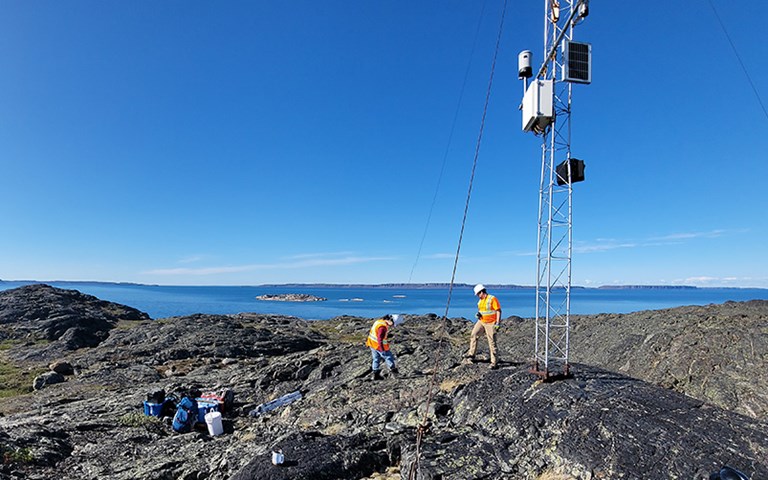
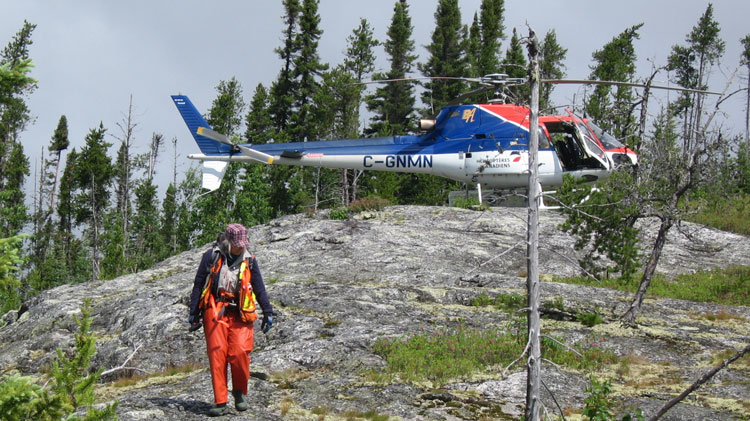
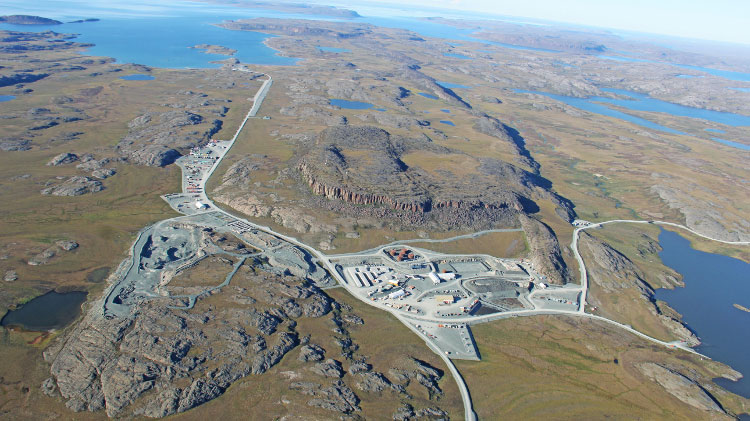
The proposed Grays Bay Road and Port project involves constructing a port at Grays Bay on the coast of Nunavut and an all-season road connecting it to the Northwest Territories. Courtesy of West Kitikmeot Resources
R.J. Simpson could sense the change; it was something in the air. Or, more accurately, something that was not: noise.
Since becoming premier of the Northwest Territories in late 2023, Simpson had grown used to pitching the territory in speeches to miners at events such as Vancouver’s AME Roundup or PDAC in Toronto. He had also grown used to the distracted chatter of audiences while he spoke. But this year was different. “Now, it’s just silent. Everyone is listening. Everyone is focused on what we’re saying,” Simpson said.
The reason for the shift is no mystery. On March 12, Prime Minister Mark Carney announced a $40 billion package of northern infrastructure projects that could reshape the economic foundations of the N.W.T. and Nunavut. The lion’s share of that spending, about $35 billion, will go to defence and security. But Carney also announced he was referring four civilian projects to the new Major Projects Office (MPO), the agency launched in August 2025 that is at the centre of his strategy to diversify the Canadian economy and make it more independent through fast-track approvals for nation-building projects.
That list included a 320-kilometre extension of the N.W.T.’s Mackenzie Valley Highway from the small community of Pehdzéh Kı̨́ to Inuvik, as well as a 60-megawatt expansion of generating and transmission capacity at the territory’s Taltson hydro facility. But the centrepiece, at least from the mining industry’s perspective, was the referral of Nunavut’s Grays Bay Road and Port project and its N.W.T. companion, the Arctic Economic and Security Corridor: a twin set of infrastructure projects that could finally open a large, mineral-rich region in the central Arctic to serious investment.
Simpson and his cabinet—particularly Finance Minister Caroline Wawzonek—were aware they had been making steady progress on their list of infrastructure pitches to Ottawa. They also had a heads-up shortly before Carney’s formal announcement of the referrals. So did West Kitikmeot Resources Corp., the Inuit-owned proponent for the Grays Bay Road and Port project.
Still, jaws hit the table when Carney made the official announcement, especially in the N.W.T. All three of its proposals had spent decades at the top of the territory’s infrastructure wish list, as had Grays Bay for Nunavut. “Even as I was standing there listening to the announcement, it hadn’t sunk in,” Simpson said. “It was hard to believe because it is such a significant investment from the federal government. And it is a shift.”
The mining industry was also noticing change in the winds as Ottawa adopted an increasingly aggressive stance in reaction to the economic chaos provoked by the Trump administration in Washington, D.C. Representatives from companies not normally associated with the North started touching base with territorial politicians to acknowledge the region’s potential, especially in meeting global demand for critical minerals. Junior explorers had already launched the early stages of a potential comeback in base metals, notably in the Grays Bay and Arctic Economic Security Corridor region. (Word is that if you’re still hoping to book a helicopter or a drill rig for the 2026 season, forget it.)
Big players emerged, too. A week and a half before Carney’s announcement, CBC North reported that Rio Tinto had secured prospecting permits to look for copper in the N.W.T.’s Sahtu region, which would be home to a future section of the Mackenzie Valley Highway. Meanwhile, ATCO Ltd., a leading energy and logistics firm based in Calgary, announced on March 23 it had acquired a 40 per cent stake in West Kitikmeot Resources for $10 million.
These developments were in process well before the MPO referrals were announced, of course. But they are proof that Ottawa’s attitudes towards the North’s infrastructure needs have shed the long-standing piecemeal approach—a few million dollars here for a study or a few more there for a small increase in road construction. Rinse and repeat every couple of years.
Northern political and business leaders describe the new vibe at the federal level as holistic and strategic, a sign that Ottawa is finally hearing the case northerners have made for a very long time. They are also realistic in their expectations. “I’m not in the mood to spike the ball on the one-yard line,” said Brendan Bell, CEO of West Kitikmeot Resources. “We still have an awful lot to solve... but the MPO is filling its ranks with serious people who have serious expectations, starting from the top. There’s not a lot of room here for hand wringing and navel gazing.”
Similarly, Yellowknife-based economist Graeme Clinton said that an initial period of euphoria following the March 12 announcement has given way to head-scratching. “You kind of look at all the projects and think, geez, how is all this going to come together?” he said. Indeed, the job ahead is massive.
In other words, welcome to the starting line. The ribbon at the finish is still some distance away.
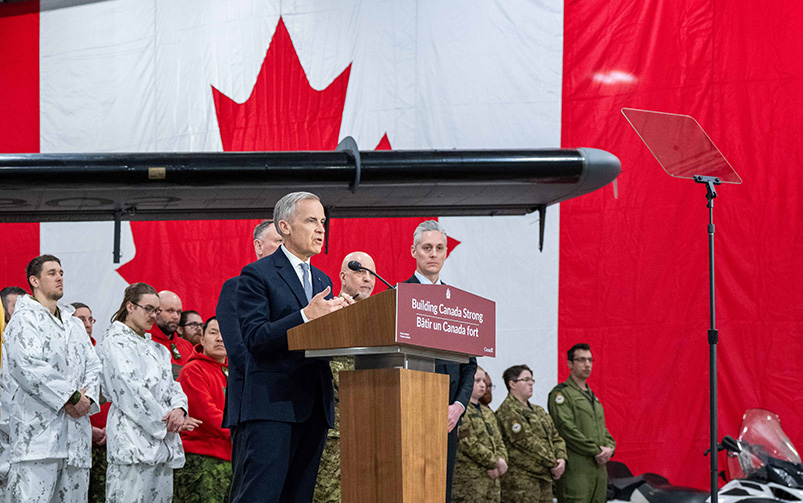 Prime Minister Mark Carney announcing the federal government’s new plan for the North on March 12. Courtesy of the Government of Canada
The economic case
If the mood in the N.W.T. and Nunavut is cautious—the Yukon’s MPO pitch to integrate its isolated electrical grid with the B.C. grid did not make the latest list of referrals—there is good reason. An extension of the Mackenzie Valley Highway, an expansion of the Taltson hydro facility and the approximately 600-kilometre road and port system (including the Arctic Economic and Security Corridor) are technically challenging projects. Dribs and drabs of federal funding over the years have provided a minimum of life support, but hopes for real progress, until now, have been low.
Another reason for caution is more concrete, especially in the N.W.T.: the diamond era, the territory’s largest industry outside government, is ending. Rio Tinto’s Diavik mine marked its last official day on March 24, ending approximately 23 years of commercial production, totalling 150 million rough carats. The loss will cost hundreds of direct and indirect jobs along with millions in annual business-to-business spending, royalties and tax revenue.
De Beers, meanwhile, announced in April that it was moving up its closure plan for the Gahcho Kué mine by two years, forecasting an end of production in 2028. In addition, Burgundy Diamond Mines’ Ekati mine is struggling, leaning on a federal government loan program designed to blunt the impact of new U.S. tariffs and, according to a letter posted on Facebook on April 8 by the Yellowknives Dene First Nation, falling behind on payments under its impact-and-benefit agreements. (In early May, after this feature was published in the May 2026 print issue of CIM Magazine, Burgundy’s Canadian subsidiary Arctic Canadian Diamond Co. filed for and received creditor protection.)
The good news amidst the gloom, said N.W.T. Finance Minister Wawzonek, is the MPO itself. “I don’t think a lot of people know how the MPO works,” she said, recalling media questions she fielded after the referral’s announcement. “A lot of the questions I got weren’t just about our projects. It was sort of ‘tell us about the MPO’ as if it was a magical thing.”
Far from it. Northern business and political leaders describe the agency as small, highly competent teams of senior government and private sector veterans with little appetite for wasting time. Look no further than the meeting schedules and deadlines. “We had a fairly lengthy meeting not too long ago and it’s setting critical paths,” Wawzonek said, noting that the MPO was looking at a 30-day deadline for plans. “It was ‘we want a critical path on all three projects,’ timelines and barriers... Everything is urgent.”
That speaks to the serious hearing the N.W.T. and Nunavut’s proposals have received, but there is no way to predict which ones, if any, will be referred by the MPO to fast-track approval processes. A top selling point for the Mackenzie Valley Highway, for example, is the social good—a road connection will moderate high costs and security issues around access to transportation, energy and food in isolated communities—but that could be a tough sell as a nation-building investment. Or it might not be, as the highway proposal has also been twinned with plans to expand Inuvik’s airport as a forward operating location for the military.
Likewise, the benefits from expanding the Taltson hydro facility, on the south side of Great Slave Lake, are difficult to measure in hard numbers. Greater power generating capacity and a transmission line to the north side of the lake will make the renewable energy supply more reliable for about 70 per cent of the N.W.T.’s population. It may also help make gold, lithium and other critical minerals exploration and development projects in the region more attractive to investors and financiers. But it will not automatically increase the number of kilowatt hours sold. And though attractive to the mining industry in the big picture, it is unlikely to drive a near-term boom.
If return on investment and trade potential is a key metric in the MPO’s northern decision making, the combination of the Grays Bay Road and Port project and the Arctic Economic and Security Corridor makes a more straightforward case. The proposals call for the construction of a port at Grays Bay on the coast of Nunavut’s Kitikmeot region connected by an all-season road to Yellowknife and the highway system leading south.
Together, they would open a mineral-rich region known as the Slave Geological Province that, to date, has supported mining only for high-value, not-too-heavy minerals that can be flown out, specifically gold and diamonds. But the region is also home to several large, high-value base metal deposits including copper and zinc, which are both on Canada’s critical minerals list. But deposits are geology. Mines are businesses, and those deposits have never been developed because there is no profitable way to get ore concentrates to refineries and markets—let alone to do so on top of the high cost of operating remote Arctic mines.
The road, port and corridor proposal, however, could change the brutal economics, potentially lifting the current gloom over the N.W.T.’s mining industry and bringing major new greenfield projects to Nunavut. “Some of these copper projects in our neighbourhood have grades that are many times higher than the average grade for a new greenfield copper project today,” West Kitikmeot’s Bell said. “The Izok Lake grade is a world beater.”
The Izok Lake project in Nunavut, one of a half dozen or so large deposits within the corridor, has indicated and inferred resources of 15 million tonnes containing 342,000 tonnes of copper grading 2.3 per cent and 1.9 million tonnes of zinc grading 13 per cent, according to a 2013 mineral resources estimate from MMG Ltd., the company that holds the exploration rights. A 2013 assessment of Glencore’s nearby Hackett River project calculated measured and indicated resources of 27 million tonnes grading 0.45 per cent copper and 4.47 per cent zinc.
Elliot Holland, West Kitikmeot’s chief operating officer, has been studying those numbers and other public data on the region’s major deposits to build business models for the Grays Bay Road and Port project. Although he cautioned he does not have access to inside corporate data, he is coming up with encouraging results.
“We’re seeing internal rates of return (IRR) of over 20 per cent for a number of these deposits,” Holland said, adding that even somewhat pessimistic models project significant returns for miners as well as meaningful tolls for the road and port operator. “If you think about the bull case for copper—copper probably has more upsides than zinc with the electrification and artificial intelligence data centre story—then you’re talking about really high IRRs.”
Potential risks
It is not hard to make a case for each of the northern infrastructure projects referred to the MPO, even if some of them lean harder on the argument that, as a country, they are simply the right thing to do. The reality, however, is that no one should be surprised if some do not pass muster at this time. The reason? Money.
In his March speech announcing the federal government’s northern agenda, Carney said the plan is backed by $40 billion in “investments to defend our sovereignty and to deter new threats” and “investments to connect, build and transform northern and Arctic communities.” Of that $40 billion, roughly $35 billion is earmarked for defence and security spending. That leaves a balance of about $5 billion for a Mackenzie Valley Highway extension, Taltson hydro expansion, Grays Bay in Nunavut and a corresponding corridor in the N.W.T.—projects Carney said represent investments of about $10 billion.
If all four projects go ahead, that leaves proponents to fill a gap of about $5 billion, one way or another. That is less than the typical 75-25 cost-sharing split between the federal and territorial departments for many northern projects, but it is still beyond the capacity of small territorial government budgets. And raising funds outside government sources will not be easy.
“[These projects] all carry enormous financial risk,” economist Clinton said. Business potential may exist, but if the infrastructure is not used to that end, “it just sits there as a care and maintenance issue.”
Bell, who served as the N.W.T.’s minister for resources between 2003 and 2007 before moving to the minerals sector, framed the issue as a “chicken-and-egg” problem. “Mines don’t get stood up and investments made until the infrastructure is in place. And infrastructure investors always say ‘Well, we can’t be there until the mines are there,’” he said. “So, how do you deal with that disconnect?”
Clinton and Bell both said this is the point where governments need to step up as an all-weather anchor customer to make the projects bankable. The challenge is maintaining support for the spending through the ebbs and flows of national politics.
“If you can rise up and say this is about future generations,” Clinton said, “at the end of it all, if it’s $10 billion, ballpark, it’s not that much money in comparison to money spent on all sorts of other things.”
Whether you buy into that perspective depends on the lens you’re looking through, Clinton continued, adding more optimistically that “if we choose this path, it could be transformative [for the North].”
Politics and process will be another point of friction. Already, some local leaders have asked who the projects really serve as communities deal with social problems such as food security and mental health on their doorsteps. Concerns also exist over the potential impacts on traditional hunting and fishing and whether expected employment opportunities will be more than short-term positions on rotation, which can be hard on families.
Likewise, debates over the final design and objectives of projects can potentially put momentum at risk. A road routing discussion, for example, might veer into issues of whether the general path can be tweaked to connect fly-in, fly-out communities to a highway system. It is a worthwhile question, but one that can also risk adding costs and delays to the larger goal.
The good news is that the new momentum behind long-sought northern infrastructure investments is also fostering partnerships. The governments of the Tłı̨chǫ Nation and the Yellowknives Dene First Nation, for example, set aside other differences in November and signed a memorandum of understanding to act jointly as proponents for the Arctic Economic and Security Corridor in collaboration with the N.W.T. government.
Paul Gruner, CEO of Tłı̨chǫ Investment Corp., the economic arm of the Tłı̨chǫ government, cited this agreement as a particular point of pride, and he is right to bring his feelings to the table. For all the questions and challenges around how to build and what to build, there is an emotional centre in the latest developments. The territories have not been treated to a holistic, national vision of their future since John Diefenbaker won a majority government in 1958 on a campaign that included his “Northern Vision” as a core theme. Other prime ministers have tried, notably Stephen Harper, but none have matched Diefenbaker’s integrated point of view.
It is worth noting that the Northern Vision failed in the early 1960s, not long after Diefenbaker’s election, as Canada slid into recession—a cautionary note for managing expectations today. But for northern communities, the renewal of a national perspective on the value of their role in the country is long overdue.
Or, as Simpson put it, “This is a vision that goes far beyond a four-year election cycle. It really is a vision for the future of Canada.”